
Chapter 14. CHEMICAL EQUILIBRIUM
Chapter 14 Equilibrium Notes page 3 of 6 pure solids and liquids: concentrations of pure solids and liquids are fixed by their density and molar mass (both constants) and do not vary with the amount.
Download Chapter 14. CHEMICAL EQUILIBRIUM

Information
Domain:
Source:
Link to this page:
Documents from same domain
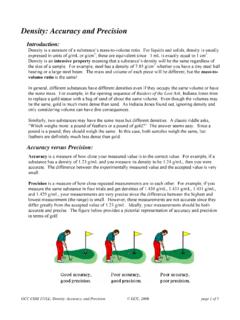
Density: Accuracy and Precision
web.gccaz.eduGCC CHM 151LL: Density: Accuracy, and Precision © GCC, 2008 page 4 of 5 glassware. ... 1. Obtain a set of 4 brass slugs and 1 aluminum slug. 2.
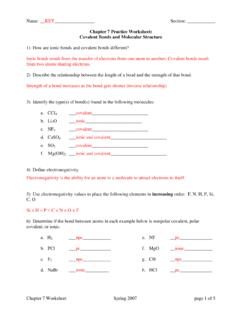
Chapter 7 Practice Worksheet: Covalent Bonds and Molecular ...
web.gccaz.eduChapter 7 Worksheet Spring 2007 page 1 of 5 Chapter 7 Practice Worksheet: Covalent Bonds and Molecular Structure 1) How are ionic bonds and covalent bonds different? ... f. Mg(OH) 2 ___ ionic and covalent _____ 4) Define electronegativity. Electronegativity is the ability for an atom in a molecule to attract electrons to itself. ...

Balancing Equations Worksheet KEY
web.gccaz.eduBalancing Equations Worksheet KEY 1. Zn (s) + 2 AgNO 3 (aq) ⇒ Zn(NO 3) 2 (aq) + 2 Ag (s) 2. N 2 (g) + 3 H 2 (g) ⇒ 2 NH 3 (g) 3. NaCl (aq) + AgC 2H 3O 2 (aq) ⇒ NaC 2H 3O 2 (aq) + AgCl (s) 4. 3 Mg(OH) 2 (aq) + 2 H 3PO 4 (aq) ⇒ 6 H 2O (l) + Mg 3(PO 4 ) 2 (aq) 5. 2 HNO 3 (aq) + Ni (s) ⇒ Ni(NO 3) 2 (aq) + H 2 (g) 6. Ba(HCO 3) 2 (s) ⇒ BaCO 3 (s) + H 2O (g) + CO
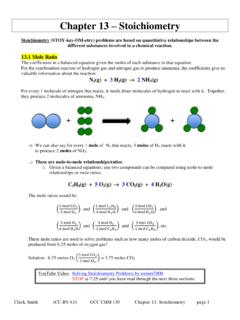
Chapter 13 Stoichiometry - Glendale Community College
web.gccaz.eduChapter 13 – Stoichiometry Stoichiometry (STOY-key-OM-etry) problems are based on quantitative relationships between the different substances involved in a chemical reaction.

Intermolecular and Ionic Forces - web.gccaz.edu
web.gccaz.eduIntermolecular and Ionic Forces ... general, intermolecular forces are much weaker than the ionic and covalent bonds that hold together the atoms and ions in a compound. ... compared in this lab. The alkane used in this activity is pentane, CH 3 CH 2 CH 2 CH 2 CH 3. Alcohols are

Marine Biology: Study Guide - web.gccaz.edu
web.gccaz.eduBIO145: Marine Biology 3 Study Guide Chapter 10 An Introduction to Ecology Ecology is the scientific study of the interactions between organisms and their environment that determine the distribution and abundance of organisms.

CHM 130LL: Electrolytes - Welcome to web.gccaz.edu
web.gccaz.edumainly in body fluids outside the cells. Human body fluids have almost the ... CHM 130LL: Electrolytes Lab . GCC CHM 130LL Spring 2016 page 2 of 7 Understanding ... This makes it possible to identify which substance is in which well (ex: A3 or C2). In your data table (on the next page), ...
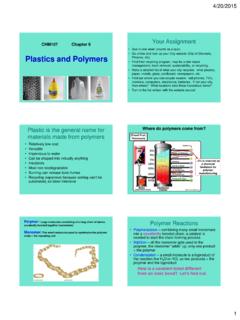
Polymers and Plastics - web.gccaz.edu
web.gccaz.edua chemical feedstock for polymer manufacturing Polymer: ... • Now back to polymers and plastics Given these monomers predict the structure of the polymer Ethylene Vinyl chloride ... recycle numbers are these plastics? • Plastic comes from oil – so less recycling means

CHM 130 Predicting Products Worksheet
web.gccaz.eduCHM 130 Predicting Products Worksheet Circle the appropriate reaction type for each, complete the reaction with products (remember to check charges for ionic compounds), include states, and finally balance each reaction.
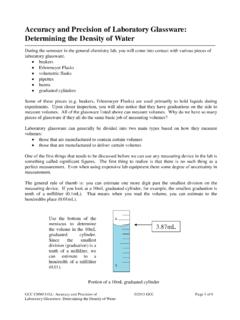
Accuracy and Precision of Laboratory Glassware ...
web.gccaz.eduGCC CHM151LL: Accuracy and Precision of ©2013 GCC Page 1 of 9 Laboratory Glassware: Determining the Density of Water
Related documents
Basic Principles and Calculations in Chemical Engineering
ptgmedia.pearsoncmg.comBASIC PRINCIPLES AND CALCULATIONS IN CHEMICAL ENGINEERING EIGHTH EDITION David M. Himmelblau James B. Riggs Upper Saddle River, NJ † Boston † Indianapolis † San Francisco

LABILITY OF DRINKING-WATER TREATMENT RESIDUALS (WTR ...
stormwater.ucf.edu1 lability of drinking-water treatment residuals (wtr) immobilized phosphorus: implications for long-term stability by sampson agyin-birikorang
Chapter 7.1 Nitrogen dioxide - WHO/Europe | Home
www.euro.who.intChapter 7.1 Nitrogen dioxide General description Many chemical species of nitrogen oxides (NO x) exist, but the air pollutant species of most interest from the point of view of human health is nitrogen dioxide …

THE CRYSTALLIZATION BEHAVIOUR OF ISOTACTIC …
www.thesis.bilkent.edu.tri the crystallization behaviour of isotactic polybutene-1 a thesis submitted to the department of chemistry and the institute of engineering and science of
MICROBIAL DEATH - vency
www.vency.com4 D T = 1 / k' (2) The use of D 90 or D 10 refers to the fact that after a treatment time t = 1 / k', 90% of the microbial population is destroyed or, alternatively, 10% of the population survives.

BENTONITE, KAOLIN, AND SELECTED CLAY MINERALS
www.who.intThe International Programme on Chemical Safety (IPCS), established in 1980, is a joint venture of the United Nations Environment Programme (UNEP), the International Labour Organization (ILO), and the World Health Organization (WHO).
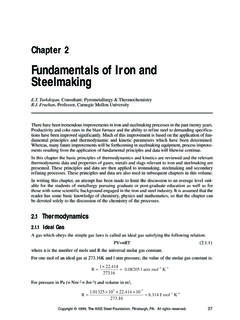
Chapter 2, Fundamentals of Iron and Steelmaking
www.yejinzg.comFundamentals of Iron and Steelmaking 39 equal to its heat of formation, but of opposite sign. The second principle is that discovered by Hess (1840); it states that “the heat of reaction depends only on the initial and final states, and not on the
Related search queries
BASIC PRINCIPLES AND CALCULATIONS IN CHEMICAL, Treatment residuals (wtr) immobilized phosphorus: implications, Chapter 7.1 Nitrogen dioxide, Chemical, Nitrogen dioxide, ISOTACTIC, Isotactic polybutene, MICROBIAL DEATH, BENTONITE, KAOLIN, AND SELECTED CLAY, World Health Organization, Chapter, Iron and Steelmaking