Chapter 14 Interference and Diffraction
14.2 Young’s Double-Slit Experiment In 1801 Thomas Young carried out an experiment in which the wave nature of light was demonstrated. The schematic diagram of the double-slit experiment is shown in Figure 14.2.1. Figure 14.2.1 Young’s double-slit experiment. A monochromatic light source is incident on the first screen which contains a slit .
Download Chapter 14 Interference and Diffraction

Information
Domain:
Source:
Link to this page:
Documents from same domain
Wireless Communications and Networks
web.mit.edu4 MIT Physical layer •The physical layer plays a very important role in wireless network because it has severe limitation on transmissions Uplink with respect to downlink
The Aleph - MIT
web.mit.eduThe Aleph by Jorge Luis Borges O God! ... He read me many other stanzas, each of which also won his own approval and elicited his lengthy explications.
Finite Element Method
web.mit.eduRobert Cook, Finite Element Modeling For Stress Analysis, John Wiley & Sons, 1995 Introduction to Finite Element Method, http://210.17.155.47 (in Korean)
Finite Element Analysis
web.mit.eduFinite Element Analysis David Roylance Department of Materials Science and Engineering Massachusetts Institute of Technology Cambridge, MA 02139 February 28, …
TECHNICAL & SERVICE MANUAL - MIT
web.mit.eduwhen wiring electrical shock can cause severe personal injury or death. only a qualified, experienced electrician should attempt to wire this system.
Chapter 21 Rigid Body Dynamics: Rotation and …
web.mit.eduChapter 21 Rigid Body Dynamics: Rotation and ... patience to the establishment of the laws of rotation of the solid ... general treatment of mechanics, ...
5.33 Lecture Notes: Introduction To Polymer …
web.mit.edu5.33 Lecture Notes: Introduction To Polymer Chemistry Polymer: A large molecule (macromolecule) built up by repetitive bonding (covalent) of smaller molecules (monomers) • Generally not a well defined structure, or molecular weight.
UNDERSTANDING, FINDING, & ELIMINATING …
web.mit.edua Senior Member of the Institute of Electrical and Electronic Engineers. CEDIA EST016 UNDERSTANDING, ... GROUNDING, AC POWER, AND SAFETY ...
PRESENTED AT THE 2004 AMERICAN CONTROL …
web.mit.eduPRESENTED AT THE 2004 AMERICAN CONTROL CONFERENCE 1 Internal and External Op-Amp Compensation: A Control-Centric Tutorial ... circuit operational …
Frank and Lillian Gilbreth and the Manufacture and ...
web.mit.eduFrank and Lillian Gilbreth and the Manufacture ... time study, despite its ... publicizing micro-motion study as an advance over time study and as an
Related documents
CIRCUITS LABORATORY EXPERIMENT 9 Operational Amplifiers
classes.engineering.wustl.eduEXPERIMENT 9 Operational Amplifiers 9.1 INTRODUCTION An operational amplifier ("op amp") is a direct-coupled, differential-input, high-gain voltage amplifier, usually packaged in the form of a small integrated circuit. The term "operational" dates back to the early days of analog computers when these devices
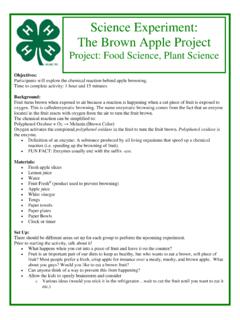
Science Experiment: The Brown Apple Project
extension.purdue.eduIntroduce the experiment: . This experiment involves dipping slices of apple in a variety of substances. These include water, lemon juice, a special substance designed to …

Example experiment report for PHYS 342L - Purdue University
www.physics.purdue.eduExample experiment report for PHYS 342L The following report is written to help students in compiling their own reports for PHYS 342L class. Note that this report does not represent a real experiment and thus should be used only as an example of style and form. The actual experiment reports will usually be longer as there is more material to cover.
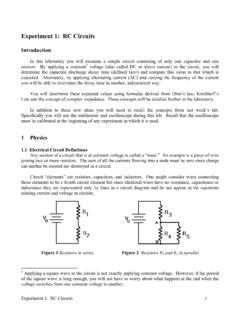
Experiment #1: RC Circuits - Physics Courses
courses.physics.ucsd.eduExperiment 1: RC Circuits 7 2.2 Complex Impedance When one is interested in finding the voltage of an element in an AC circuit, the method of complex impedance is very useful. In general, the complex impedance is defined as follows: Z V ~ I ~ (11) where Z is complex (of the form a ib where a & b
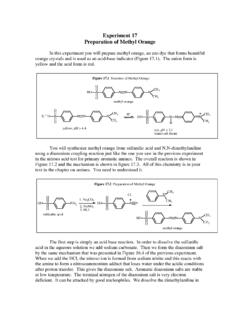
Experiment 17 Preparation of Methyl Orange
myweb.liu.eduExperiment 17 Preparation of Methyl Orange In this experiment you will prepare methyl orange, an azo dye that forms beautiful orange crystals and is used as an acid-base indicator (Figure 17.1). The anion form is yellow and the acid form is red. S N N N CH3 CH3 O O HO Figure 17.1 Structure of Methyl Orange S N N N CH3 CH3 O O X + -O yellow, pH ...

CHM 335 Experiment #1 The Absorption Spectra of …
www.chm.uri.eduDuring this experiment, you will be expected to: 1. Find the maximum absorbance wavelength (λ max) of each conjugated dye. 2. Calculate the theoretical maximum based on the free-electron model and compare this result to your experimental data. 3. Write a laboratory report following the specified format. Objectives 3

CIRCUITS LABORATORY EXPERIMENT 3 AC Circuit Analysis
classes.engineering.wustl.eduEXPERIMENT 3 AC Circuit Analysis 3.1 Introduction The steady-state behavior of circuits energized by sinusoidal sources is an important area of study for several reasons. First, the generation, transmission, distribution, and consumption of electric energy occur under essentially sinusoidal steady-state conditions.
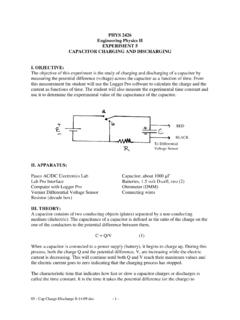
PHYS 2426 Engineering Physics II EXPERIMENT 5 CAPACITOR ...
www.austincc.eduEXPERIMENT 5 CAPACITOR CHARGING AND DISCHARGING I. OBJECTIVE: The objective of this experiment is the study of charging and discharging of a capacitor by measuring the potential difference (voltage) across the capacitor as a function of time. From this measurement the student will use the Logger Pro software to calculate the charge and the

Experiment 4 Analysis by Gas Chromatography
www.kbcc.cuny.eduexperiment. An example of an analysis for cholesterol esters is shown above. If it could be done at all, this separation would take weeks by traditional wet chemistry. Here it took 21 min for the analysis and a few hours to prepare the sample for injection into the chromatograph.