
Chapter 3
For our Hooke’s law example earlier, the slope is the spring constant2. 2Since the spring constant k is de ned as F= kx (where is the force and x is the stretch), the slope in Figure3.1ais actually the inverse of the spring constant. 2. Statistics for Research Projects Chapter 3
Download Chapter 3

Information
Domain:
Source:
Link to this page:
Documents from same domain
Modeling Network Coded TCP Throughput: A …
www.mit.eduModeling Network Coded TCP Throughput: A Simple Model and its Validation MinJi Kim MIT Cambridge, MA 02139 minjikim@mit.edu Muriel Médard MIT Cambridge, MA 02139
LM108/LM208/LM308 Operational Amplifiers - …
www.mit.eduAbsolute Maximum Ratings If Military/Aerospace specified devices are required, please contact the National Semiconductor Sales Office/ Distributors for …
Chapter 8 New Product Development* - mit.edu
www.mit.eduUnfortunately, new product development is an extremely challenging and complex process. Innovation is inherently risky, and firms may invest considerable time and money in
The Voice of the Customer
www.mit.eduQuality Function Deployment (QFD) (see WIEM05-023), or the setting of detailed design specifications (see WIEM05-049). The Voice of the Customer process has important outputs and benefits for product developers.

Note on Conjoint Analysis - mit.edu
www.mit.eduM I T S L O A N C O U R S E W A R E > P. 1 Note on Conjoint Analysis John R. Hauser Suppose that you are working for one of the primary brands of global
a Ultralow Offset Voltage Operational Amplifiers OP07
www.mit.eduREV.A Information furnished by Analog Devices is believed to be accurate and reliable. However, no responsibility is assumed by Analog Devices for its
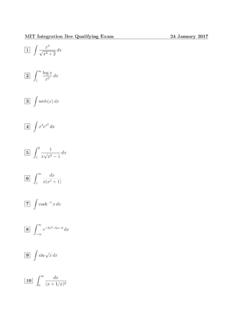
MIT Integration Bee Qualifying Exam 24 January 2017
www.mit.eduMIT Integration Bee Qualifying Exam 24 January 2017 1 Z x2 p x3 +2 dx 2 Z 1 1 logx x2 dx 3 Z sech(x)dx 4 Z x3ex2 dx 5 Z 2 1 1 x p x2 1 dx 6 Z 1 1 dx x(x2 +1) 7 Z cosh 1 xdx 8 Z 1 1 e 2x2 5x 3 dx 9 Z sin p xdx 10 Z 1 0 dx (x+1=x)2
Efficient wireless non-radiative mid-range energy …
www.mit.eduEfficient wireless non-radiative mid-range energy transfer Aristeidis Karalis a,*, J.D. Joannopoulos b, Marin Soljacˇic´ b a Department of Electrical Engineering and Computer Science, Massachusetts Institute of Technology,
Freedom of Association Is Not the Answer* - mit.edu
www.mit.eduFine Freedom of Association Is Not the Answer 339 dom of association and exclusion: few would argue with Amy Gutmann’s statement that “the freedom to associate . . . entails the freedom to
a Operational Amplifier Low-Noise, Precision OP27
www.mit.eduREV. C –3– OP27 ELECTRICAL CHARACTERISTICS (@ V S = ±15 V, –55 C £ T A £ 125 C, unless otherwise noted.) OP27A OP27C Parameter Symbol Conditions Min Typ Max Min Typ Max Unit INPUT OFFSET
Related documents
The Properties of Materials - Princeton University
assets.press.princeton.edu1) The law of inertia: An object in motion will remain in motion unless acted upon by a net force. The inertia of an object is its reluctancetochangeitsmotion. 2) The law of acceleration: The acceleration of a body is equal to the force applied to it divided by its mass, as summarized in the equation F = ma, (1.1)

Module 3 Constitutive Equations
web.mit.eduConcept Question 3.1.1. Derivation of Hooke’s law. Derive the Hooke’s law from quadratic strain energy function Starting from the quadratic strain energy function and the de nition for the stress components given in the notes, 1.derive the Generalized Hooke’s law ˙ ij = C ijkl kl. Solution: We start by computing: @ ij @ kl = ik jl

Hooke’s law in terms of stress and strain is
www.phys.ufl.eduHooke’s law in terms of stress and strain is stress strain In terms of the definitions L L Y A F The constant of proportionality is called the elastic modulus or Young’s modulus. If has the same units as stress. Y is a property of the material used. Hooke’s law holds up to a maximum stress called the proportional limit.

Forces r,}}l [ oÁ
cdn.savemyexams.co.uk1 (a) (i) On Fig. 3.1, draw a graph of extension against load for a spring which obeys Hooke’s law. [1] extension 0 0 load Fig. 3.1 (ii)State the word used to describe the energy stored in a spring that has been stretched or

Oscillations - Harvard University
scholar.harvard.edua Hooke’s-law potential is! = p k=m. So for a general potential V(x), the k · V00(x0) equivalence implies that the frequency is! = r V00(x0) m: (3) 1.1.2 Solving for x(t) The long way The usual goal in a physics setup is to solve for x(t). There are (at least) two ways to do this for the force F(x) = ¡kx. The straightforward but messy way ...
forces & Newton’s laws of motion - Old Dominion University
ww2.odu.edu! springs & Hooke’s law an empirical, approximate law. physics 111N 53 a spring balance! we can use Hooke’s law to build a device to measure weight calibration for this spring every centimeter of extension means 12 N of weight . physics 111N 54 a spring balance
Guidelines for a Physics Lab Reports - Baylor University
www.baylor.eduOct 21, 2005 · Hooke’s Law Experiment Objective: To measure the spring constant of a spring using two different methods. Background: If a weight, W = mg, is hung from one end of an ordinary spring, causing it to stretch a distance x, then an equal and opposite force, F, is created in the spring which opposes the pull of the weight. If W is not so large as to permanently distort …