Chapter 3 Protecting Groups - chem.usu.edu
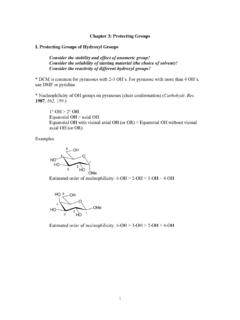
Chapter 3: Protecting Groups ... relatively strong acid (TFA) to remove * Stable in basic conditions * The reagent, MOMCl, is considered carcinogenic Reagent/Condition Reference MOMCl, NaH in THF or ... Protecting Groups of Amino Groups (i) Masking NH2 (amino) as N3 (azido)
Download Chapter 3 Protecting Groups - chem.usu.edu

Information
Domain:
Source:
Link to this page:
Documents from same domain
Chromosome 16: PV92 PCR - Utah State University
ion.chem.usu.eduChromosome 16: PV92 PCR A Bio-Rad Biotechnology Explorer™ Experiment Introduction to PCR—The Polymerase Chain Reaction You are about to perform a procedure known as PCR1—the amplification of a
The Central Science 9th Edition - Chemistry Department
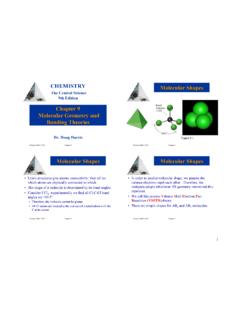
ion.chem.usu.edu• count the total number of electron pairs around the central atom, • arrange the electron pairs in one of the above geometries to minimize e − -e − repulsion, and count multiple bonds as one

Introduction to Organic Chemistry: Hydrocarbons
ion.chem.usu.eduOrganic Compounds Organic chemistry is the study of carbon compounds. An organic compound • Always contains carbon and hydrogen atoms • May also contain other nonmetals such as oxygen, nitrogen, phosphorus, or a halogen. • Organic compounds are found in: •Gasoline, medicines, shampoos, plastics, and perfumes •Carbohydrates, fats, and proteins
Chapter 12 Introduction to Organic Chemistry: Hydrocarbons
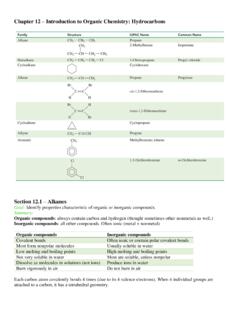
ion.chem.usu.eduChapter 12 – Introduction to Organic Chemistry: Hydrocarbons Section 12.1 – Alkanes Goal: Identify properties characteristic of organic or inorganic compounds. Summary: Organic compounds: always contain carbon and hydrogen (thought sometimes other nonmetals as well.) Inorganic compounds: all other compounds.Often ionic (metal + nonmetal) Organic …
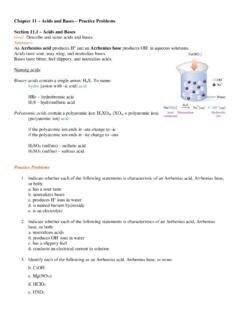
Chapter 11 Acids and Bases Practice Problems Section 11.1 ...
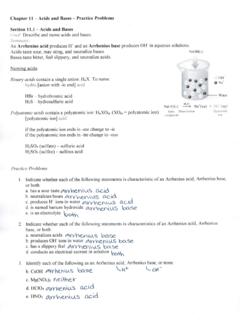
ion.chem.usu.eduSection 11.1 – Acids and Bases Goal: Describe and name acids and bases. Summary: An Arrhenius acid produces H+ and an Arrhenius base produces OH-in aqueous solutions. Acids taste sour, may sting, and neutralize bases. Bases taste bitter, feel slippery, and neutralize acids. Naming acids: Binary acids contain a single anion: H n X. To name:
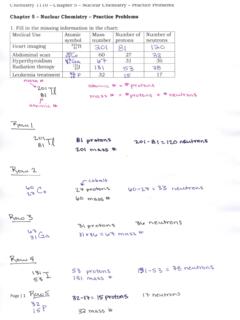
Utah State University Chemistry and Biochemistry | USU
ion.chem.usu.educnermstry 1 1 IU — unapter — Nuclear cnermstry — practice yrot)lerns 32. When a gamma ray is emitted from the nucleus of an atom, the nuclear mass A) increases by two units. B) decreases by one unit. C) increases by one unit. D decreases by two units. emains the same. 33. Radium-226 decays by alpha decay to A) barium-131. B) cobalt-60. C ...
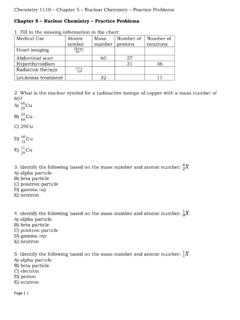
Nuclear Chemistry Practice Problems
ion.chem.usu.eduChemistry 1110 – Chapter 5 – Nuclear Chemistry – Practice Problems Page | 10 47. The half-life of a radioisotope is A) one-half of the time it takes for the radioisotope to completely decay to a nonradioactive isotope. B) the time it takes for the radioisotope to become an isotope with one-half of the atomic
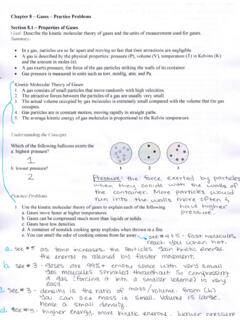
Utah State University Chemistry and Biochemistry | USU
ion.chem.usu.eduExample: A sample of helium gas (He) has a volume 6.8 L and a pressure of 2.5 atm. What is the final volume, ... The volume is compressed to 2.0 L. b. The volume expands to 12 L. 9. A gas at a pressure of 2.0 atm is in a closed container. Indicate the changes (increases, decreases, or does
Utah State University Chemistry and Biochemistry | USU
ion.chem.usu.eduth1S IS a basic solution. !nderstanding the Concepts: Why are the concentrations ofH30 and OH- equal in pure water? One is + What is the meaning and value of Kw at 250C? In an acidic solution how does the concentration of 1-130 compare to the concentration of …
CH3 Practice Key Updates - Utah State University
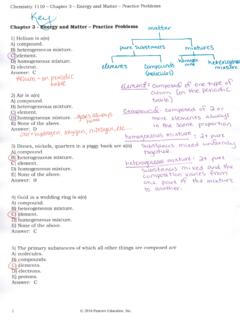
ion.chem.usu.eduChemistry 1 110 — Chapter 3 — Enerw and Matter — 26) 3.25 kcal is the same amount of enerw as Practice Problems A) 3.25 J. B) 0.777 J. C 777 J.
Related documents
1,2-Dimethylindole-3-sulfonyl (MIS), the Most Acid- …
diposit.ub.eduamino acid side chains are protected by trifluoroacetic acid (TFA)-labile protecting groups, usually tBu derivatives; and the C-terminal amino acid is anchored to the solid support through a TFA-labile

Amino Acid-Protecting Groups - UB
diposit.ub.eduinvolve a carboxylic acid-protecting group which is removed upon amino protection and those that involve less reactive electrophiles on the reagent used to introduce the protecting group. An example of the former is the use of trimethylsilyl esters of amino acids prepared in

Coupling Reagents - Bachem
documents.bachem.comCoupling Reagents 2. COUPLING REAGENTS AND . ... amino acid. PG, PG’: protecting groups. Act: activating group. Coupling Reagents 4 tendency to racemize considerably. Ure-thane derivatives, which include standard α-amino protecting groups as Fmoc, Boc, and Z, of amino acids usually retain their optical purity upon …

ORTHOGONALITY OF PROTECTING GROUPS - …
documents.bachem.comORTHOGONALITY OF PROTECTING GROUPS ... the amino-protecting group intact. On the other hand, the pairs Boc/OPp or Fmoc/ ivDde are merely quasi-orthogonal because both groups are acid-labile or cleaved by bases, respectively. OPp can be removed selectively in the presence of Boc/tBu by

New Methods in Peptide Synthesis. Part 111.l …
jupiter.chem.uoa.grNew Methods in Peptide Synthesis. Part 111.l Protection of Carboxyl Group By G. C. Stelakatos, A. Paganou, ... The protecting groups more commonly used so far ... behaviour of O-benzyl and O-tritryl groups. Amino- acid …

Protecting Groups Handout A - University of Houston
may.chem.uh.eduProtecting Groups Hydroxyl Protection Methyl Ethers Formation: ... AlBr 3,EtSH PhSe-Ph 2P-Me 3SiI Stable to Acid and Base CH 2N 2, SiO 2 or HBF 4 NaH, MeI, THF Methylthiomethyl Ethers (MTM) Formation: Stability: Cleavage: MeSCH 2Cl, NaH, THF Stable to base and mild acid ... protecting primary over secondary alcohols. Mild Acid …

PROTECTING GROUPS 57 Smith: Chapter 7
vanderbilt.eduPROTECTING GROUPS 58 Methoxyethoxymethyl ethers (MEM) R-OH → R-OCH2OCH2CH2OMe stable to base and mild acid Formation: - MeOCH2CH2OCH2Cl, NaH, THF - MeOCH2CH2OCH2Cl, CH2Cl2, iPr2EtN TL 1976, 809 Cleavage - Lewis acids such as ZnBr2, TiCl4, Me2BBr2 C 5 H 11 O MEM-O

Solid Phase Peptide Synthesis, Strategies and Resins
www-oc.chemie.uni-regensburg.deSide Chain Protecting Groups Ser, Thr, Tyr: Ether tert-Butylether Asp and Glu: tert-Butylester Lys: boc-protecting group protects the reactive functional group of the amino acid Öprevents formation of branched chains permanent, orthogonal, compatible with Nα-protection Öremain attached troughout the synthesis easy to remove (with acid) after …

Safety-Catch Protecting Groups in Peptide Synthesis
www.5z.com"SAFETY-CATCH" PROTECTING GROUPS IN PEPTIDE SYNTHESIS* Marcel PATEK and Michal LEBL ... which makes this amino acid more difficult to couple and cleave. Both amino acid ... are earlier studies of Okamoto and Brownz1 which utilized the Hammett equation

A Review of Organosilanes in Organic Chemistry - …
www.acros.comA Review of Organosilanes in Organic Chemistry ... amines and amino acids, carboxylic acids, ... Most easily cleaved of all silyl protecting groups in acid and base. Chlorotrimethylsilane, 1M solution in THF 38161 Chlorotrimethylsilane, 1M solution in DCM 38160 Et 3
Related search queries
Acid, Amino acid, Protecting groups, Amino Acid-Protecting Groups, Protecting, Amino, Coupling Reagents, Amino protecting groups, ORTHOGONALITY OF PROTECTING GROUPS, Groups, Methods in Peptide Synthesis. Part, Protecting Groups Handout A, Solid Phase Peptide Synthesis, Strategies and Resins, Review of Organosilanes in Organic Chemistry