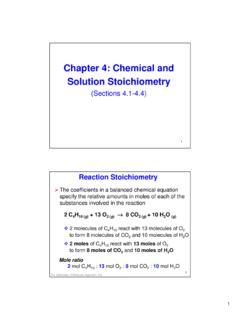
Chapter 4: Chemical and Solution Stoichiometry
Stoichiometry and Chemical Reactions The most common stoichiometric problem will present you with a certain mass of a reactant and then ask the amount or mass of product that can be formed. This is called mass-to-mass stoichiometry problem 5 Predicting Amounts from Stoichiometry – Cont. 1. You cannot convert mass (g) of one substance directly to
Download Chapter 4: Chemical and Solution Stoichiometry

Information
Domain:
Source:
Link to this page:
Documents from same domain

Lecture7 Heavy Metals - Bridgewater State University
webhost.bridgew.edu6 Toxic Heavy Metals: Mercury – Cont. Severity of health effects from mercury exposure depends on: the chemical form of mercury; the dose; the age of the person exposed (the fetus is the most susceptible);

Chapter 9: POLYPROTIC ACID-BASE EQUILIBRIA
webhost.bridgew.edu3/28/2014 1 Chapter 9: POLYPROTIC ACID-BASE EQUILIBRIA Images available at http://www.800mainstreet.com/acid_base/0000-01a-oxyacids-.html and http://www.sciencephoto.com/images/
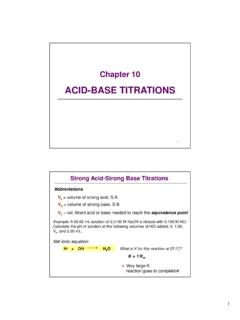
Lec7 Ch11 AcidBase Titn - Bridgewater State University
webhost.bridgew.edu1 Chapter 10 ACID-BASE TITRATIONS 1 Strong Acid-Strong Base Titrations Abbreviations Example: A 50.00 mL solution of 0.0100 M NaOH is …
WASTE MINIMIZATION, UTILIZATION, and …
webhost.bridgew.edu1 Lecture Topic #2 (Chapter 20) WASTE MINIMIZATION, UTILIZATION, and TREATMENT 1 MAJOR TOPICS Means for minimizing waste Utilizing materials that might go into waste Treating waste
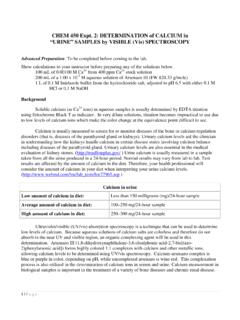
Expt 2 Calcium by visible spectroscopy
webhost.bridgew.eduUltraviolet/visible (UV/vis) absorption spectroscopy is a technique that can be used to determine low levels of calcium. Because aqueous solutions of calcium salts are colorless and therefore do not
Chapter 4: Solution Stoichiometry – Cont.
webhost.bridgew.edu13 Solution Stoichiometry • Because molarity relates the moles of solute to the liters of solution, it can be used to convert between amount of reactants and/or products in a chemical reaction 14 Tro: Chemistry: A Molecular Approach, 2/e

HIGH PERFORMANCE LIQUID CHROMATOGRAPHY (HPLC)
webhost.bridgew.eduHigh Performance Liquid Chromatography (HPLC) An analytical separation technique that involves the high-pressure flow of a liquid through a column that contains the stationary phase. Stationary phase: Can be a solid (LSC) or a liquid (LLC) A mixture of compounds injected at one end of the column separates as the compounds pass through.

Chemistry of Natural Waters - Bridgewater State University
webhost.bridgew.eduPrecipitation Infiltration Runoff Transpiration 5 The Hydrologic Cycle – Cont. Source: Manahan, p. 56 Evaporation = involves vaporization of ocean water Condensation = process of water changing from a vapor to a liquid Precipitation = water being released from clouds as rain, snow, sleet or hail Clouds = water droplets suspended in air
Related documents
Precipitation Titration: Determination of Chloride by the ...
academic.brooklyn.cuny.eduunknown. Then the concentration of the unknown can be calculated using the stoichiometry of the reaction and the number of moles of standard solution needed to reach the so called end point. Precipitation titrations are based upon reactions that yield ionic compounds of limited solubility. The most important precipitating reagent is silver nitrate.
Basic Principles and Calculations in Chemical Engineering
ptgmedia.pearsoncmg.comThe Prentice Hall International Series in the Physical and Chemical Engineering Sciences had its auspicious beginning in 1956 under the direction ... CHAPTER 5 MATERIAL BALANCES INVOLVING REACTIONS 189 5.1 Stoichiometry 190 5.2 Terminology for Reaction Systems 198 ... M SOLUTION OF SETS OF EQUATIONS 902 N FITTING FUNCTIONS TO DATA 924
Chapter 10 ChemiCal alCulations and equations
preparatorychemistry.com10.1 Equation Stoichiometry 369 The ratio of moles of P 4O 10 to moles of P (which came from the subscripts in the chemical formula, P 4O 10) provided the key conversion factor that allowed us to convert from units of phosphorus to units of tetraphosphorus decoxide. Now let’s assume that you have been transferred to the division responsible for the

Stoichiometry: Baking Soda and Vinegar Reactions
labsci.stanford.eduUsing the concept of stoichiometry, the amount of product that results from a chemical reaction can be predicted. Baking soda is a powdered chemical compound called sodium bicarbonate, and vinegar includes acetic acid. These 2 components react in solution to form carbon dioxide, water, and sodium acetate as shown in the chemical reaction below ...
CHEMISTRY (Code No. 043) 2019-20 - CBSE
cbseacademic.nic.inNature of matter, laws of chemical combination, Dalton's atomic theory: concept of elements, atoms and molecules. Atomic and molecular masses, mole concept and molar mass, percentage composition, empirical and molecular formula, chemical reactions, stoichiometry and calculations based on stoichiometry.
Chapter 10 ChemiCal alCulations and equations
preparatorychemistry.comChapter 10 ChemiCal CalCulations and ChemiCal equations 367 10.1 Equation . Stoichiometry 10.2 Real-World . Applications of . Equation Stoichiometry 10.3 Molarity and . Equation . Stoichiometry lthough Chapter 9 was full of questions that began with, “

STOICHIOMETRY - LIMITING REAGENT
alpha.chem.umb.eduStoichiometry – Limiting Reagent Laboratory ... and the amount of products produced by a chemical reaction. The principles of stoichiometry ... This reaction goes to completion and there are no undesirable side reactions that form other products. Given this and based on your percent yields and perhaps some
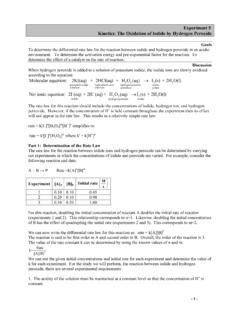
Experiment 5 Kinetics: The Oxidation of Iodide by Hydrogen ...
www.kbcc.cuny.edublue solution is formed by the complex of starch–iodine. The color change is sharp, and the time elapsed to this point is determined simply by use of a timer. The time from the addition of the peroxide solution to the appearance of the blue color is ∆t for the reaction. Since the stoichiometry of the thiosulfate–iodine

Chapter 04 - Aqueous Reactions and Solution Stoichiometry
www.unf.eduMicrosoft PowerPoint - Chapter 04 - Aqueous Reactions and Solution Stoichiometry.pptx Author: spuds Created Date: 1/29/2019 1:35:31 PM ...