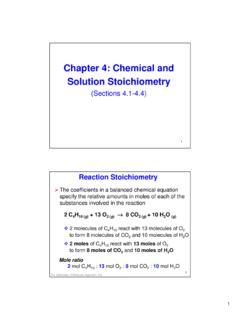
Chapter 4: Chemical and Solution Stoichiometry
Use mole theoretical mole ratio (fr. the balanced eq.) and compare it with the actual ratio (given) to find the limiting reactant. 19 2Al + 3 I2 -----> 2 AlI 3 Obviously, 489 g is less than 652, so Al is the limiting reagent (lower yield from Al), making I 2 the excess reagent 20
Download Chapter 4: Chemical and Solution Stoichiometry

Information
Domain:
Source:
Link to this page:
Documents from same domain

Lecture7 Heavy Metals - Bridgewater State University
webhost.bridgew.edu6 Toxic Heavy Metals: Mercury – Cont. Severity of health effects from mercury exposure depends on: the chemical form of mercury; the dose; the age of the person exposed (the fetus is the most susceptible);

Chapter 9: POLYPROTIC ACID-BASE EQUILIBRIA
webhost.bridgew.edu3/28/2014 1 Chapter 9: POLYPROTIC ACID-BASE EQUILIBRIA Images available at http://www.800mainstreet.com/acid_base/0000-01a-oxyacids-.html and http://www.sciencephoto.com/images/
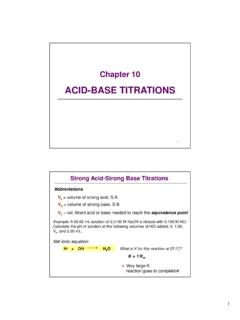
Lec7 Ch11 AcidBase Titn - Bridgewater State University
webhost.bridgew.edu1 Chapter 10 ACID-BASE TITRATIONS 1 Strong Acid-Strong Base Titrations Abbreviations Example: A 50.00 mL solution of 0.0100 M NaOH is …
WASTE MINIMIZATION, UTILIZATION, and …
webhost.bridgew.edu1 Lecture Topic #2 (Chapter 20) WASTE MINIMIZATION, UTILIZATION, and TREATMENT 1 MAJOR TOPICS Means for minimizing waste Utilizing materials that might go into waste Treating waste
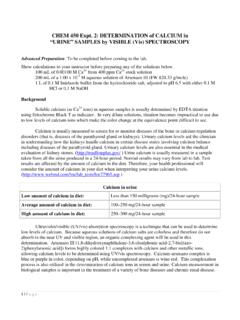
Expt 2 Calcium by visible spectroscopy
webhost.bridgew.eduUltraviolet/visible (UV/vis) absorption spectroscopy is a technique that can be used to determine low levels of calcium. Because aqueous solutions of calcium salts are colorless and therefore do not
Chapter 4: Solution Stoichiometry – Cont.
webhost.bridgew.edu13 Solution Stoichiometry • Because molarity relates the moles of solute to the liters of solution, it can be used to convert between amount of reactants and/or products in a chemical reaction 14 Tro: Chemistry: A Molecular Approach, 2/e

HIGH PERFORMANCE LIQUID CHROMATOGRAPHY (HPLC)
webhost.bridgew.eduHigh Performance Liquid Chromatography (HPLC) An analytical separation technique that involves the high-pressure flow of a liquid through a column that contains the stationary phase. Stationary phase: Can be a solid (LSC) or a liquid (LLC) A mixture of compounds injected at one end of the column separates as the compounds pass through.

Chemistry of Natural Waters - Bridgewater State University
webhost.bridgew.eduPrecipitation Infiltration Runoff Transpiration 5 The Hydrologic Cycle – Cont. Source: Manahan, p. 56 Evaporation = involves vaporization of ocean water Condensation = process of water changing from a vapor to a liquid Precipitation = water being released from clouds as rain, snow, sleet or hail Clouds = water droplets suspended in air
Related documents

Chapter 11: Stoichiometry
www.mcvts.netMole ratios You have read that the coefficients in a chemical equa-tion indicate the relationships between moles of reactants and products. You can use the relationships between coefficients to derive conversion factors called mole ratios. A mole ratio is a ratio between the numbers
4. MATERIALAND ENERGY BALANCE
beeindia.gov.inMole fraction of salt = 0.34 / (5.56 + 0.34) = 0.058 d) The molar concentration (M) is 220.5/58.5 = 3.77 moles in m3 Note that the mole fraction can be approximated by the (moles of salt/moles of water) as the number of moles of water are dominant, that is the mole fraction is close to 0.34 / 5.56 = 0.061.
Chapter 10 ChemiCal alCulations and equations
preparatorychemistry.comChapter 10 ChemiCal CalCulations and ChemiCal equations 367 10.1 Equation . Stoichiometry 10.2 Real-World . Applications of . Equation Stoichiometry 10.3 Molarity and . Equation . Stoichiometry lthough Chapter 9 was full of questions that began with, “

Biology Scoring Guidelines 2015 - College Board
secure-media.collegeboard.org1 mole of glucose in the organism. Describe. what happens to the excess energy that is released from the metabolism of glucose. ... evolutionary relationships of the organisms. Provide reasoning. for the placement on the tree of the species that is least related to the others.

Common Equations Used in Chemistry
www.sctcc.eduRelationships of rate constants at two different temperatures: ln k1 k2 = Ea R ( T1 - T2 T1T2) Law of Mass Action - General expression of equilibrium constant: K = [C]c[D]d [A]a[B]b Relationship between Kp and Kc: Kp = Kc(0.0821*T)∆ n The equilibrium constant for the overall reaction is given by the product of
Appendix A. Units of Measure, Scientific Abbreviations ...
www.adfg.alaska.govmole mol newton N normal N or n ohm ... show mathematical relationships. If you, the author, cannot quickly see the key re-lationships in an equation, then the equation is surely too complex for someone un-familiar with the topic, and the equation should be restated using a …

First Law, Heat Capacity, Latent Heat and Enthalpy
faculty.uca.eduIn this section we will explore the relationships between heat capacities and specific heats and internal. Heat Capacity The heat capacity of an object is the energy transfer by heating per unit temperature change. That is, C = Q 4T. In this expression, we will frequently put subscripts on …

Effective Communication in Relationships
www.scott.af.milRelationships The way couples communicate can enhance their relationship or lead to escalating disagreements ... If you can respectfully discuss frustrations early you can conquer them as mole-hills instead of mountains. I B H C Effective Communication in Relationships 2

Solutions Manual for Materials Science and Engineering An ...
downloadusb.com(b) Mole, in the context of this book, is taken in units of gram-mole. On this basis, how many atoms are there in a pound-mole of a substance? Solution (a) In order to determine the number of grams in one amu of material, appropriate manipulation of the amu/atom, g/mol, and atom/mol relationships is all that is necessary, as #g/ a m u = 1§ m ol
Principle of Maximum Entropy
mtlsites.mit.eduone mole of material (an amount with mass in grams equal to the atomic weight of the element) then there would be Avogadro’s number N ... conclusions and general relationships we will be able to establish. 10.2 Probabilities Although the problem has been set up, we do not know which actual state the system is in. To express