Classification and regression trees
duce ensemble models using bagging16 and random forest17 techniques. Table 1 summarizes the features of the algorithms. To see how the algorithms perform in a real ap-plication, we apply them to a data set on new cars for the 1993 model year.18 There are 93 cars and 25 variables. We let the Y variable be the type of drive
Download Classification and regression trees

Information
Domain:
Source:
Link to this page:
Documents from same domain
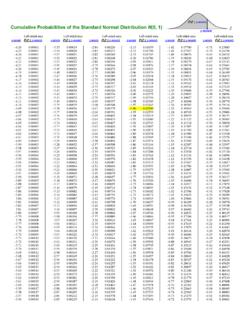
P(Z Cumulative Probabilities of the Standard …
pages.stat.wisc.eduCumulative Probabilities of the Standard Normal Distribution N(0, 1) Left-sided area Left-sided area Left-sided area Left-sided area Left-sided area Left-sided area
BASIC CALCULUS REFRESHER - pages.stat.wisc.edu
pages.stat.wisc.edu3 y = x y = x2 Notice that the line has the generic equation y = f (x) = mx + b, where b is the Y-intercept (in this example, b = +3), and m is the slope of the line (in this example, m = +2). In general, the slope of any line is defined as the ratio of “height change” y to “length change” x, that is, m = y
Solutions to Homework 5 Statistics 302 Professor Larget
pages.stat.wisc.eduSolutions to Homework 5 Statistics 302 Professor Larget Textbook Exercises 4.79 Divorce Opinions and Gender In Data 4.4 on page 227, we introduce the results of a May 2010 Gallup poll of 1029 US adults. When asked if they view divorce as \morally acceptable", 71% of the men and 67% of the women in the sample responded yes. In the test for a di ...
Using lme4: Mixed-Effects Modeling in R
pages.stat.wisc.eduDe nition of linear mixed-e ects models A mixed-e ects model incorporates two vector-valued random variables: the response, Y, and the random e ects, B. We observe the value, y, of Y. We do not observe the value of B. In a linear mixed-e ects model the conditional distribution, YjB, and the marginal distribution, B, are independent,
Applications of Fourier Transform to Imaging Analysis
pages.stat.wisc.eduCallosum (CC) data are used to demonstrate the advantages of our method over previous methods. The possibilities of applications of this method to image analysis is discussed. 1 Introduction Fourier transform (FT) is named in the honor of Joseph Fourier (1768-1830), one of greatest names in the history of mathematics and physics.
Solutions to Homework 1 Statistics 302 Professor Larget
pages.stat.wisc.eduselected. Other options are possible: for example, we could number the plants from 1 to 30000 and randomly select 30 numbers between 1 and 30000. (b) Answers will vary for this question, but the procedure should be explained and the three numbers which were obtained should be listed. Here is the start of one sample. Row Plant #94 #180 #83 # 81 ...

3. The Gaussian kernel
pages.stat.wisc.eduThe Gaussian kernel is defined in 1-D, 2D and N-D respectively as ... process of observation s can never become zero. For, this would imply making an observation through an infinitesimally small aperture, which is impossible. The factor of 2 in the exponent is a matter of convention,

CHAPTER 8. RANDOMIZED COMPLETE BLOCK DESIGN …
pages.stat.wisc.eduMSEB is the mean square of design-B with degrees of freedom dfB. If RE>1, design A is more efficient. If RE<1, the converse is true. If a randomized complete block design (say, design-A) is used, one may want to estimate the relative efficiency compared with a completely randomized design (say, design-B).
Practice Exam Questions; Statistics 301; Professor Wardrop
pages.stat.wisc.edu13. A sample space has three possible outcomes, B, C, and D. It is known that P(C) = P(D). The operation of the chance mechanism is simulated 10,000 times (runs). The sorted frequencies of the three outcomes (B, C, and D) are: 2322, 2360, and 5318. (a) What is your approximation of P(B)? To receive credit you must explain your an-swer.
Power and Sample Size Determination
pages.stat.wisc.eduPower and Sample Size Determination Bret Hanlon and Bret Larget Department of Statistics University of Wisconsin|Madison November 3{8, 2011 Power 1 / 31 Experimental Design To this point in the semester, we have largely focused on methods to analyze the data that we have with little regard to the decisions on how to gather the data.
Related documents

Lecture 1: Entropy and mutual information
www.ece.tufts.eduSimilarly to the discrete case we can define entropic quantities for continuous random variables. Definition The differential entropy of a continuous random variable X with p.d.f f(x) is h(X) = − Z f(x)logf(x)dx = −E[ log(f(x)) ] (15) Definition Consider a pair of continuous random variable (X,Y) distributed according to the joint p.d.f ...

Random Variables, Distributions, and Expected Value
www0.gsb.columbia.eduExpectations of Random Variables 1. The expected value of a random variable is denoted by E[X]. The expected value can bethought of as the“average” value attained by therandomvariable; in fact, the expected value of a random variable is also called its mean, in which case we use the notationµ X.(µ istheGreeklettermu.) 2.
3.1 Concept of a Random Variable
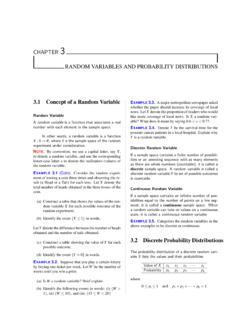
www.d.umn.eduT is a random variable. Discrete Random Variable If a sample space contains a finite number of possibil-ities or an unending sequence with as many elements as there are whole numbers (countable), it is called a discrete sample space. A random variable is called a discrete random variable if its set of possible outcomes is countable.

Techniques for finding the distribution of a transformation ...
www2.econ.iastate.eduDiscrete examples of the method of transformations. 3.1.1. One-to-one function. Find a formula for the probability distribution of the total number of heads obtained in four tossesof a coin where the probability of a head is 0.60. The samplespace, probabilities and the value of the random variable are given in table 1.