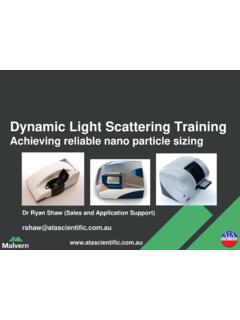
Dynamic Light Scattering Training
the laser wavelength (› For the He-Ne laser ( = 633nm) used in the Zetasizer, this equates to particles less than about 60nm › The scattering produced by such small particles is isotropic i.e. equal in all directions › The intensity of light they produce is proportional to d6 where d is the particle diameter (ie. I α 6d)
Download Dynamic Light Scattering Training

Information
Domain:
Source:
Link to this page:
Documents from same domain
Standard practices for Fmoc-based solid-phase …
www.chem.uci.eduStandard practices for Fmoc-based solid-phase peptide synthesis in the Nowick laboratory (Version 1.6.1) Adam G. Kreutzer and Patrick J. Salveson
An Introduction to Fluorescence Spectroscopy
www.chem.uci.eduAn Introduction to Fluorescence Spectroscopy 3 Table of Contents ... molecular extinction coefficient of the compound; in other words, the corrected
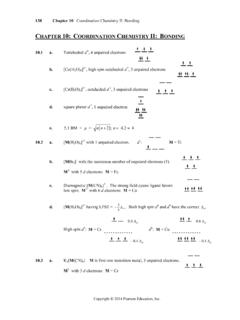
CHAPTER 10: COORDINATION CHEMISTRY II: BONDING
www.chem.uci.edu10.8 Co(II) is d 7. In tetrahedral complexes, it is generally high spin and has 3 unpaired electrons; in In tetrahedral complexes, it is generally high spin and has 3 unpaired electrons; in octahedral complexes, it is also typically high spin and also has 3 unpaired electrons; in square
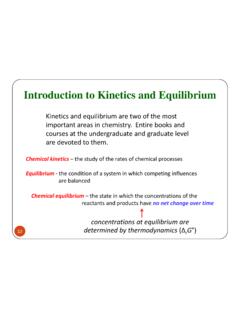
Introduction to Kinetics and Equilibrium
www.chem.uci.eduIntroduction to Kinetics and Equilibrium Kinetics and equilibrium are two of the most ... At iitill tii lPClA system initially containing only PCl 5 at t ti f 0 100t a concentration of 0.100 M has a Q c = 0, which is less than 0.030. What are the equilibrium concentrations
Introductionto FourierTransform InfraredSpectrometry ...
www.chem.uci.eduof material present. With modern software algorithms, infrared is an excellent tool for quantitative analysis. Older Technology. The original infrared instruments were of the . dispersive. type. These instruments separated the individual frequencies of energy emitted from the infrared source. This was accomplished by the use of a prism or grating.
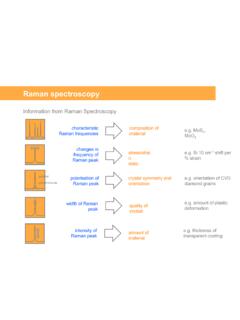
Raman spectroscopy
www.chem.uci.eduFrom the Renishaw Raman software the user can select: • a fixed grating measurement with a spectrum 'window' of 400 cm-1 to 1000 cm (configuration dependent) • a unique 'extended scanning' facility allowing the user to choose any Raman shift range up to about 10000 cm-1 (configuration dependent). Essential for extended range
A Second Application of Symmetry
www.chem.uci.eduWe can use character tables to determine the symmetry of all 18 motions and then assign them to translation, rotation, or vibration. We can also tell which vibrations are IR or Raman active. Procedure: 1. Assign x,y,z coordinates to each atom. 2. Determine how each axis transforms for every class of symmetry operation in the group.
Coordination Chemistry II: Ligand Field Theory Continued
www.chem.uci.eduCoordination Chemistry II: Ligand Field Theory Continued Chapter 10 Wednesday, November 25, 2015. Adding Metal Electrons e g e g * a1g a1g * t1u t1u * t2g Metal ions typically have some valence electrons that can be accommodated in the metal d …
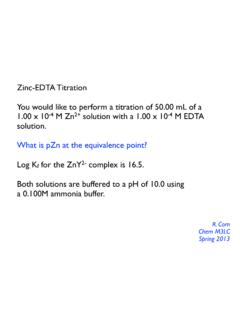
Zinc-EDTA Titration
www.chem.uci.eduZinc-EDTA Titration You would like to perform a titration of 50.00 mL of a 1.00 x 10⁻⁴ M Zn2+ solution with a 1.00 x 10⁻⁴ M EDTA solution. What is pZn at the equivalence point? Log K f for the ZnY2-complex is 16.5. Both solutions are buffered to a pH of 10.0 using

A Guide to Recording Fluorescence Quantum Yields
www.chem.uci.eduJobin Yvon Ltd. 2 Dalston Gardens, Stanmore, Middlesex HA7 1BQ UK Tel: 020 8204 8142 Fax: 020 8204 6142 Email: jy@jyhoriba.co.uk www.jyhoriba.co.uk
Related documents

Laser Welding Fundamentals - AMADA WELD TECH
amadaweldtech.comLaser Welding Fundamentals The diode laser is a well-established laser technology that been used for many plastic welding applications, notably in the automotive industry for welding the rear light housing. Welding of plastics with lasers is a current growth area, particularly with the development of laser-friendly plastics and

Laser Fundamentals - Michigan State University
ehs.msu.eduactual trends in laser research and development, Vol. VIII/1 is split into three parts: Vol. VIII/1A with its two subvolumes 1A1 and 1A2 covers laser fundamentals, Vol. VIII/1B deals with laser systems and Vol. VIII/1C gives an overview on laser applications. In Vol. VIII/1A1 the following topics are treated in detail:

Chapter 4 Fundamentals of Laser-Material Interaction and ...
spikelab.mycpanel.princeton.edu4.2 Fundamentals of Laser Surface Processing One of the major advantages of the laser as a tool for material processing is the abil-ity to precisely control where in the material and at what rate energy is deposited. This control is exercised throughthe properselection of laser processing parameters to achieve the desired material modification.
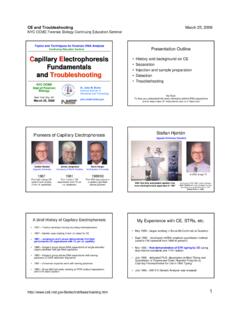
Capillary Electrophoresis Fundamentals and Troubleshooting
strbase.nist.govFundamentals and Troubleshooting Capillary Electrophoresis and Troubleshooting Dr. John M. Butler National Institute of Standards and Technology ... Laser Fill with Polymer Solution Fill with Polymer Solution 50-100 µm x 27 cm 5-20 kV5-20 kV-Burn …
Raman spectroscopy
www.chem.uci.eduThe minimum laser focus is determined by: 1. the focusing optic N.A. 2. laser wavefront (distortion or M2) 3. How the back aperture of the objective is filled Laser focused spot size Delivering the light Raman spectroscopy utilizing a microscope for laser excitation and Raman light collection offers that highest Raman light collection efficiencies.
Fundamentals of Optical Communications
www.cse.wustl.eduFundamentals of Optical Communications The Ohio State University Columbus, OH 43210 Nayna Networks Milpitas, CA 95035 Raj Jain ... (Laser pointers produce 650 nm) ! OK for short distance applications and home use! Cheaper Devices: Plastic amplifiers, Plastic lasers. 16 ©2002 Raj Jain
Laser Safety Fundamentals - EHS
www.ehs.washington.edu1. Laser Basics . 1.1 Laser Theory. Fig. 1 Electromagnetic Spectrum . A laser (Light Amplification by Stimulated Emission of Radiation) is a device that generates a very intense light beam which is either visible or invisible. Laser light differs from usual white light …