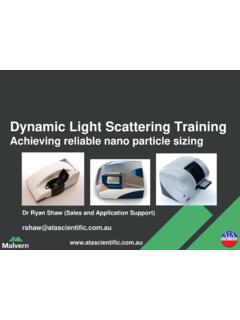
Dynamic Light Scattering Training
What is Light Scattering? › Light scattering is a consequence of the interaction of light with the electric field of a small particle or molecule › An incident photon induces an oscillating dipole in the electron cloud › As the dipole changes, energy is radiated in all directions › This radiated energy is called “scattered light”
Download Dynamic Light Scattering Training

Information
Domain:
Source:
Link to this page:
Documents from same domain
Standard practices for Fmoc-based solid-phase …
www.chem.uci.eduStandard practices for Fmoc-based solid-phase peptide synthesis in the Nowick laboratory (Version 1.6.1) Adam G. Kreutzer and Patrick J. Salveson
An Introduction to Fluorescence Spectroscopy
www.chem.uci.eduAn Introduction to Fluorescence Spectroscopy 3 Table of Contents ... molecular extinction coefficient of the compound; in other words, the corrected
CHAPTER 10: COORDINATION CHEMISTRY II: BONDING
www.chem.uci.edu10.8 Co(II) is d 7. In tetrahedral complexes, it is generally high spin and has 3 unpaired electrons; in In tetrahedral complexes, it is generally high spin and has 3 unpaired electrons; in octahedral complexes, it is also typically high spin and also has 3 unpaired electrons; in square
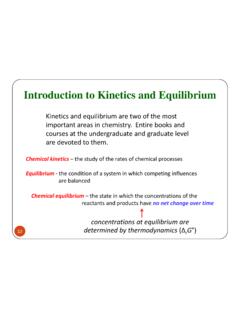
Introduction to Kinetics and Equilibrium
www.chem.uci.eduIntroduction to Kinetics and Equilibrium Kinetics and equilibrium are two of the most ... At iitill tii lPClA system initially containing only PCl 5 at t ti f 0 100t a concentration of 0.100 M has a Q c = 0, which is less than 0.030. What are the equilibrium concentrations
Introductionto FourierTransform InfraredSpectrometry ...
www.chem.uci.eduof material present. With modern software algorithms, infrared is an excellent tool for quantitative analysis. Older Technology. The original infrared instruments were of the . dispersive. type. These instruments separated the individual frequencies of energy emitted from the infrared source. This was accomplished by the use of a prism or grating.
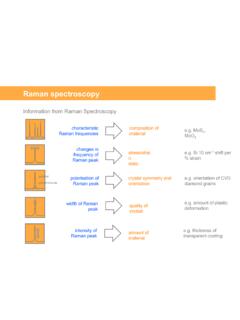
Raman spectroscopy
www.chem.uci.eduFrom the Renishaw Raman software the user can select: • a fixed grating measurement with a spectrum 'window' of 400 cm-1 to 1000 cm (configuration dependent) • a unique 'extended scanning' facility allowing the user to choose any Raman shift range up to about 10000 cm-1 (configuration dependent). Essential for extended range
A Second Application of Symmetry
www.chem.uci.eduWe can use character tables to determine the symmetry of all 18 motions and then assign them to translation, rotation, or vibration. We can also tell which vibrations are IR or Raman active. Procedure: 1. Assign x,y,z coordinates to each atom. 2. Determine how each axis transforms for every class of symmetry operation in the group.
Coordination Chemistry II: Ligand Field Theory Continued
www.chem.uci.eduCoordination Chemistry II: Ligand Field Theory Continued Chapter 10 Wednesday, November 25, 2015. Adding Metal Electrons e g e g * a1g a1g * t1u t1u * t2g Metal ions typically have some valence electrons that can be accommodated in the metal d …
Zinc-EDTA Titration
www.chem.uci.eduZinc-EDTA Titration You would like to perform a titration of 50.00 mL of a 1.00 x 10⁻⁴ M Zn2+ solution with a 1.00 x 10⁻⁴ M EDTA solution. What is pZn at the equivalence point? Log K f for the ZnY2-complex is 16.5. Both solutions are buffered to a pH of 10.0 using

A Guide to Recording Fluorescence Quantum Yields
www.chem.uci.eduJobin Yvon Ltd. 2 Dalston Gardens, Stanmore, Middlesex HA7 1BQ UK Tel: 020 8204 8142 Fax: 020 8204 6142 Email: jy@jyhoriba.co.uk www.jyhoriba.co.uk
Related documents
Interpreting and Understanding Dynamic Light Scattering …
www.horiba.comWhat is Dynamic Light Scattering? Dynamic light scattering refers to measurement and interpretation of light scattering data on a microsecond time scale. Dynamic light scattering can be used to determine Particle/molecular size Size distribution Relaxations in complex fluids

Scattering - Michigan Technological University
pages.mtu.eduscattered light is the same as the incident light (Rayleigh and Mie scattering) • Inelastic scattering – the emitted radiation has a wavelength different from that of the incident radiation (Raman scattering, fluorescence) • Quasi-elastic scattering – the wavelength (frequency) of the scattered light shifts (e.g., in moving matter due to
DYNAMIC LIGHT SCATTERING - University of California, San …
neurophysics.ucsd.eduThe light scattering: ccording to the semi-classical light scattering theory [Berne and Pecora, "Dynamic Light scattering" John Wiley, 1975], when light impinges on matter, the electric field of the light induces an oscillating polarization of electrons in the molecules. Hence the molecules provide a secondary source of light and
Dynamic Light Scattering: An Introduction in 30 Minutes
warwick.ac.ukLight Scattering Theories Rayleigh Scattering If the particles are small compared to the wavelength of the laser used (typically less than d ª 10 or around 60nm for a He-Ne laser), then the scattering from a particle illuminated by a vertically polarised laser will be essentially isotropic, i.e. equal in all directions. The Rayleigh ...

Light Scattering - NBI
www.nbi.dkDynamic light scattering, DLS, in particu-lar can be frustrating because it is a low resolution technique, a fact that is usually recognized only after one or more minor depressions. A more comprehensive set of lecture notes (Light Scattering Demystified) explain-ing in more detail about the physical background for the light scattering methods

Rayleigh Mie Light Scattering - University of Florida
plaza.ufl.eduFormal light scattering theory may be categorized in terms of two theoretical frameworks. One is the theory of Rayleigh scattering (after Lord Rayleigh) that is, strictly speaking as originally formulated, applicable to small, dielectric (non-absorbing), spherical particles. The second is the theory of Mie scattering (after Gustav Mie) that ...

Lecture 7: Propagation, Dispersion and Scattering
topex.ucsd.eduThe amount of scattering is inversely related to the fourth power of the radiation's wavelength (!-4). Jensen 2005 Jensen 2005 Rayleigh scattering The intensity of Rayleigh scattering varies inversely with the fourth power of the wavelength (!-4). So blue light (0.4 µm) is scattered 16 times more than near-infrared light (0.8 µm).