FINITE ELEMENT METHOD - IIST
1.2. FINITE ELEMENT METHOD 5 1.2 Finite Element Method As mentioned earlier, the finite element method is a very versatile numerical technique and is a general purpose tool to solve any type of physical problems. It can be used to solve both field problems (governed by differential equations) and non-field problems.
Download FINITE ELEMENT METHOD - IIST

Information
Domain:
Source:
Link to this page:
Documents from same domain

FORMAT FOR PREPARATION OF PROJECT REPORT
www.iist.ac.inFORMAT FOR PREPARING THE INTERNSHIP PROJECT REPORT ... 3.1 Cover Page & Title Page – A specimen copy of the Cover page & Title page of the ... as per the format in Appendix 2. The certificate shall carry the supervisor‟s signature and HoD's signature fro projects done in IIST and signatures of equivalent people if it is done outside IIST.

Conservation Equations of Fluid Dynamics
www.iist.ac.inConservation Equations of Fluid Dynamics A. Salih Department of Aerospace Engineering Indian Institute of Space Science and Technology, Thiruvananthapuram { February 2011 {This is a summary of conservation equations (continuity, Navier{Stokes, and energy) that govern the ow of a Newtonian uid.

Delta Function and Heaviside Function - IIST
www.iist.ac.inIf the delta function is acting at the origin, i.e., if a =0, the regularized delta function defined by (15) becomes δε(x)= 1 2ε 1+cos πx ε if −ε<x <ε, 0 otherwise. (17) Another example of regularized delta function is a sequence of bell-shaped pulses defined as δk(x−a)= 1 k √ 2π e− 1 2(x−a k) 2 (18) where k is a parameter.

Streamfunction-Vorticity Formulation
www.iist.ac.inThe relation connecting the streamfunction and vorticity (6) is listed below: ¶2y ¶x2 ¶2y ¶y2 = w (15) Equations (14) and (15) form the system PDEs for streamfunction-vorticity formulation.

Method of Characteristics - Home | IIST
www.iist.ac.inThe method of characteristics is a technique for solving hyperbolic partial differential equa-tions (PDE). Typically the method applies to first-order equations, although it is valid for any 3. hyperbolic-type PDEs. The method involves the determination of special curves, called char-

Kelvin–Helmholtz Instability - IIST
www.iist.ac.inkinematic boundary condition which states that the interface moves up and down with a velocity ... complex wave speed. Note that hˆ is the original amplitude of the interface displacement and is a constant. It speci es the size of all perturbed quantities. When c

FORMAT FOR PREPARATION OF PROJECT REPORT
www.iist.ac.in3.2 Bonafide Certificate – The Bonafide Certificate shall be in double line spacing Times New Roman using Font Style and Font Size 14, as per the format in Appendix 2. The certificate shall carry the supervisor‟s signature and HoD's signature fro projects done in IIST and signatures of equivalent people if it is done outside IIST.
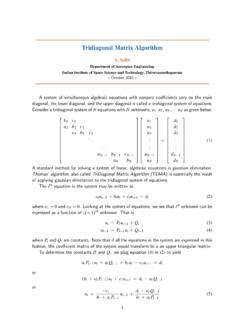
Tridiagonal Matrix Algorithm - Indian Institute of Space ...
www.iist.ac.inThomas’ algorithm, also called TriDiagonal Matrix Algorithm (TDMA) is essentially the result of applying gaussian elimination to the tridiagonal system of equations. The ith equation in the system may be written as a iu i 1 + b iu i + c iu i+1 = d i (2) where a 1 =0 and c N =0. Looking at the system of equations, we see that ith unknown can be

Second-Order Wave Equation - Indian Institute of Space ...
www.iist.ac.inthe domain is infinite. In this method, a canonical form of the wave equation (3) is first obtained using a suitable transformation. The canonical form enable us to easily integrate the equation to obtain the general solution. Below we give a brief description of the solution method. We can factor the linear differential operators of (3) to ...
Related documents
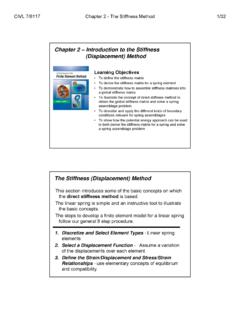
Chapter 2 – Introduction to the Stiffness (Displacement ...
www.ce.memphis.eduThe steps to develop a finite element model for a linear spring follow our general 8 step procedure. 1. Discretize and Select Element Types-Linear spring elements 2. Select a Displacement Function -Assume a variation of the displacements over each element. 3. Define the Strain/Displacement and Stress/Strain

Lecture 6 Writing a UMAT or VUMAT - iMechanica
imechanica.orgSteps Required in Writing a UMAT or VUMAT Writing User Subroutines with ABAQUS L6.19 ABAQUS • Verifying the UMAT or VUMAT with a small (one element) input file. 1. Run tests with all displacements prescribed to verify the integration algorithm for stresses and state variables. Suggested tests include: – Uniaxial – Uniaxial in oblique ...

Finite Element Analysis Using ABAQUS - University of Florida
mae.ufl.eduFinite Element Analysis Using ABAQUS EGM 6352 (Spring 2017) Instructor: Nam-Ho Kim (nkim@ufl.edu) ... Method: By number Number of elements = 40 OK – Menu Mesh Part Yes ... –Steps Procedure type: General Static, General Continue onm:oe–Ngl – Incrementation: Max No of increments: 200 Initial: 0.05 ...
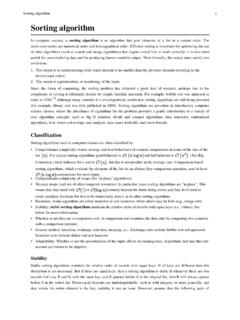
Sorting algorithm - Saylor Academy
resources.saylor.org• General method: insertion, exchange, selection, merging, etc.. Exchange sorts include bubble sort and quicksort. Selection sorts include shaker sort and heapsort. • Adaptability: Whether or not the presortedness of the input affects the running time. Algorithms that take this into account are known to be adaptive. Stability
ABAQUS Tutorial rev0 - Institute for Advanced Study
sig.ias.eduAbaqus is a suite of powerful engineering simulation programs based on the finite element method, sold by Dassault Systèmes as part of their SIMULIA Product Life-cycle Management (PLM) software tools. The lectures in MANE 4240/CILV 4240 will cover the basics of linear finite element analysis with examples primarily from linear elasticity.
Introduction to Finite Element Analysis in Solid Mechanics
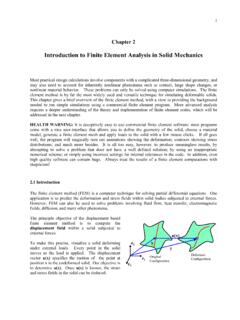
www.brown.eduThe finite element method (FEM) is a computer technique for solving partial differential equations. ... There are two general types of finite element analysis in solid mechancis. In most cases, we are interested ... The steps in running a finite element computation are discussed in more detail in the following sections. 3

About this Tutorial
www.tutorialspoint.comAn algorithm is a set of steps of operations to solve a problem performing calculation, data processing, and automated reasoning tasks. An algorithm is an efficient method that can be expressed within finite amount of time and space. An algorithm is the best way to represent the solution of a particular problem in a very simple and efficient way.