
Introduction to Queueing Theory
Stochastic Processes Process: Function of time Stochastic Process: Random variables, which are functions of time Example 1: n(t) = number of jobs at the CPU of a computer system Take several identical systems and observe n(t) The number n(t) is a random variable. Can find the probability distribution functions for n(t) at
Download Introduction to Queueing Theory

Information
Domain:
Source:
Link to this page:
Documents from same domain
Fundamentals of Networking - Washington …
www.cse.wustl.eduFundamentals of Networking Raj Jain Professor of CIS The Ohio State University Columbus, OH 43210 ... Networking: Two or more nodes. The …
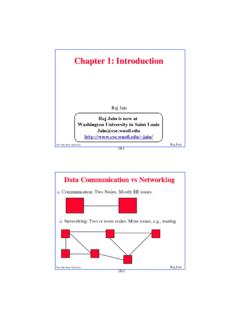
Chapter 1: Introduction - Computer Science & …
www.cse.wustl.eduChapter 1: Introduction Raj Jain ... Data Communication vs Networking ... Chapter 1: Introduction to Computer Networks Author: Raj Jain
Introduction to Computer Networking: Trends and …
www.cse.wustl.eduIntroduction to Computer Networking: Trends and Issues Keywords: Why Study Computer Networking?, Stone Age to Networking Age, Current Issues in Networking, 1.
Data Communications and Networking Overview
www.cse.wustl.eduData Communication vs Networking! Communication: Two Nodes. Mostly EE issues.! Networking: Two or more nodes. More issues, e.g., routing. 2-4 Washington University in St. Louis CSE473s ©2005 Raj Jain Distributed Systems vs Networks! Distributed Systems: ! …
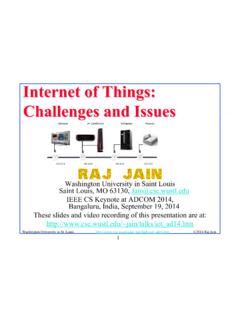
Internet of Things: Challanges and Issues
www.cse.wustl.eduInternet of Things: Challenges and Issues Washington University in Saint Louis Saint Louis, MO 63130, Jain@cse.wustl.edu IEEE CS Keynote at ADCOM 2014, Bangaluru, India, September 19, 2014 . These slides and video recording of this presentation are at: ... Internet of European Things ...
Introduction to TCP/IP - Washington University in St. Louis
www.cse.wustl.eduIntroduction to TCP/IP ... (IP), IP Datagram Format, IP Addressing, Subnetting, Forwarding an IP Datagram, Private Addresses, Domain Name Service, Name Hierarchy, Name Resolution, Autonomous Systems, Routing Protocols, Routing Information Protocol, Shortcomings of RIP V1, Open Shortest Path First (OSPF), Router Types, OSPF Operation, Border ...
Abstract: Table of Contents - cse.wustl.edu
www.cse.wustl.eduor CMOS (complementary metal oxide semiconductor). This paper will explain the fundamentals of how a digital image sensor works, focusing on how photons are converted into electrical signals, and thus images.
Survey of Wireless Based Indoor Localization Technologies
www.cse.wustl.eduSurvey of Wireless Based Indoor Localization Technologies Junjie Liu, junjie.liu@wustl.edu (A paper written under the guidance of Prof. Raj Jain) Download Abstract The market of localization based service (LBS) is expanding.
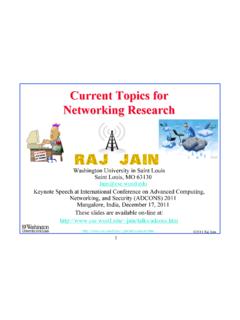
Current Topics for Networking Research
www.cse.wustl.eduCurrent Topics for Networking Research Washington University in Saint Louis Saint Louis, MO 63130 Jain@cse.wustl.edu Keynote Speech at International Conference on Advanced Computing, Networking, and Security (ADCONS) 2011 Mangalore, India, December 17, 2011 These slides are available on-line at:
A Survey of Computer Network Topology and Analysis …
www.cse.wustl.eduTree Network Topology is constructed from either making a set of Star Network Topologies subordinate to a central node, or by linking a set of Star Network Topologies together directly via a bus, thereby distributing
Related documents

1 Discrete-time Markov chains - Columbia University
www.columbia.eduStochastic processes are meant to model the evolution over time of real phenomena for which randomness is inherent. For example, X n could denote the price of a stock ndays from now, the population size of a given species after nyears, the amount of bandwidth in use in a telecommunications network after nhours of operation, or the amount of ...

Introduction to Probability Models - Sorin Mitran
mitran-lab.amath.unc.eduThis text is intended as an introduction to elementary probability theory and stochastic processes. It is particularly well suited for those wanting to see how probability theory can be applied to the study of phenomena in fields such as engineering, computer sci - ence, management science, the physical and social sciences, and operations research.
Probability, Statistics, and Stochastic Processes
ramanujan.math.trinity.edu4.1 Introduction 271 4.2 The Law of Large Numbers 272 4.3 The Central Limit Theorem 276 4.3.1 The Delta Method 281 4.4 Convergence in Distribution 283 4.4.1 Discrete Limits 283 4.4.2 Continuous Limits 285 5 Simulation 289 5.1 Introduction 289 5.2 Random-Number Generation 290 5.3 Simulation of Discrete Distributions 291
A Brief Introduction to Stochastic Calculus
www.columbia.eduA Brief Introduction to Stochastic Calculus These notes provide a very brief introduction to stochastic calculus, the branch of mathematics that is most identi ed with nancial engineering and mathematical nance. We will ignore most of the technical details and take an \engineering" approach to the subject.

Introduction to Online Convex Optimization
arxiv.orgThis book serves as an introduction to the expanding theory of online convex optimization. It was written as an advanced text to serve as a basis for a graduate course, and/or as a reference to the researcher diving into this fascinating world at the intersection of optimization and …

Discrete Stochastic Processes, Chapter 7: Random Walks ...
ocw.mit.edu7.1 Introduction Definition 7.1.1. Let {X i; i ≥ 1} be a sequence of IID random variables, and let S n = X 1 + X 2 + ··· + X n. The integer-time stochastic process {S n; n ≥ 1} is called a random walk, or, more precisely, the one-dimensional random walk based on {X i; i ≥ 1}. For any given n, S n is simply a sum of IID random ...

Introduction to Stochastic Calculus - Duke University
services.math.duke.edu(b)Themes: Direct calculation with stochastic calculus, connections with pdes (c) Introduction: Probability Spaces, Expectations, ˙-algebras, Conditional expectations, Random walks and discrete time stochastic processes. Continuous time stochastic pro-cesses and characterization of the law of a process by its nite dimensional distributions
Random Walk: A Modern Introduction
www.math.uchicago.eduRandom walk – the stochastic process formed by successive summation of independent, identically distributed random variables – is one of the most basic and well-studied topics in probability theory. For random walks on the integer lattice Zd, the main reference is the classic book by Spitzer [16].