Shielding vs. Deshielding - UCLA
Shielding vs. Deshielding: Pre-tutorial: Things we need to know before we start the topic: What does the NMR Chemical shift do? The chemical shift is telling us …
Download Shielding vs. Deshielding - UCLA

Information
Domain:
Source:
Link to this page:
Documents from same domain
Get In The Zone The basics of Reading Infrared ...
www.chem.ucla.eduGet In The Zone The basics of Reading Infrared Spectrometry Graphs What You Will Learn This is a tutorial to help you learn to
13C NMR - UCLA
www.chem.ucla.edu13C NMR The 13C NMR is generated in the same fundamental was as proton NMR spectrum. Only 1.1 % of naturally occurring carbon is 13C and actually an advantage because of less coupling.
carbonyl fundamentals - UCLA
www.chem.ucla.eduo Nucleophilic Carbonyl Substitution: LG is present. Occurs with ester, amide, anhydride, and acid chloride functional groups. Accept electrophile (usually H+) at oxygen
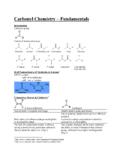
Carbonyl Chemistry – Fundamentals - UCLA
www.chem.ucla.eduCarbonyl Chemistry – Fundamentals Introduction Carbonyl group: Carbonyl functional groups: Brief Nomenclature of Aldehydes & Ketones1 IUPAC system:
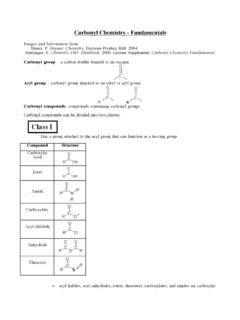
Carbonyl Chemistry - Fundamentals
www.chem.ucla.edu- resides in the polarity of the carbonyl group o Oxygen is more electronegative than carbon. 3 Fundamental Carbonyl Group Mechanism Steps: (Thinkbook Lecture Supplement pg 26)
Electrode Preparation & Maintenance Manual - UCLA
www.chem.ucla.eduPreface This manual is designed to highlight the key features, setup procedures and general maintenance of the S1 Electrode Disc. Document Conventions
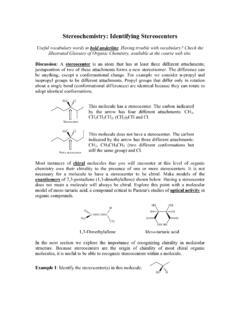
Stereochemistry: Identifying Stereocenters - UCLA
www.chem.ucla.eduAnswer: When looking for stereocenters, pay careful attention to the "different attachments" criterion. Recall that hydrogens of "stick structures" are usually not drawn. Also note attachments that differ only in conformation do not make a stereocenter.
Get In The Zone The basics of Reading Infrared ...
www.chem.ucla.eduGet In The Zone The basics of Reading Infrared Spectrometry Graphs What You Will Learn This is a tutorial to help you learn to
Chemistry Tutorial: Aromaticity - UCLA
www.chem.ucla.eduSection 3: Conjugation and Aromaticity Overview: Conjugation requires at least three overlapping p orbitals
Brønsted‐Lowry Lewis Acid Base - UCLA Chemistry …
www.chem.ucla.edu1 Acids and Bases: The Influence of Structure on Reactivity Background: Brønsted‐Lowry Lewis Acid A proton
Related documents
RESEARCH PRODUCTS NMR Solvent Data Chart
www2.chem.umd.eduThe 1H spectra of the residual protons and 13C spectra were obtained on a Varian Gemini 200 spectrometer at 295°K. The NMR solvents used to acquirethese

Principles of NMR
process-nmr.com- 1 - Principles of NMR By John C. Edwards, Ph.D. Process NMR Associates LLC, 87A Sand Pit Rd, Danbury CT 06810 Nuclear magnetic resonance spectroscopy (NMR) was first developed in 1946 by
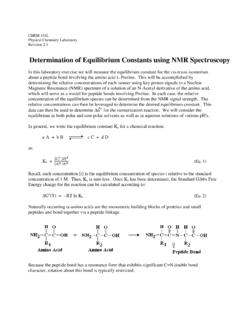
Determination of Equilibrium Constants using NMR …
infohost.nmt.eduCHEM 331L Physical Chemistry Laboratory Revision 2.1 Determination of Equilibrium Constants using NMR Spectroscopy In this laboratory exercise we will measure the equilibrium constant for the cis-trans isomerism about a peptide bond involving the amino acid L-Proline.This will be accomplished by

6.1 Measuring 13C NMR Spectra - UW-Madison Chemistry
www.chem.wisc.edu6-CMR-2.1 6.2 Referencing C-13 NMR Spectra Tetramethylsilane (TMS) is the primary reference for C-13 spectra. The relatively low sensitivity of C-13
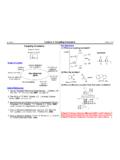
Lecture 3: Coupling Constants Chem 117 - Harvard University
www.people.fas.harvard.eduE. Kwan Lecture 3: Coupling Constants Chem 117 H Me H H What about 3-methylcyclopropene? H Me HD H D These protons are related by reflection and are enantiotopic. They are chemically and magnetically equivalent.
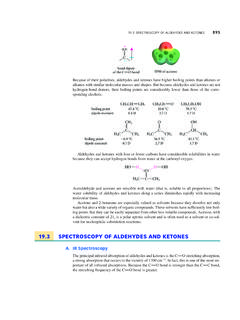
19.3 SPECTROSCOPY OF ALDEHYDES AND KETONES
www.saplinglearning.com898 CHAPTER 19 • THE CHEMISTRY OF ALDEHYDES AND KETONES. CARBONYL-ADDITION REACTIONS C. Carbon NMR Spectroscopy The most characteristic absorption of aldehydes and ketones in 13C NMR spectroscopy is that of the carbonyl carbon, which occurs typically in the d190–220 range (see Fig. 13.20, p. 624).
13C NMR - UCLA
www.chem.ucla.edu13C NMR The 13C NMR is generated in the same fundamental was as proton NMR spectrum. Only 1.1 % of naturally occurring carbon is 13C and actually an advantage because of less coupling. Requirement for NMR: Spin quantum # (I) ≠ 0 Meaning must be an odd number

hsqc topspin ver2 - Columbia University
www.columbia.edu2 John Decatur Version 6.0 10/4/2011 HSQC Procedure 1. Do not spin the sample. Lock, shim and take a normal 1D proton spectrum. Be sure to tune the proton

Polymer characterization of cellulose and hemicellulose
www.formatex.infoPolymer characterization of cellulose and hemicellulose S. Sabiha-Hanim*,1,2 and A. Aziatul-Akma1 1 School of Chemistry and Environment, Faculty of Applied Sciences, Universiti Teknologi MARA (UiTM) Selangor, 40450 Shah Alam, Malaysia 2 Industrial Waste Conversion & Processes Research Group, Universiti Teknologi MARA (UiTM) Selangor, 40450 Shah Alam, Malaysia
Related search queries
NMR Solvent Data Chart, Principles of NMR, Nuclear magnetic resonance, Determination of Equilibrium Constants using NMR, Determination of Equilibrium Constants using NMR Spectroscopy, Measuring 13C NMR Spectra, Lecture 3: Coupling Constants Chem 117, 19.3 SPECTROSCOPY OF ALDEHYDES AND KETONES, 13C NMR, Proton NMR, Hsqc topspin ver2, Columbia University, Proton, Polymer characterization of cellulose and hemicellulose