Stochastic Difierential Equations
Problem 6 is a stochastic version of F.P. Ramsey’s classical control problem from 1928. In Chapter X we formulate the general stochastic control prob-lem in terms of stochastic difierential equations, and we apply the results of Chapters VII and VIII to show that the problem can be reduced to solving
Download Stochastic Difierential Equations

Information
Domain:
Source:
Link to this page:
Documents from same domain
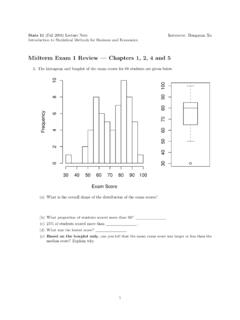
Midterm Exam 1 Review — Chapters 1, 2, 4 and 5
www.stat.ucla.eduStats 11 (Fall 2004) Lecture Note Instructor: Hongquan Xu Introduction to Statistical Methods for Business and Economics Midterm Exam 1 Review — Chapters 1, 2, 4 …
Estimation of Space–Time Branching Process Models in ...
www.stat.ucla.eduEstimation of Space–Time Branching Process Models in Seismology Using an EM–Type Algorithm Alejandro VEEN and Frederic P. SCHOENBERG Maximum likelihood estimation of branching point process models via numerical optimization procedures can be unstable and computa-tionally intensive. We explore an alternative estimation method based on the ...
Distributions related to the normal distribution - Website
www.stat.ucla.eduDistributions related to the normal distribution Three important distributions: Chi-square (˜2) distribution. tdistribution. Fdistribution. Before we discuss the ˜2;t, and F distributions here are few important things about the gamma distribution.
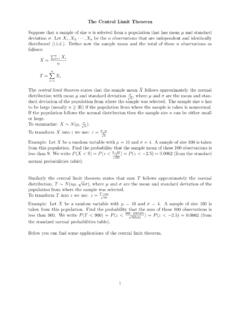
The Central Limit Theorem - Main Concepts
www.stat.ucla.eduCentral limit theorem - proof For the proof below we will use the following theorem. Theorem: Let X nbe a random variable with moment generating function M Xn (t) and Xbe a random variable with moment generating function M X(t). If lim n!1 M Xn (t) = M X(t) then the distribution function (cdf) of X nconverges to the distribution function of Xas ...
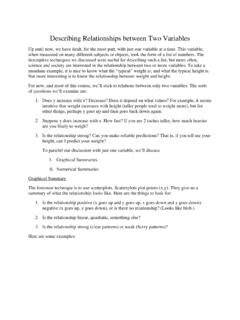
Describing Relationships between Two Variables
www.stat.ucla.eduIs the relationship strong (clear patterns) or weak (fuzzy patterns)? Here are some examples: This data comes from class. The picture comes from plotting each person’s height and weight. For example ( 74, 180), (69, 175), (76, 170), etc. This is a positive relation, fairly …

Covariance and correlation - Main Concepts
www.stat.ucla.eduCorrelation: However, the covariance depends on the scale of measurement and so it is not easy to say whether a particular covariance is small or large. The problem is solved by standardize the value of covariance (divide it by ˙ X˙ Y), to get the so called coe cient of correlation ˆ XY. ˆ= cov(X;Y) ˙ X˙ Y; Always, 1 ˆ 1 cov(X;Y) = ˆ ...
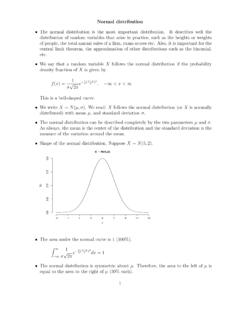
Normal distribution - University of California, Los Angeles
www.stat.ucla.eduWe say that a random variable X follows the normal distribution if the probability density function of Xis given by f(x) = 1 ˙ p 2ˇ e 1 2 (x ˙)2; 1 <x<1 This is a bell-shaped curve. We write X˘N( ;˙). We read: Xfollows the normal distribution (or Xis normally distributed) with mean , and standard deviation ˙.
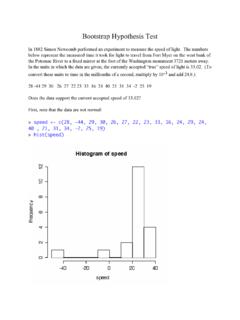
Bootstrap Hypothesis Test - University of California, Los ...
www.stat.ucla.eduWhat if we used the t-test? Since the data now look normal, there’s no reason not to. > t.test(betterspeed,alternative="two.sided",mu=33.02) One Sample t-test data: betterspeed t = -4.6078, df = 17, p-value = 0.0002508 alternative hypothesis: true mean is not equal to 33.02 95 percent confidence interval: 23.83863 29.60582 sample estimates ...
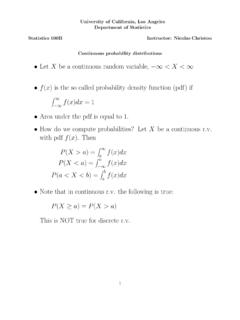
Z f x dx = 1 be a continuous r.v. f x
www.stat.ucla.eduSuppose Xfollows the exponential distribution with = 1. If Y = p X nd the pdf of Y. Example 2 Let X ˘N(0;1). If Y = eX nd the pdf of Y. Note: Y it is said to have a log-normal distribution. Example 3 Let Xbe a continuous random variable with pdf f(x) = 2(1 x);0 x 1. If Y = 2X 1 nd the pdf of Y. Example 4 Let Xbe a continuous random variable ...
Related documents

Random Walk: A Modern Introduction - University of Chicago
www.math.uchicago.edu4.4.3 One dimension 92 4.5 Fundamental solutions 95 4.6 Green’s function for a set 96 5 One-dimensional walks 103 5.1 Gambler’s ruin estimate 103 5.1.1 General case 106 5.2 One-dimensional killed walks 112 5.3 Hitting a half-line 115 6 Potential Theory 119 6.1 Introduction 119 6.2 Dirichlet problem 121 6.3 Difference estimates and Harnack ...

An Introduction To Stochastic Modeling
appliedmath.arizona.edu6. Discrete Renewal Theory* 457 VIII Brownian Motion and Related Processes 473 1. Brownian Motion and Gaussian Processes 473 2. The Maximum Variable and the Reflection Principle 491 3. Variations and Extensions 498 4. Brownian Motion with Drift 508 5. The Ornstein-Uhlenbeck Process* 524 IX Queueing Systems 541 1. Queueing Processes 541 2.
LECTURE 10: CHANGE OF MEASURE AND THE GIRSANOV …
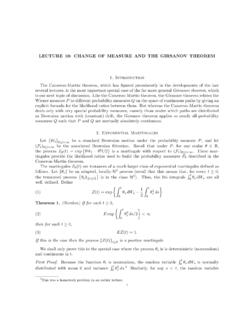
galton.uchicago.edu(3) EZ(t) = 1. If this is the case then the process {Z(t)} t≥0 is a positive martingale. We shall only prove this in the special case where the process θ s is is deterministic (nonrandom) and continuous in t. First Proof. Because the function θ t is nonrandom, the random variable R t 0 θ s dW s is normally distributed with mean 0 and ...

Brownian Motion - University of California, Berkeley
www.stat.berkeley.edu3. Markov processes derived from Brownian motion 53 4. The martingale property of Brownian motion 57 Exercises 64 Notes and Comments 68 Chapter 3. Harmonic functions, transience and recurrence 69 1. Harmonic functions and the Dirichlet problem 69 2. Recurrence and transience of Brownian motion 75 3. Occupation measures and Green’s functions 80 4.

Martingale Theory Problem set 3, with solutions …
people.maths.bris.ac.ukMartingale Theory Problem set 3, with solutions Martingales The solutions of problems 1,2,3,4,5,6, and 11 are written down. The rest will come soon.