
Using SPSS, Chapter 8: Hypothesis Testing - One Sample
Using SPSS, Chapter 8: Hypothesis Testing - One Sample Chapter 8.2 - Hypothesis Tests About a Proportion SPSS doesn’t do this the same way it is done in the book. Click here for online calculators that work well. Chapter 8.3 - Hypothesis Tests About a Mean: ˙Not Known (t-test) 2 SPSS does this really well but you do need the raw data.
Download Using SPSS, Chapter 8: Hypothesis Testing - One Sample

Information
Domain:
Source:
Link to this page:
Documents from same domain
Using R: Chapter 8 Hypothesis Testing - One Sample
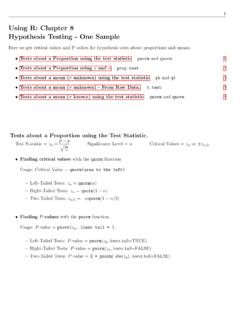
cosmosweb.champlain.eduUsing R: Chapter 8 Hypothesis Testing - One Sample Here we get critical values and P-values for hypothesis tests about proportions and means. Tests about a Proportion using the test statistic pnorm and qnorm. 1 Tests about a Proportion using xand n prop.test 2 Tests about a mean (˙unknown) using the test statistic pt and qt 3

Using Excel, Chapter 8: Hypothesis Testing - One Sample
cosmosweb.champlain.eduChapter 8.2 - Hypothesis Testing About a Proportion Notation { Test Statistic = z ^p = p^ p q pq n { Signi cance Level = (in decimal form) { Critical Values = z or z =2 Finding Critical Values Here we use the NORM.S.INV function. NORM.S.INV stands for the inverse of the standard normal distribution (z-distribution).

Using SPSS, Chapter 9: Hypothesis Testing - Two Samples
cosmosweb.champlain.eduChapter 9.2 - Hypothesis Tests for Two Means: Independent Data 4 SPSS does this really well but you do need the raw data1. Click here for online calculators that work well with summary statistics. Chapter 9.3 - Hypothesis Tests for Two Proportions 6 SPSS doesn’t do this the same way it is done in the book.
Using R: Frequency Distributions, Histograms, Scatterplots ...
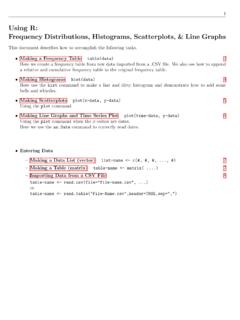
cosmosweb.champlain.eduThen we created a relative and cumulative frequency table from this. Frequency Distribution: Males Scores Frequency 30 - 39 1 40 - 49 3 50 - 59 5 60 - 69 9 70 - 79 6 80 - 89 10 90 - 99 8 Relative Frequency Distribution: Males Relative Scores 30 - 39 2.4% 40 - 49 7.1% 50 - 59 11.9% 60 - 69 21.4% 70 - 79 14.3% 80 - 89 23.8% 90 - 99 19.0% ...

Using R, Chapter 6: Normal Distributions pnorm and …
cosmosweb.champlain.edu1 Using R, Chapter 6: Normal Distributions The pnorm and qnorm functions. Getting probabilities from a normal distribution with mean and standard deviation ˙

Using the TI-83/84 Plus Chapter 8: Hypothesis Testing ...
cosmosweb.champlain.eduChapter 8: Hypothesis Testing - One Sample Here we see how to use the TI 83/84 to conduct hypothesis tests about proportions and means. The software will calculate the test statistic and the P-value for the test statistic. It does not give you the critical value.
A Collection of Multiple-Choice Cumulative Questions In …
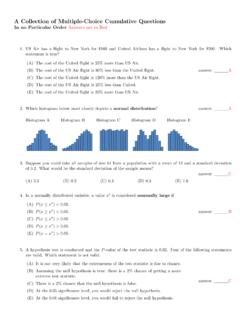
cosmosweb.champlain.eduA Collection of Past Questions Organized by Chapter Chapter 1: Sampling, Levels of Measurement, Percentages 1.A random sample is one with which characteristic? (A)Its members are chosen haphazardly. answer: (B)Every member of the population has an equal chance of being chosen for the sample.
Related documents
A CHRONOLOGICAL BIBLE READING SCHEDULE
thebible.netNov 17, 1997 · A CHRONOLOGICAL BIBLE READING SCHEDULE Week Two - January 8-14 Day Scriptures Notes Job 11:1-20 The third “friend,” …
Time Series - Princeton University
www.princeton.eduTo specify a range of dates (or integers in general) you can use the tin() and twithin() functions. tin() includes the first and last date, twithin() does not. Use the format of the date variable in your dataset. /* Make sure to set your data as time series before using tin/twithin */ tsset date . regress y x1 x2 if tin(01jan1995,01jun1995)
Standard Decontamination Surgical Instruments
www.ast.orgtimes by HCWs. C. Prior to HCWs using cleaning equipment and/or cleaning agents that are not recommended by the manufacturer for particular instruments or devices, the HCW should contact the manufacturer for recommendations, as well as contact the manufacturers of the cleaning equipment and cleaning agent(s). 2.

National Cancer Waiting Times Monitoring Dataset
www.england.nhs.ukdataset using both versions 2.0 and 2.1. Trusts submitting in version 2.0 of the dataset will be able to amend the records submitted manually on the national system, for example recording the new treatment adjustment options Implementation during the COVID-19 pandemic

Working with Time Series Data in R - University of Washington
faculty.washington.eduUse the Date class to represent a time index only involving dates but not times within a day. The Date class by default represents dates internally as the number of days since January 1, 1970. You create Date objects from a character string representing a date using the as.Date() function.

Working with dates and times - Stata
www.stata.comStata stores dates, times, and dates and times as integers such as 4,102, 0, 82, 4,227, and 1,479,735,745,213. It works like this: 1. You begin with the datetime variables in your data however they are recorded, such as 21nov2006 or 11/21/2006 or November 21, 2006, or 13:42:02.213 or 1:42 p.m. The original values are

Using Outlook from the Web - Wisconsin
dcf.wisconsin.govdrop-down lists, select the appropriate dates and times. NOTE: Click the “All Day” checkmark if there isn’t a start and end time. 4. You can type in a location for the event, or choose the “Online Meeting” option to make this event a virtual event, and add a Teams or Zoom link. 5. In the Busy
Dates and Times - EnglishForEveryone.org
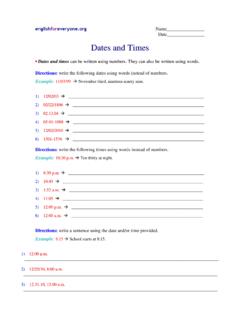
englishforeveryone.orgDates and Times • Dates and times can be written using numbers. They can also be written using words. Directions: write the following dates using words instead of numbers. Example: 11/03/99 November third, nineteen ninety nine. 1) 12/02/03 _____