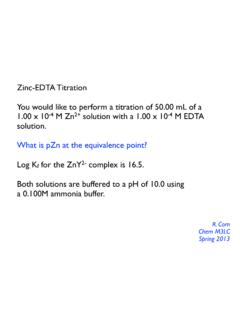
Zinc-EDTA Titration
Zinc-EDTA Titration You would like to perform a titration of 50.00 mL of a 1.00 x 10⁻⁴ M Zn2+ solution with a 1.00 x 10⁻⁴ M EDTA solution. What is pZn at the equivalence point? Log K f for the ZnY2-complex is 16.5. Both solutions are buffered to a pH of 10.0 using
Download Zinc-EDTA Titration

Information
Domain:
Source:
Link to this page:
Documents from same domain
Standard practices for Fmoc-based solid-phase …
www.chem.uci.eduStandard practices for Fmoc-based solid-phase peptide synthesis in the Nowick laboratory (Version 1.6.1) Adam G. Kreutzer and Patrick J. Salveson
An Introduction to Fluorescence Spectroscopy
www.chem.uci.eduAn Introduction to Fluorescence Spectroscopy 3 Table of Contents ... molecular extinction coefficient of the compound; in other words, the corrected
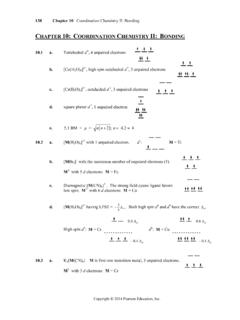
CHAPTER 10: COORDINATION CHEMISTRY II: BONDING
www.chem.uci.edu10.8 Co(II) is d 7. In tetrahedral complexes, it is generally high spin and has 3 unpaired electrons; in In tetrahedral complexes, it is generally high spin and has 3 unpaired electrons; in octahedral complexes, it is also typically high spin and also has 3 unpaired electrons; in square

Dynamic Light Scattering Training
www.chem.uci.eduwww.atascientific.com.au Mie Theory › Mie theory is an exact description of how spherical particles of all sizes and optical properties scatter light › When particles become larger than /10, the scattering changes from being isotropic to a distortion in the
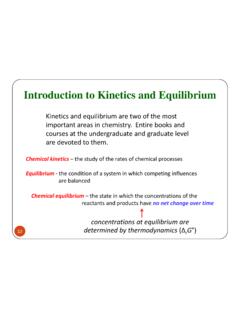
Introduction to Kinetics and Equilibrium
www.chem.uci.eduIntroduction to Kinetics and Equilibrium Kinetics and equilibrium are two of the most ... At iitill tii lPClA system initially containing only PCl 5 at t ti f 0 100t a concentration of 0.100 M has a Q c = 0, which is less than 0.030. What are the equilibrium concentrations
Introductionto FourierTransform InfraredSpectrometry ...
www.chem.uci.eduof material present. With modern software algorithms, infrared is an excellent tool for quantitative analysis. Older Technology. The original infrared instruments were of the . dispersive. type. These instruments separated the individual frequencies of energy emitted from the infrared source. This was accomplished by the use of a prism or grating.
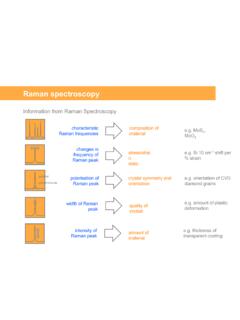
Raman spectroscopy
www.chem.uci.eduFrom the Renishaw Raman software the user can select: • a fixed grating measurement with a spectrum 'window' of 400 cm-1 to 1000 cm (configuration dependent) • a unique 'extended scanning' facility allowing the user to choose any Raman shift range up to about 10000 cm-1 (configuration dependent). Essential for extended range
A Second Application of Symmetry
www.chem.uci.eduWe can use character tables to determine the symmetry of all 18 motions and then assign them to translation, rotation, or vibration. We can also tell which vibrations are IR or Raman active. Procedure: 1. Assign x,y,z coordinates to each atom. 2. Determine how each axis transforms for every class of symmetry operation in the group.
Coordination Chemistry II: Ligand Field Theory Continued
www.chem.uci.eduCoordination Chemistry II: Ligand Field Theory Continued Chapter 10 Wednesday, November 25, 2015. Adding Metal Electrons e g e g * a1g a1g * t1u t1u * t2g Metal ions typically have some valence electrons that can be accommodated in the metal d …

A Guide to Recording Fluorescence Quantum Yields
www.chem.uci.eduJobin Yvon Ltd. 2 Dalston Gardens, Stanmore, Middlesex HA7 1BQ UK Tel: 020 8204 8142 Fax: 020 8204 6142 Email: jy@jyhoriba.co.uk www.jyhoriba.co.uk
Related documents

An iodine / thiosulfate titration
mccscience.yolasite.comThe titration reaction may be represented by the equation: I2 + 2S 2O3 2- → 2I-+ S 4O6 2- Concentration of sodium thiosulfate solution (Note that in this experiment a standard solution of iodine is used to standardise a sodium thiosulfate solution. But you also need to know that a standard solution of sodium thiosulfate can be used to ...
Experiment 6 Titration II – Acid Dissociation Constant
chemistry.uccs.eduTitration II – Acid Dissociation Constant Introduction: An acid/base titration can be monitored with an indicator or with a pH meter. In either case, the goal is to determine the equivalence point of the titration. This is the point at which enough titrant has been added to the analyte to just exactly neutralize the analyte. In this
Titration Answer Keys - Ms. Bloedorn's Class
msbloedorn.weebly.comIn a titration of 40.0 ml of an acetic acid solution, the end point is reached when 35.0 ml of 1.00 M NaOH is added. Calculate the molarity of the acetic acid solution. (l , 77 5 g 5. What volume of 0.300 M HN03 will be required to react with 24 ml o 0.250 M KOH? 6. What is the concentration of a 15 ml sample of HCI if 28.2 ml of 0.150
Determination of Mg by Titration with EDTA
chemlab.truman.eduThe endpoint of the titration is determined by the addition of Eriochrome Black T, which forms a colored chelate with Mg2+ and undergoes a color change when the Mg2+ is released to form a chelate with EDTA. While it is possible to achieve relatively good results by titration with

Chem 141 Titration Lab Lecture Notes - University of …
facultystaff.richmond.eduTitration is a way of determining how many moles of a chemical are in a solution phase sample by completely reacting it with another chemical. Q: What reaction do we do to determine the number of moles of NaOH? We’re reacting KHP with NaOH. The products are water and a …

Experiment 17: Potentiometric Titration
www.bc.eduTitration curve for the titration of a strong acid with a strong base. The equilibrium expression for this reaction is: Eq. 1 or where Ka is the acid-ionization constant for the weak acid. Let us assume that the initial dissociation of the weak acid is negligible. The progressive addition of NaOH during the
aspirin tablets titration - Bellevue College
www.bellevuecollege.eduA titration is a procedure for determining the concentration of a solution (the analyte) by allowing a carefully measured volume of this solution to react with another solution whose concentration is known (the titrant). The point in the titration where enough of the titrant has