Transcription of Investor Education: 2022 tax rates, schedules, and ...
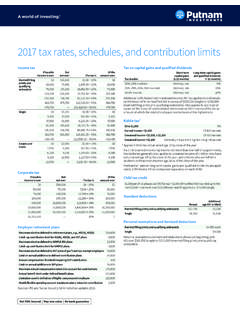
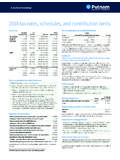
1 2022 tax rates, schedules, and contribution limits Income tax Tax on capital gains and qualified dividends If taxable Income income But Of the Single Married/Filing jointly/Qualifying Widow(er) Tax rate is over not over The tax is amount over $0 $41,675 $0 $83,350 0%. Married/Filing $0 $20,550 $ +10% $0. jointly and Over $41,675 but not qualifying $20,550 $83,550 $2,055 + 12% $20,550. over $459,750 Over $83,350 but not over $517,200 15%. widow(er)s $83,550 $178,150 $9,615 + 22% $83,550. Over $459,750 Over $517,200 20%. $178,150 $340,100 $30,427 + 24% $178,150. Additional federal net investment income (NII) tax applies to individuals $340,100 $431,900 $69,295 +32% $340,100. on the lesser of NII or modified AGI in excess of $200,000 (single) or $250,000. $431,900 $647,850 $98,671 + 35% $431,900 (married/filing jointly and qualifying widow(er)s).
2 Also applies to any trust or $647,850 $174, + 37% $647,850 estate on the lesser of undistributed NII or AGI in excess of the dollar amount Single $0 $10,275 $ + 10% $0 at which the estate/trust pays income taxes at the highest rate ($13,450). $10,275 $41,775 $1, + 12% $10,275. Kiddie tax*. $41,775 $89,075 $4, + 22% $41,775. Child's unearned income above $2,300 is generally subject to taxation at $89,075 $170,050 $15, + 24% $89,075. the parent's marginal tax rate; unearned income above $1,150 but not $170,050 $215,950 $34, + 32% $170,050. more than $2,300 is taxed at the child's tax rate. $215,950 $539,900 $49, + 35% $215,950. A. 1 pplies if either parent of the child is alive at the close of the taxable year, the child $539,900 $162,718 + 37% $539,900 does not file a joint return for the taxable year, and the child either (a) has not Estates and $0 $2,750 $ + 10% $0 attained age 18 by close of the year, (b) has attained age 18 before the close of the trusts year, but the child's earned income represents not more than one half of support $2,750 $9,850 $275 + 24% $2,750.
3 Needs and the child has not attained age 19 by the close of the year, or (c) the child $9,850 $13,450 $1,979 + 35% $9,850. is a full-time student who has not attained age 24 as of the close of the year and $13,450 $3,239 + 37% $13,450 the child's earned income represents not more than one half of support needs. Tax on corporations and other businesses Preferential rates on long-term capital gains and qualified dividends are applicable; federal NII tax is imposed separately on each child if modified 21% tax rate applied on C-corporation income AGI exceeds threshold amounts stated above. Taxpayers may generally deduct up to 20% of the qualified business income (QBI) of S corporations, partnerships, and sole proprietorships (reduced by Child tax credit net capital gain and qualified dividends), subject to limitations: $2,000 per qualifying child (who has not attained age 17 during the year).
4 Deduction generally not available for a Specified Service Trade or Business phased out as modified AGI exceeds $400,000 (married/filing jointly) or (SSTB) if taxable income exceeds $220,050 (single) or $440,100 (married/. $200,000 (all other); $1,500 per child is refundable filing jointly); the deduction is subject to a phaseout unless taxable income is at or below $170,050 (single) or $340,100 (married/filing jointly) $500 nonrefundable credit for qualified dependents other than qualifying children (with some modified AGI phaseouts). If taxable income exceeds $220,050 (single) or $440,100 (married/filing jointly), the deduction is limited to the lesser of: (a) 20% of QBI or (b) the greater of (i) 50% of W-2 wages paid by each business or (ii) 25% of W-2 Additional wages paid by each business plus of the unadjusted basis of qualified Standard deductions Annual age 65+ or blind property; wage and qualified property limitations are not applicable to Married/Filing jointly and qualifying widow(er)s $25,900 $1,400.
5 Taxable incomes at or below $170,050 (single) or $340,100 (married/filing Single $12,950 $1,750. jointly) and are fully phased in once taxable income exceeds $220,050. (single) or $440,100 (married/filing jointly). Health savings accounts contribution limits Individual $3,650. Employer retirement plans Family $7,300. Maximum elective deferral to retirement plans, , 401(k), 403(b) $20,500. Catch-up contribution: Taxpayers who are 55 or older in 2022 may contribute Catch-up contribution limit for 401(k), 403(b), and certain 457 plans $6,500 an additional $1,000, or a total of $4,650 for individuals and $8,300 for families. Maximum elective deferral to simple plans $14,000. Catch-up contribution limit for simple plans $3,000 Deduction for mortgage interest Maximum elective deferral to 457 plans of government Deduction on interest for qualifying mortgages up to $750,000 ($375,000.)
6 And tax-exempt employers $20,500 if married/filing separately); homes under agreement before 12/15/17 for Limit on annual additions to defined contribution plans $61,000 purchase prior to 1/1/18 (provided purchase occurred by 4/1/18) grandfathered Annual compensation threshold requiring SEP contribution $650 under previous $1,000,000 ($500,000 if married/filing separately) limits Limit on annual additions to SEP plans $61,000 Interest on home equity lines of credit (HELOC) deductible in certain cases where proceeds are utilized to acquire or improve a residence Maximum annual compensation taken into account for contributions $305,000. Annual benefit limit under defined benefit plans $245,000 Deduction for state and local taxes Limitation used in definition of highly compensated employee $135,000. Individuals may deduct state and local income (or sales) taxes and real and personal Health flexible spending account maximum salary reduction property taxes up to $10,000 ($5,000 if married filing separately) in the aggregate.
7 Contribution $2,850. Sources: IRS and Social Security Administration updates 2022. Maximum Qualified Long-Term-Care insurance premiums Maximum compensation subject to FICA taxes eligible for deduction in 2022 OASDI (Social Security) maximum $147,000. Age 40 or less Age >40, 50 Age >50, 60 Age >60, 70 Age over 70 HI (Medicare) maximum No limit $450 $850 $1,690 $4,510 $5,640 OASDI and HI tax rate: OASDI and HI ( combined) for self- employed; and ( combined) for employees. An additional Traditional IRAs HI tax imposed on individuals with wages or self-employment income in excess of $200,000 (single and qualifying widow(er)s) or $250,000 (married/ filing jointly). Maximum annual contribution Lesser of compensation or $6,000. Death/gifts occurring in 2022*. Up to $6,000 contribution can also be made for nonworking spouse Catch-up contributions (age 50 and over): $1,000 (subtract applicable credit from calculated tax).
8 If gift/gross But Of the estate is over not over The tax is amount over Traditional IRA deductibility table $0 $10,000 $0 + 18% $0. Covered by $10,000 $20,000 $1,800 + 20% $10,000. employer's Filing retirement Modified AGI Modified AGI $20,000 $40,000 $3,800 + 22% $20,000. status plan 2022 2021 Deductibility $40,000 $60,000 $8,200 + 24% $40,000. Single No Any amount Any amount Full $60,000 $80,000 $13,000 + 26% $60,000. Yes $68,000 or less $66,000 or less Full $80,000 $100,000 $18,200 + 28% $80,000. Yes $68,001 $77,999 $66,001 $75,999 Partial Yes $78,000 or more $76,000 or more None $100,000 $150,000 $23,800 + 30% $100,000. Married/ Neither Any amount Any amount Full $150,000 $250,000 $38,800 + 32% $150,000. Jointly spouse $250,000 $500,000 $70,800 + 34% $250,000. covered $500,000 $750,000 $155,800 + 37% $500,000.
9 Married/ Both $109,000 or less $105,000 or less Full $750,000 $1,000,000 $248,300 + 39% $750,000. Jointly spouses $109,001 $128,999 $105,001 $124,999 Partial covered $129,000 or more $125,000 or more None $1,000,000 $345,800 + 40% $1,000,000. Married/ Yes, but $109,000 or less $105,000 or less Full A. 1 nnual gift tax exclusion: individual, $16,000; married electing split gifts, $32,000. Jointly spouse is $109,001 $128,999 $105,001 $124,999 Partial Combined lifetime gift tax and gross estate tax exemption: $12,060,000. not covered $129,000 or more $125,000 or more None GST tax exemption: $12,060,000. Married/ No, but $204,000 or less $198,000 or less Full Jointly spouse is $204,001 $213,999 $198,001 $207,999 Partial Higher education tax credits covered $214,000 or more $208,000 or more None Modified AGI phaseouts for American Opportunity Tax Credit Roth IRAs Married/Filing jointly $160,001 $179,999.
10 Others $80,001 $89,999. Maximum annual contribution Lesser of compensation or $6,000 Modified AGI phaseouts for Lifetime Learning Credit Up to $6,000 contribution can also be made for nonworking spouse Married/Filing jointly $160,001 $179,999. Catch-up contributions (age 50 and over): $1,000. Single $80,001 $89,999. Contribution eligibility Modified AGI is less than $129,000 (single) or $204,000 (married/filing jointly);. phaseouts apply if modified AGI is $129,000 $143,999 (single) or $204,000 AMT exemptions $213,999 (married/filing jointly). Single $75,900. Deductibility Married/Filing jointly and qualifying widow(er)s $118,100. Contributions to Roth IRAs are not deductible. Phases out beginning with alternative minimum taxable income over Conversion eligibility $1,079,800 (married/filing jointly and qualifying widow(er)s) or $539,900.