Transcription of Gibbs Phase Rule: f = c – p + 2 - Colby College
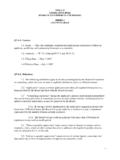
1 Colby College Gibbs Phase Rule: f = c p + 2 f = Intensive Degrees of freedom = variance Number of intensive variables that can be changed independently without disturbing the number of phases in equilibrium p = number of phases gas, homogeneous liquid phases , homogeneous solid phases c = components Minimum number of independent constituents Case I. No chemical reactions: c = constituents Example 1: start with methanol and water 2 components Case II With chemical reactions: Example 2: start with NaH2PO4 in water -- Ka2 Ka3 H2PO4- HPO42- + H+ PO43- + H+ Constituents: Na+, H+, H2PO4-, HPO42-, PO43-, H2O but only 2 components -- NaH2PO4 and H2O. Example 3: start with NaH2PO4 and Na2 HPO4 in water -- Same constituents: Na+, H+, H2PO4-, HPO42-, PO43-, H2O but now 3 components -- NaH2PO4, Na2 HPO4, and H2O. Need to know: T, P, yA, yB, xA, xB total intensive variables = c p + 2 But yA + yB = 1 xA + xB = 1 Get p such equations, one for each Phase : Independent variables = c p + 2 p But, chemical potential is everywhere equal: A(xA) = A(g) B(xB) = B(g) Get p 1 for each component Get c( p 1) such equations: Independent variables = c p + 2 p c( p 1) f = c p + 2 A & B liquid A(g) A(xA) = B(xB) = B(g) xA + xB =1 A & B vapor yA + yB =1 f ' = c p + 1 P = cst 0 1 xA, yA liquid A & B f ' = 2 vapor A & B T f ' = 1 f ' = 2 T*bA T*bB Colby College f ' = c p + 1 cst.
2 P f "= c p cst. T&P Binary solid-liquid Equilibrium Melting Point Variation with Composition c = 2 p = 3 liquid, pure solid A, pure solid B Solid-liquid 2- Phase region: f ' = 2 2 + 1 = 1 Eutectic: f ' = 2 3 + 1 = 0 invariant at cst P For NaCl in water: Eutectic oC at 23% wt/wt giving NaCl 2H2O Add One Extensive Independent Variable for Each Phase : Gibbs energy is extensive: Degrees of freedom: D = f + p Binary Solid-Liquid at constant T & P: Solid-liquid 2- Phase region: f " = 2 2 = 0 D " = f " + p = 0 + 2 = 2 dG = A dnA + B dnB dnA and dnB: totals for both phases since: A(s) = A(l), and B(s) = B(l) (doesn t matter which Phase ) A & B liquid Solid A & Solid B P = cst 0 1 xA solid A & solid B liquid A & B T f ' =1 liq. & solid B f ' =1 liq. & solid A f ' =0 f ' =2 f ' = c p + 1