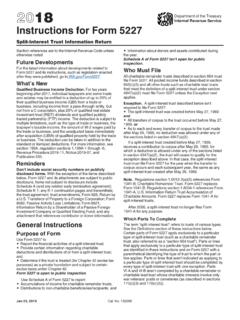
Transcription of Instructions for Form 5405 (Rev. December 2017)
1 Userid: CPMS chema: instrxLeadpct: 100%Pt. size: Draft Ok to PrintAH XSL/XMLF ileid: .. ns/I5405/201712/A/XML/Cycle04/source(Ini t. & Date) _____Page 1 of 4 9:07 - 29-Nov-2017 The type and rule above prints on all proofs including departmental reproduction proofs. MUST be removed before for Form 5405(Rev. December 2017) Repayment of the First-Time Homebuyer CreditDepartment of the TreasuryInternal Revenue ServiceSection references are to the Internal Revenue Code unless otherwise InstructionsFuture DevelopmentsFor the latest information about developments related to Form 5405 and its Instructions , such as legislation enacted after they were published, go to requirement. The repayment requirement has expired for homes purchased after 2008. The repayment requirement continues to apply to homes purchased in of FormUse Form 5405 to do the the IRS that the home you purchased in 2008 and for which you claimed the credit was disposed of or ceased to be your main home in 2017.
2 Complete Part I and, if applicable, Parts II and the amount of the credit you must repay with your 2017 tax return. Complete Part II and, if applicable, Part Must FileYou must file Form 5405 with your 2017 tax return if you purchased your home in 2008 and you meet either of the following disposed of it in ceased using it as your main home in see Exceptions, all other cases, you aren't required to file Form 5405. Instead, enter the repayment on Form 1040, line 60b, or Form 1040NR, line 59b, whichever applies. For example, you aren't required to file Form 5405 if you are making an installment payment of the credit you claimed for a home you purchased in 2008, and you owned and used the home as your main home during all of claimed on a joint return. If you and your spouse claimed the credit on a joint return, each spouse is treated as having been allowed half of the credit for purposes of repaying the credit.
3 Each spouse who meets either condition 1 or 2 above must file a separate Form following are exceptions to the repayment or threat of condemnation. If the home is destroyed or you sell the home through condemnation or under threat of condemnation to someone who isn't related to you and you don't acquire a new home within the 2-year period, the repayment with your return for the year in which the 2-year period ends is limited to the gain on the disposition as determined in Part III of Form 5405. The amount of the credit in excess of the gain doesn't have to be repaid. (See Related Persons, later.)Transfer to spouse or ex-spouse. If the home was transferred to a spouse (or ex-spouse as part of a divorce settlement), the spouse who received the home is responsible for repaying the credit (regardless of whether he or she was the purchaser) if none of the other exceptions who claimed the credit dies.
4 If a person who claimed the credit dies, repayment of the remaining balance of the credit isn't required unless the credit was claimed on a joint return. If the credit was claimed on a joint return, then the surviving spouse is required to continue repaying his or her half of the credit (regardless of whether he or she was the purchaser) if none of the other exceptions PersonsRelated persons include the spouse, ancestors (parents, grandparents, etc.), or lineal descendants (children, grandchildren, etc.). corporation in which you directly or indirectly own more than 50% in value of the outstanding stock of the partnership in which you directly or indirectly own more than 50% of the capital interest or profits more information about related persons, see the discussion under Nondeductible Loss in chapter 2 of Pub. 544, Sales and Other Dispositions of Assets.
5 When determining whether you acquired your main home from a related person, family members in that discussion include only the people mentioned in (1) InstructionsPart I. Disposition or Change in Use of Main Home for Which the Credit Was ClaimedComplete Part I if you claimed the first-time homebuyer credit for a home purchased in 2008 and either you disposed of the home or it ceased to be your main home in 2017. This includes situations where:You sold the home (including through foreclosure);You converted the entire home to business or rental property;You abandoned the home (except in connection with a sale or foreclosure);The home was destroyed, condemned, or disposed of under threat of condemnation; orThe taxpayer who claimed the credit died in (including through foreclosure). In the case of a sale (including through foreclosure) of your main home, you must repay the credit with the tax return for the tax year in which the sale is completed.
6 In general, this will occur when the purchaser (or lender) obtains title to your and social security number. Enter your name and social security number. Each spouse who meets condition 1 Nov 29, 2017 Cat. No. 54378 FPage 2 of 4 Fileid: .. ns/I5405/201712/A/XML/Cycle04/source9:07 - 29-Nov-2017 The type and rule above prints on all proofs including departmental reproduction proofs. MUST be removed before 2 earlier under Who Must File must file a separate Form 5405. Each spouse must enter only his or her name and social security number on his or her separate Form 5405. This is true whether a joint return or separate returns are 1. If your home was destroyed or condemned, or you disposed of the home under threat of condemnation, enter the date it was destroyed, condemned, or disposed of under threat of condemnation (or the date it ceased to be your main home, whichever is earlier).
7 Line 2. Check the box if you (or your spouse, if married):Are, or were, a member of the uniformed services or Foreign Service or an employee of the intelligence community (defined below); andSold the home or the home ceased to be your main home after 2008 because you (or your spouse, if married) received Government orders to serve on qualified official extended duty (defined next).If you (or your spouse, if married) meet both of these conditions, you (and your spouse, if married) don't have to repay the official extended duty. You are on qualified official extended duty while:Serving at a duty station that is at least 50 miles from your main home, orLiving in Government quarters under Government are on extended duty when you are called or ordered to active duty for a period of more than 90 days or for an indefinite services. The uniformed services are:The Armed Forces (the Army, Navy, Air Force, Marine Corps, and Coast Guard),The commissioned corps of the National Oceanic and Atmospheric Administration, andThe commissioned corps of the Public Health Service member.
8 For purposes of the credit, you are a member of the Foreign Service if you are any of the Chief of Ambassador at member of the Senior Foreign Foreign Service of the Foreign Service of the intelligence community. For purposes of the credit, you are an employee of the intelligence community if you are an employee of any of the Office of the Director of National Central Intelligence National Security Defense Intelligence National Geospatial-Intelligence National Reconnaissance Office and any other office within the Department of Defense for the collection of specialized national intelligence through reconnaissance of the intelligence elements of the Army, the Navy, the Air Force, the Marine Corps, the Federal Bureau of Investigation, the Department of the Treasury, the Department of Energy, and the Coast Bureau of Intelligence and Research of the Department of of the elements of the Department of Homeland Security concerned with the analyses of foreign intelligence 3a, 3b, and 3c.
9 If you sold your home to someone who isn't related to you, complete Part III to figure the gain or (loss) on the sale. (The person isn't related to you if he or she doesn't meet the definition under Related Persons, earlier.) The repayment is limited to the amount of gain. The amount of the credit in excess of the gain doesn't have to be 3d. See the Tip below for information about converting your entire home to business or rental 't check this box if you converted only a part of the home to rental or business use and you continue to use the other part as your main home. Don't file Form 5405 for this conversion. Enter your annual repayment on your 2017 Form 1040, line 60b, or Form 1040NR, line 59b, whichever 1. You claimed the credit for a home you purchased in 2008. In January 2017, you converted the basement of your home for use as a child care business.
10 You continued to use the rest of your home as your main home in 2017. You are required to repay at least 1/15 of the credit with your 2017 return. You don't have to file Form 5405. Instead, enter the repayment on your 2017 Form 1040, line 60b, or Form 1040NR, line 59b, whichever 2. You claimed the credit for a home you purchased in 2008. In January 2017, you moved out of the home and converted it to rental property. You must check the box on line 3d and complete Part II. In this case, you must repay the balance of the credit with your 2017 tax you convert your entire home to business or rental use, you no longer use any part of it as your main home. The home is used for business if you use it for an activity that you carry on to make a profit. The facts and circumstances of each case determine whether or not an activity is a 3e. Check the box on line 3e if you meet either of the following transferred the home to your and your spouse divorced and you transferred the home to your ex-spouse as part of the divorce settlement.