Transcription of CHAPTER 3: DERIVATIVES - kkuniyuk.com
1 (Answers to Exercises for CHAPTER 3: DERIVATIVES ) CHAPTER 3: DERIVATIVES SECTION : DERIVATIVES , TANGENT LINES, and RATES OF CHANGE 1) a) () f3() 3; this is f3+h() f3()h with h= () f3() 3; this is f3+h() f3()h with h= () f3() 3; this is f3+h() f3()h with h= () f3() 3; this is f3+h() f3()h with h= () f3() 3; this is f3+h() f3()h with h= () f3() 3; this is f3+h() f3()h with h= b) No c) 30 2) a) fa()=323a 2. Hint: Rationalize the numerator of the difference quotient. b) Point-Slope Form: y 5=310x 9(), Slope-Intercept Form: y=310x+2310 c) Point-Slope Form: y 5= 103x 9(), Slope-Intercept Form: y= 103x+35 3) a) i.
2 , ii. ; b) 4cmsec (Answers to Exercises for CHAPTER 3: DERIVATIVES ) SECTION : DERIVATIVE FUNCTIONS and DIFFERENTIABILITY 1) Hint: fx+h() fx()h=1x+h()2 1x2h; fx()= 2x3 2) Hint: rx+h() rx()h=x4+4x3h+6x2h2+4xh3+h4() x4h; rx()=4x3 3) fx()=6x1/3, or 6x3, fx()= 2x4/3, or 2x43, fx()=83x7/3, or 83x73(), f4()x()= 569x10/3, or 569x103() 4) 0 5) a) vt()=20t4 b) v1()=20mph, v2()=320mph, v ()= ; mph = miles per hour c) at()=80t3 d) a1()=80mihr2, a2()=640mihr2, a ()= 6) a) Yes; b) No; c) No; d) No (observe that p is discontinuous at 1); e) No; f) Yes 7) a) Yes, there is a vertical tangent line; a cusp b) Yes, there is a vertical tangent line; neither a corner nor a cusp c) No, there is not a vertical tangent line; a corner 8) (Answers to Exercises for CHAPTER 3: DERIVATIVES ) SECTION : TECHNIQUES OF DIFFERENTIATION 1) Hint: gw+h() gw()h=3w+h()2 5w+h()+4 3w2 5w+4 h; gw()=6w 5 2) a) 15x2+6x3 12x3/2+118x2/3, or 15x2+6x3 12x3+118x23() b) 135 t()2, or 13t 5()2 c) 4z3 16z; this can be factored as 4zz+2()z 2().
3 D) 2w 3()w3 2()+w2 3w+1()3w2() e) i. 1x3 52x2 (Hint: First, reexpress using algebra.), ii. 2 5x2x3, which is equivalent to 1x3 52x2. f) 43+4x()3x+2x2()2, which could be simplified to 43+4x()x23+2x()2; ask your instructor if s/he has a preference. g) 18x h) 63x+1()3 3) a) vt()=12t2+30t 18 b) v1()=24ftmin, v2()=90ftmin, v ()= c) at()=24t+30 d) a1()=54ftmin2, a2()=78ftmin2, a ()= (Answers to Exercises for CHAPTER 3: DERIVATIVES ) 4) a) Point-Slope Form: y 1= 12x 2(), Slope-Intercept Form: y= 12x+2 b) Point-Slope Form: y 1=2x 2(), Slope-Intercept Form: y=2x 3 5) Hint: Dxfx()gx()hx() =Dxfx()gx() hx()().
4 6) 3fx() 2 fx(). Hint: Assume that f, g, and h are equivalent functions. 7) a) 13,7354 and 2, 5() b) Point-Slope Form: y 52 = 4x 1(), Slope-Intercept Form: y= 4x+32 c) Point-Slope Form: y 52 =14x 1(), Slope-Intercept Form: y=14x 114 d) 3, 12 and 43, 8527 8) a) 10,200() and 10,200(). Hint: Find the point(s) a,fa()() on the flight path where the slope of the tangent line there equals the slope of the line connecting the point and the target. b) 2,104() and 50,2600() (Answers to Exercises for CHAPTER 3: DERIVATIVES ) SECTION : DERIVATIVES OF TRIGONOMETRIC FUNCTIONS 1) a) 14 b) 53.
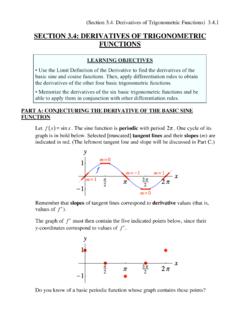
5 Hint: limx 0sin5x()5x=1. c) 1000 d) 0. Hint: Factor the numerator. 2) a) 5x4cosx x5sinx, or x45cosx xsinx() b) 11+cosw c) csc2r cscr()cotr(), or cscr()cscr cotr() d) 7sec ()tan ()+8 e) 2 tan + 2sec2 , or 2tan + sec2 () f) 0, Dom k()= 2+ nn () 3) x x= 4+2 n,orx=3 4+2 nn () 4) a) x x= nn (){} b) x x=4 3+2 n,orx=5 3+2 nn () c) Tangent line: y=3, Normal line: x=0 (Answers to Exercises for CHAPTER 3: DERIVATIVES ) 5) Tangent line: Point-Slope Form: y 2=3x 3 4 , Slope-Intercept Form: y=3x+9 +84.
6 Normal line: Point-Slope Form: y 2= 13x 3 4 , Slope-Intercept Form: y= 13x+8 4 6) Most efficiently: x x= 2+2 3n,orx= 2+2 nn () . Equivalently, x x= 2+ n,orx= 6+2 n,orx=7 6+2 nn () . Hint 1: Use a Double-Angle ID. Hint 2: sin2x=sinx()sinx(). 7) Hint: Dxcotx()=Dxcosxsinx 8) Hint: Dxcscx()=Dx1sinx SECTION : DIFFERENTIALS and LINEARIZATION OF FUNCTIONS 1) 2) 3) 233+ 180=1203+ 180 (Answers to Exercises for CHAPTER 3: DERIVATIVES ) SECTION : CHAIN RULE 1) a) 3x2 3x+8()22x 3(), or 32x 3()x2 3x+8()2 b) 10mm2+4()6 c) 6x2 1x2 52x+2x3 , or 12x+1x3 x2 1x2 5, or 12x4+1x3 x4 1x2 5, or 12x4+1()x4 1()5x13 d) 18tan26t() sec26t() e) 3x2sin22x()+4x3sin2x() cos2x() , or x2sin2x() 3sin2x()+4xcos2x() , or 3x2sin22x()+2x3sin4x(), or x23sin22x()+2xsin4x() f) 8t28t3+27()2/3, or 8t28t3+27()23, or 8t28t3+273()8t3+27 g) 7 6 5+csc5 () 6 30 4 5csc5 () cot5 () (), or 35 6 5+csc5 () 66 4+csc5 () cot5 () () h)
7 2sec2w() tan2w() +2sec22w(), or 2sec2w() tan2w()+sec2w() i) Same as h). j) sin ()2 sin 2cos , or 12sin () +sin ()sec , or 2sin ()+sin () sec (Answers to Exercises for CHAPTER 3: DERIVATIVES ) k) 186x 7()28x2+9()4+64x6x 7()38x2+9()3, which factors and simplifies as 2264x2 224x+81()6x 7()28x2+9()3. By the Test for Factorability from Section in the Precalculus notes, the discriminant of 264x2 224x+81() is not a perfect square, so it cannot be factored further over the integers. l) xx2 3()3x2+23()x2+5()3/2, or xx2 3()3x2+23()x2+5()3, or xx2 3()3x2+23()x2+5()x2+5, or xx2 3()3x2+23()x2+5x2+5()2 2) 63x+1()3 3) 3fx() 2 fx(), just like in Section , Exercise 4.
8 4) Most efficiently: x x= 2+2 3n,orx= 2+2 nn () . Equivalently, x x= 2+ n,orx= 6+2 n,orx=7 6+2 nn () , just like in Section , Exercise 6. 5) 42 6) a) Dxx3()5 =Dxx15 =15x14 b) Dxx3()5 =5x3()43x2()=15x14 c) dydx=dydududx=5u4()3x2()=15x2u4=15x2x3() 4=15x14 (Answers to Exercises for CHAPTER 3: DERIVATIVES ) 7) a) Dx1x2+1 = Dxx2+1()x2+1()2= 2xx2+1()2 b) Dx1x2+1 =Dxx2+1() 1 = x2+1() 22x()= 2xx2+1()2 c) dydx=dydududx= 1u2 2x()= 2xu2= 2xx2+1()2 8) Hints: How are slopes of perpendicular lines (or line segments) related?
9 Dxa2 x2()= xa2 x2. Horizontal and vertical tangent lines correspond to special cases. 9) Hint: You will need the Cofunction Identities again: sec 2 x =cscx and tan 2 x =cotx. 10) a) 2cos2x() b) Dxsin2x() =Dx2sinx()cosx() =..=2cos2x sin2x()=2cos2x() c) The range of Dxsin2x() is 2,2[]. The range of Dxsinx() is 1,1[]. This tells us, among other things, that the steepest tangent lines to the graph of y=sin2x() are twice as steep as the steepest tangent lines to the graph of y=sinx. More incisively, the slope of the tangent line to the graph of y=sin2x() at x=a is twice the slope of the tangent line to the graph of y=sinx at x=2a, where a is any real value.
10 (Answers to Exercises for CHAPTER 3: DERIVATIVES ) SECTION : IMPLICIT DIFFERENTIATION 1) a) dydx= y22xy+1 b) 12 2()2+2()=4 c) 43 d) Point-Slope Form: y 2= 43x 12 , Slope-Intercept Form: y= 43x+83 2) a) dydx=2y 10x 9x2y426x3y3 x 4y() b) 52()2 22() 1()+32()3 1()4 4 1()2=44 c) 2946 d) Point-Slope Form: y 1()=2946x 2(), Slope-Intercept Form: y=2946x 5223 3) a) dydx=2ycosy2xysiny cosy() b) sin0()+3cos0=3 c) 0 4) Hints: Consider the equation x2+y2=a2, where a>0. How are slopes of perpendicular lines (or line segments) related? Horizontal and vertical tangent lines correspond to special cases.