Transcription of Tax Tips for the Cosmetology BarBer Industry
1 &Tax Tips for the CosmetologyBarBer IndustryWhether a shop owner, an employee, or a booth renter (in-dependent contractor), you need to know your federal tax responsibilities, including how to report your income and tips you receive from your customers. The most common forms of business are the sole proprietorship, part-nership, and corporation. Your form of business determines which in-come tax return form you have to file. Publication 583, Starting a Busi-ness and Keeping Records, available free from the IRS, can help you purpose of this publication is to describe some of the Federal tax responsibilities that owners and workers must address each a shop owner you can elect to structure your business in different forms.
2 You can choose to operate your business as a sole proprietor-ship, partnership, or as a corporation. Your business may have employ-ees who work for you or you may decide to operate without employees. Another common arrangement is renting space to another individual who operates an independent business. This is commonly referred to as a booth renter and will be discussed later in this doesn t matter which business structure you choose; there are basic principles that do not change. Income received in the course of your business is taxable income and must be reported on the appropriate income tax return you operate your business without employees, where you are the only worker, then your federal tax responsibilities would be limited to reporting your income earned (including tip income) and expenses on the appropriate tax form.
3 For example, a sole proprietorship would file Form 1040, using Schedule C to report business income and expenses and Schedule SE to report Self-Employment you decide to hire workers you must make a determination if they are your employees or if they will operate their own independent busi-ness (booth renters).3 Table of ContentShop OwnerShop Owner 3 Who is an Employee? 4 Shop Owner/Employer Tax Responsibilities 4 Booth Renters 6 Tip Income Responsibilities for the Employer or Booth Renter 8 Employee Tip Reporting Responsibilities 9 Tip Rate Determination and Education Program (TRD/EP) 9 References 105 Who is an employee?
4 Simply stated, an employee is an individual who works at the control and direction of another. It is important to remember that as the em-ployer you do not have to control the worker all of the time, you simply have to have the right to control. The following questions are helpful in determining if someone is your employee or an independent contrac-tor: As the owner, do you establish the hours the shop is open? Who makes the determination regarding who works specific shifts? Do the workers purchase their own supplies with their own money? Who determines the prices charged to customers?
5 Do the workers each set their own appointments? Who is responsible for expenses, such as insurance, advertising, questions are not all inclusive, but they will provide insight as to whether you are their employer. If you give extensive instructions as to how, when, or where to do the work and where to purchase the supplies, then more than likely you are the employer and the worker is your employee. For additional information, see Publication 1779, Inde-pendent Contractor or Employee?Shop Owner/Employer Tax ResponsibilitiesAs an employer, federal law requires you to withhold taxes from your employees paychecks.
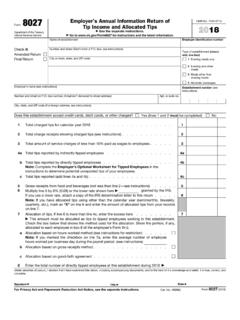
6 Depending on the wages, you must take out of your employees paychecks certain amounts for federal income tax, so-cial security tax, and Medicare tax. You must then pay any liability for the employer s share of social security and Medicare taxes. This portion, your share, is not withheld from employees. You may also be required to pay unemployment (FUTA) taxes on these wages. In addi-tion to reporting all taxable income on the appropriate income tax form, you would also have the responsibility for issuing Form W-2, Wage and Tax Statement. The wages paid, along with the taxes withheld, are reported on a quar-terly basis by filing Form 941, Employer s QUARTERLY Federal Tax Return.
7 You may also be required to file an annual form to pay Fed-eral unemployment taxes. This is done by filing Form 940, Employer s Annual Federal Unemployment (FUTA) Tax Return. Form W-2 is fur-nished to employees after the close of the calendar year, but no later than January 31st. For more information about payroll taxes, see Publication 15 (Circular E), Employer s Tax Guide that you can download at and click on the Employment Taxes booth renter is someone who leases space from an existing business and operates their own business as an independent contractor.
8 As a booth renter, or independent contractor, you are responsible for your own record-keeping and timely filing of returns and payments of taxes related to your that you are an independent contractor include, but are not limited to: Having a key to the establishment Setting your own hours Purchasing your own products Having your own phone number and business name Determining the prices to be chargedIf these factors are not present, then you are likely an employee of the business who is providing the space to the above factors are present, then as an independent contractor you would be responsible for your federal taxes.
9 Your tax responsibilities would include: Reporting all income (including tips) on the appropriate income tax return form, such as Form 1040, using Schedule C or Schedule C-EZ. Social Security and Medicare Taxes are reported on Schedule SE. As a booth renter you must issue Form 1099-MISC for business rent paid of more than $600 or more to non-corporate landlords each year. Issue Form 1099 MISC or W-2 to workers you hire or a booth renter, or independent contractor, you may need to make es-timated tax payments during the year to cover your tax liabilities.
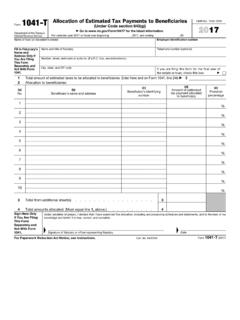
10 This is because as a booth renter (independent contractor), the business does not withhold taxes from your pay. Estimated tax is the method used to pay tax on income that is not subject to withholding, such as earnings from self-employment you receive as a booth tax payments are made each quarter using Form 1040-ES, Estimated Tax for Individuals. For additional information regarding tax withholding and estimated tax, see Publication 505, Tax Withholding and Estimated you hire others to work for you it is possible that these workers would be your employees.