Transcription of Business axes for Agricultural Industries
1 Business Taxes forAgriculturalIndustriesThis publication provides information as to howKansas taxes apply to your Agricultural common industry examples, it explainswhich items are taxable, which are exempt andhow to properly claim the exemptions. Kansaslaw provides several sales tax exemptions forthose engaged in the Agricultural industry, butthese tax exemptions are specific in nature anddo not apply to all aspects of your included is information about how toreport and pay the taxes. By law, businesses arerequired to submit their Sales, CompensatingUse and Withholding Tax returns offers several electronic file and paysolutions see page this publication as a supplement toKansas Department of Revenue s basic salestax publication, KS-1510, Kansas Sales andCompensating Use KS-1550(Rev. 10-19)NOTE: Underlying law may have changed.
2 See Revenue Notice 19-04 concerning OF CONTENTSINTRODUCTION TO KANSAS SALES 3 What Sales are Taxable?Sales Tax StructureRetailer and Consumer ResponsibilitiesHow to RegisterSALES TAX EXEMPTIONS FOR AGRIBUSINESS .. 4 Agribusiness Defined for Sales TaxAgricultural AnimalsFarm Machinery and EquipmentPropane for Ag UseSoil Erosion PreventionResale ExemptionIngredient or Component Part ExemptionConsumed in Production ExemptionINDUSTRY APPLICATIONS AND EXAMPLES .. 8 Animals and Animal CareConstruction ProjectsCrop DustingFarriersFeedlotsFuelsGrain ElevatorsGrain StorageIrrigation EquipmentMaintenance AgreementsOther Business EquipmentPest ControlPlant Nurseries/Christmas Tree FarmsUtilitiesVehicles and TrailersVeterinarian ServicesWellsWeldingWindmillsCLAIMING THE EXEMPTIONS .. 15 Signing the InvoiceUsing an Exemption CertificateExemption Certificates for AgribusinessHow to Claim a Utility ExemptionOTHER KANSAS TAXES.
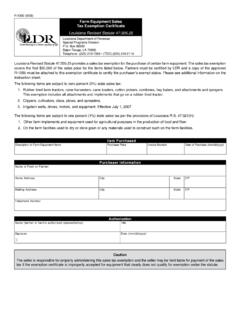
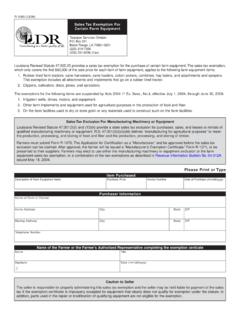
3 17 Compensating Use TaxMotor Fuel TaxLiquor Taxes Tire Excise TaxWithholding TaxYOUR FILE AND PAY OPTIONS .. 19 ADDITIONAL INFORMATION ..19 Tax AssistanceWebsite Information Library (PIL)Key Statutes and RegulationsEXEMPTION CERTIFICATES .. 20 Agricultural Exemption Certificate (ST-28F)Designated Exemption Certificate (ST-28)Resale Exemption Certificate (ST-28A)Utility Exemption Request (ST-28B)ASSISTANCE ..BACK COVER If there is a conflict between the law and information found in this publication, the law remains the final authority. Under no circumstances should the contents of this publication be used to set or sustain a technical legal position. A library of current policy information is also available on the Kansas Department of Revenue s website at: TO KANSAS SALES TAXThis publication is designed to provide farmers, ranchers and others in agribusiness with information you will need to determine which of your purchases are subject to sales or use tax, which are exempt and how to properly claim theexemptions.
4 Throughout this publication we will cite or refer to the statute ( ) or regulation ( ) applicable to that section. The laws and regulations on which the information is based are listed on page we can begin any discussion of what is exemptfrom Kansas sales tax, we must first identify the transactions that are taxable in Kansas. Kansas sales tax applies to three general types of ) The retail sale, rentalor leaseof tangible personal property;2) The fees for labor services to install, apply, repair, service,alter or maintain tangible personal property;3) The sale of admissions to places providing amusement, entertainment or saleis a sale to the final consumer or personal property is any item to which you canattach a monetary value, has a physical presence and can be moved. Tangible personal property is different fromintangible property (stocks and bonds) or real property (land and buildings).
5 Examples of tangible personal property used by the Agricultural industry include ATVs, combines, fencing, grain, hand tools, livestock, pipe, seed, tractors and trucks. Some of these items qualify for exemption from sales tax whenpurchased by a farmer or rancher, others do labor services taxable in Kansas are only thoseservices enumerated in the law and listed above. Examples oftaxable services used by the Agricultural industry are irrigationsystem installation, machine and truck repair, welding, and welldrilling. As with the purchase of tangible personal property, some of these services are exempt when purchased byagribusiness, others are of admissions subject to tax include movietickets and admissions to a fair or trade and ranchers who make retail sales of products or taxable services also must register to collect sales tax from their customers.
6 For detailed information about sales anduse tax, obtain a copy of Pub. KS-1510, Kansas Sales and Compensating Use Tax, from our TAX STRUCTUREThe Kansas sales tax rate is a combination of the state rate of , plus any local sales tax imposed by a city and/or county. Local sales (and use) tax rates vary by locality (jurisdiction), and may change quarterly. The law requiresthese local taxes be administered by the Department ofRevenue. Local sales tax generally applies whenever thestate sales tax applies. Exception: Utilities (except water) used for Agricultural or residential purposes are subject to local tax only (see page 12).The combined tax rate collected on a retail sale of goods or taxable services is the rate in effect where the customer takes delivery of the merchandise or first makes use of the taxable service.
7 This is called destination based sourcing. On over-the-counter sales, it will generally be the rate of tax at thelocation of the retailer; on delivered sales, it will be the rate of tax at the customer s (or customer s designee) location (ship-to address). For taxable labor services, it will be the rate in effect at the job site where the labor services are assist retailers in collecting the correct sales tax rate for the destination or source of the sale, the Departmentof Revenue publishes a complete list of state and local tax jurisdictions and rates. Pub. KS-1700, Sales and Use Tax Jurisdiction Code Booklet, and its quarterly updates areavailable on our AND CONSUMER RESPONSIBILITIESK ansas retailers are required by law to collect the full amount of sales tax due on each sale to the final user or consumer, and remit it on a regular basis to the Department ofRevenue.
8 When added to the purchase price of taxable goodsor services, the sales tax is a debt from the consumer to the retailer. As such, the sales tax is recoverable by the retailer from the customer in the same manner as any other consumersare likewise obligated to paythe full amount of sales or use tax due on all taxable purchases. If the purchase is from a Kansas retailer, the Kansas retailers sales tax must be paid to the retailer. When tangible personal property is purchased from a retailer in another state, a Kansascompensating use tax may be due (see page 17).For every sale of merchandise or taxable services, aKansas retailer must either collect the total amount of sales tax due or obtain documentation as to why a particular sale is exempt. A consumer who is entitled to an exemption from sales or use tax is obligated to provide this documentation and should not demand that a retailer exempt a sale without it.
9 Discussion on how to properly claim the sales and use tax exemptions begin on page TO REGISTERTo apply for a tax number or to register for Kansas Retailers Sales Tax, visit and sign in to the KDORC ustomer Service Center. After you complete the application you will receive a confirmation number for your registration and account number(s). See Pub. KS-1216, Business Tax Application/Instructions, for more Department of Revenue assigns a sales tax account number to you after you complete a Business Tax Application (CR-16). The account number is printed on your Retailers Sales Tax Registration Certificate and is used to report and pay the sales tax you collect from your customers. Additionally,your sales tax number must also appear on the resale and ingredient or component part exemption certificates you give your supplier. For more information about Kansas sales tax account numbers, including how they are formatted, see , Kansas Sales and Compensating Use TAX EXEMPTIONS FOR AGRIBUSINESSAGRIBUSINESS DEFINED FOR SALES TAXFor the purpose of applying sales tax, Kansas tax lawdefines farmingor ranchingas any activity which is ordinary and necessary for the growing or raising of agriculturalproducts; the operation of a feedlot; or, farm and ranch work for hire.
10 Therefore, anyone engaged in the production ofagricultural commodities for resale may claim an Agricultural exemption. Included are farmers, ranchers, feedlots,Christmas tree farms, plant nurseries, and the aquaculture industry those who are engaged in the controlled cultivation and harvest of aquatic plants and or ranching includes, but is not limited to, such enterprises producing: bees and apiary products dairy products fish forages fruits of all kinds, including grapes, nuts and berries fur animals grains and feed crops livestock, including beef and dairy cattle, sheep, swine, goats or rabbits, including the breeding, grazing andfeeding of any or all such animals plant nursery operations, including bushes, flowers,grass, sod and trees maple syrup poultry and poultry products vegetablesTo be considered as farm and ranch work for hire, theactivity must be ordinary and necessary for the growing or raising of Agricultural products or livestock.