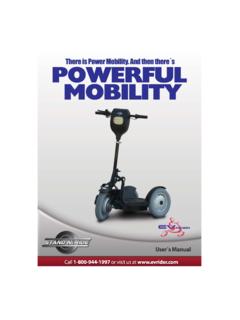
Transcription of Wheelchair Scooter Mobility Device Safety in ... - Oklahoma
1 WheelchairScooter& Mobility DeviceSafety inCentral OklahomaSafety Begins with you!Rules of the Road 3 How to Travel Safely 5 Safe Driving Tips 7 Scooter Basics 12 Transporting Scooters / wheelchairs 21 Scooter / Wheelchair Breakdown 22 Maintenance 23 Self-Assessment Checklist 24 Reference/Sources 25 Table of ContentsThis brochure is provided as informational only and does not constitute legal advice. The infor-mation contained herein may not be comprehensive or current. You are solely responsible for knowing and obeying the laws which pertain to you. This brochure only covers wheelchairs and scooters that fall within the definition of Wheelchair and may not apply to other power-driven Mobility devices , such as motorized scooters or electric personal assistive Mobility devices .2 Rules of the RoadPursuant to Oklahoma and Federal Law, when you are operating a Scooter / Wheelchair you have the same rights and duties applicable to pedestrians and are subject to the same rules.
2 (See 47 and 28 CFR (2011).You should review local and Oklahoma state laws that may be ap-plicable to your motorized Mobility devices such as motor vehicle laws. There are several general rules that users of Mobility devices mu st k n ow. Be smart, be safe, think Safety at all times when caring for and oper-ating your Mobility Device . Your personal Mobility Device is a battery-operated personal mobil-ity vehicle. Please exercise caution and consideration when you are operating it. Driving your Mobility Device carefully and thoughtfully will help ensure your personal Safety and the Safety of other people. Be familiar with local rules and statutes about operating your mo-torized Mobility Device . Generally, where a sidewalk is provided , it is unlawful for you to op-erate your Wheelchair / Scooter along the adjacent roadway.)
3 However, where sidewalks are not provided and when practicable; you can op-erate your Mobility Device only on the left side of the roadway or its shoulder facing traffic and shall to yield to vehicles. (See 47 11-506) You cannot use a road if a No Pedestrian sign is posted. Only cross streets at corner street crossings with careful attention to cross traffic. Drinking and driving is strongly discouraged. Alcohol related of-fenses such as public intoxication would apply. A motorized Mobility Device such as a motorized Wheelchair or Scooter is defined under Oklahoma law as any self-propelled vehicle, designed for and used by a person with a disability, that is incapable of a speed in excess of eight (8) miles per hour. (See 47 ) Your owner s manual is an important reference about safe use of your Mobility Device and should be referenced when you have a 3 question.
4 Do not exceed the weight requirements of your Mobility Device as listed in your owner s documentation. Do not tow. Do not give other people a lift. Do not leash lead an animal when on your Mobility Device . If your Device is equipped with a Safety restraint please use in accor-dance with the owner s manual. If your Mobility Device is equipped with batteries, these can be a Safety hazard; refer to your owner s manual for proper charging and storage. Your Mobility Device must be adjusted to you by a competent tech-nicianSpeed signs on pathways must be honored to provide a safe environ-ment for both the Mobility Device and pedestrians. 4 Safety Begins with you!How To Travel SafelyPlan your journey carefully You may be able to find a route that avoids busy intersections and allows you to keep to sidewalks. Travel along quieter streets, even if it means a longer journey.
5 Know where there are curb ramps or driveways that you can use for safe road crossings. Read you user manual carefully so you understand range and time of battery and charge. Where Can You Go? Be familiar with local rules and applicable laws. Generally a mobili-ty Device can be operated in areas open to pedestrian use, as long as general Safety rules are followed and the specification of the Mobility Device are not exceeded. This includes ramps, slopes and Yourself Assess yourself using the Self-Assess-ment Checklist to make sure you can satisfy all the basic requirements for Scooter / Wheelchair use. Check that any new medication will not impair your judgment and affect your driving skills. Always use a hat and sunscreen. Think about getting a shade cover if you travel long distances. Make sure that hats and clothing do not obstruct your vision or hearing when using the Scooter / Wheelchair .
6 Make yourself as visible as possible by wearing brightly colored clothing and something reflective at night. Safety vests are a good investment. If possible, carry a mobile phone for Habits Use the racks and baskets if applicable on your Scooter / Wheelchair to carry things rather than using your lap. Always keep your feet on the floor-pad when in motion. Lock the seat assembly before moving. Check that the rear view mirror has not been knocked or moved before moving off. Always turn the key to the OFF position when stopped or when getting on or off your Scooter / Wheelchair . Never make sharp turns at high speed. Slow down when coming to a turn. Never stop on an incline to rest or dismount. The Scooter /wheel-chair may roll or tip when you restart. When you are in a crowded area, : in a shopping mall, travel at the speed others are visibleBe aware that when you are travel-ing by Scooter you are at a height disadvantage to the other users of the road and sidewalk.
7 Make sure you and your Scooter have the fol-lowing Safety features:1. Brightly colored and/or reflec-tive clothing2. Reflective strips on front, sides and back of Scooter 3. Light on front of scooter4. Light on back of scooter5. Fluorescent orange bike flag attached to the back seat of the scooter6 Safety Begins with you!Safe Driving TipsKnow your Scooter / Wheelchair or Mobility Device On soft gravel or sand, take care when making turns and allow extra space to stop and start. Know the space required for your Scooter / Wheelchair manual for its rating for maximum slope gradient or incline. Keep within this rating and approach all slopes directly. It may be hard to judge slope, so always be cautious and Safety your Scooter / Wheelchair manual for the weight of the Device . Avoid temporary structures such as wooden platforms or ramps unless you are cer-tain they can withstand the combined weight of yourself and your Scooter / wheel chair.
8 Public conveyance and private taxi hoists may have a maximum load weight that they can accommodate, it is best to call navigate curbs and ramps approach slope straight up or down not at an Sidewalks Beware of vehicles backing out of driveways. When driving up behind a pedestrian, call out or honk the horn to let them know you are there. Some Mobility devices can travel very quiet and cannot be Bike Paths You are allowed to use dedicated cycle paths that are not on city streets, however, keep to the right and be aware of the high speed of some cyclists. Listen and if available use your rear view mirror to stay traffic the Road Use caution when operating your Scooter / Wheelchair on rough edges of roads. Avoid congested areas. Travel slowly, about walking pace, especially in busy areas. If you are able to walk short distances, it may be easier to leave your Scooter / Wheelchair outside stores or designated accessible restrooms.
9 When passing parked cars, watch out for doors or other vehicles moving without warning. Important to remember that drivers may not see Your Scooter / Wheelchair When parking your Scooter / Wheelchair remember to leave clear-ance around the Device for those trying to maneuver baby car-riages or shopping carts. You should try not to cause an obstruc-tion to other pedestrians. Remember to turn switch to off and take your key with you. Remember to park in a sheltered spot if Your Scooter / Wheelchair at Night If you use your Scooter / Wheelchair at night, lights and reflectors should be installed. We recommend: 1. A flashing or steady light clearly visible for 200 yards from the front. 2. A flashing or steady colored light clearly visible for 200 yards from the A red reflector clearly visible for 50 yards from the rear of the Scooter as reflected by a car s low Begins with you!
10 Crossing the Road When traffic-control signals are not in place or not in operation, the driver of a vehicle shall yield the right-of-way, slowing down or stopping to a person using a Mobility Device crossing the roadway within a crosswalk. (See 47 11-502) Every person operating a Scooter / Wheelchair that is crossing a roadway at any point other than within a marked crosswalk or within an unmarked crosswalk at an intersection shall yield the right-of-way to all vehicles upon the roadway. (See 47 11-503) You shall move, whenever practicable, upon the right half of cross-walks. (See 47 11-505) You should not cross the road without making sure you can get back onto the sidewalk on the other side of the road. Try to cross the road at traffic signals, cross walks, or an intersec-tion with stop signs. Drivers cannot always see you behind a parked car.