Transcription of Chapter 11 Acids and Bases Practice Problems Section 11.1 ...
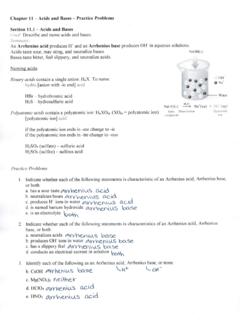
1 Chapter 11 Acids and Bases Practice Problems Section Acids and Bases Goal: Describe and name Acids and Bases . Summary: An Arrhenius acid produces H+ and an Arrhenius base produces OH- in aqueous solutions. Acids taste sour, may sting, and neutralize Bases . Bases taste bitter, feel slippery, and neutralize Acids . naming Acids : binary Acids contain a single anion: HnX. To name: hydro [anion with -ic end] acid HBr hydrobromic acid H2S hydrosulfuric acid Polyatomic Acids contain a polyatomic ion: HnXOm (XOm = polyatomic ion) [polyatomic ion] acid if the polyatomic ion ends in -ate change to -ic if the polyatomic ion ends in -ite change to -ous H2SO4 (sulfate) sulfuric acid H2SO3 (sulfite) sulfous acid Practice Problems 1.
2 Indicate whether each of the following statements is characteristic of an Arrhenius acid , Arrhenius base, or both: a. has a sour taste b. neutralizes Bases c. produces H+ ions in water d. is named barium hydroxide e. is an electrolyte 2. Indicate whether each of the following statements is characteristics of an Arrhenius acid , Arrhenius base, or both: a. neutralizes Acids b. produces OH- ions in water c. has a slippery feel d. conducts an electrical current in solution 3. Identify each of the following as an Arrhenius acid , Arrhenius base, or none: b. CsOH c. Mg(NO3)2 d. HClO4 e. HNO2 f. MgBr2 g. NH3 h. Li2SO3 4. Name each of the following Acids or Bases : a. HCl b. Ca(OH)2 c. HClO4 d. HNO3 e. H2SO3 5.
3 Name each of the following Acids or Bases : a. Al(OH)3 b. H2SO4 c. HBr d. KOH e. HNO2 f. HClO2 6. Write formulas for each of the following Acids or Bases : a. rubidium hydroxide b. hydrofluoric acid c. phosphoric acid d. lithium hydroxide e. ammonium hydroxide 7. Write formulas for each of the following Acids or Bases : a. barium hydroxide b. hydroiodic acid c. nitric acid d. acetic acid e. hypochlorous acid Section Bronsted-Lowery Acids Goal: Identify conjugate acid -base pairs for Bronsted-Lowry Acids and Bases . Summary: A Bronsted-Lowry acid donates H+ and a Bronsted-Lowry base accepts H+. Identifying Conjugate acid -Base Pairs According to Bronsted-Lowry theory, a conjugate acid -base pair consists of molecules or ions related by the loss of one H+ by an acid , an the gain of one H+ by a base.
4 Every acid -base reaction contains two conjugate acid -base pairs because an H+ is transferred in both the forward and reverse directions. When an acid such as HF loses one H+, the conjugate base F- is formed. When H2O acts as a base, it gains one H+, which forms its conjugate acid , H3O+. Practice Problems 8. Write the formula for the conjugate base for each of the following Acids : a. HCO3- b. HPO42- c. HBrO 9. Write the formula for the conjugate acid for each of the following Bases : a. CO32- b. H2O c. H2PO4- 10. In the following reaction, the acid -conjugate base pair is __i__ and the base-conjugate acid pair is __ii__. H3PO4(aq) + H2O(l) H2PO4-(aq) + H3O+(aq) a. (i) H3PO4/H3O+ (ii) H2O/H2PO4- b.
5 (i) H3PO4/H2O (ii) H2PO4-/H3O+ c. (i) H2O/H3O+ (ii) H3PO4/H2PO4- d. (i) H2O/H2PO4- (ii) H3PO4/H3O+ e. (i) H3PO4/H2PO4- (ii) H2O/H3O+ 11. In the following reaction, the acid -conjugate base pair is __i__ and the base-conjugate acid pair is __ii__. CO32-(aq) + H2O(l) HCO3-(aq) + OH-(aq) a. (i) CO32-/ H2O (ii) HCO3-/OH- b. (i) H2O/HCO3- (ii) CO32-/OH- c. (i) H2O/OH- (ii) CO32-/HCO3- d. (i) CO32-/OH- (ii) H2O/HCO3- e. (i) CO32-/HCO3- (ii) H2O/OH- 12. In the following reaction, the acid -conjugate base pair is __i__ and the base-conjugate acid pair is __ii__. H3PO4(aq) + NH3(aq) H2PO4-(aq) + NH4+(aq) a. (i) H3PO4/H2PO4- (ii) NH3/NH4+ b. (i) H3PO4/NH4+ (ii) NH3/H2PO4- c.
6 (i) H3PO4/NH3 (ii) H2PO4-/NH4+ d. (i) H2PO4-/H3PO4 (ii) NH4+/NH3 e. (i) NH3/NH4+ (ii) H3PO4/H2PO4- 13. Complete the following table: acid Conjugate Base HI Cl- NH4+ HS- 14. Complete the following table: Base Conjugate acid F- HC2H3O2 HSO3- ClO- 15. When ammonium chloride dissolves in water, the ammonium ion NH4+ donates an H+ to water. Write a balanced equation for the reaction of the ammonium ion with water. a. NH4+ + H2O NH3 + H3O+ b. NH4+ + H3O+ NH3 + H2O + H+ c. NH4+ + H3O+ NH3 + H2O + OH- d. NH3 + H2O NH2- + H3O+ e. NH3 + H3O+ NH4+ + H2O 16. When sodium carbonate dissolves in water, the carbonate ion CO32- acts as a base.
7 Write a balanced equation for the reaction of the carbonate ion with water. a. CO32- + H2O CO2 + H3O+ b. CO32- + H2O HCO3- + OH- c. CO32- + H2O H2CO4 d. CO32- + OH- CO32- + H2O e. CO32- + H2O H2CO3 Section Strengths of Acids and Bases Goal: Write equations for the dissociation of strong and weak Acids ; identify the direction of reaction. Summary: Strong Acids dissociate completely in water, and the H+ is accepted by H2O acting as a base. HCl + H2O H3O+ + Cl- A weak acid dissociates only slightly in water, producing only a small amount of H+ and therefore a small amount of H3O+ HI + H2O H3O+ + I- Strong Bases are hydroxides with metals from Groups 1 and 2 and dissociate completely in water.
8 (NaOH, Ca(OH)2, ..) An important weak base is ammonia, NH3. Understanding the Concepts: In diagrams A and B, determine if the diagram represents a strong acid or a weak acid . The acid has the formula HX. Practice Problems 17. Using Table , identify the stronger acid in each of the following pairs: a. NH4+ or H3O+ b. H2SO4 or HCl c. H2O or H2CO3 18. Using Table , identify the weaker acid in each of the following pairs: a. HCl or HSO4- b. HNO2 or HF c. HCO3- or NH4+ 19. Predict whether the following reaction contains mostly reactants or products at equilibrium: H2CO3(aq) + H2O(l) HCO3-(aq) + H3O+(aq) a. mostly products b. mostly reactants 20. Predict whether the following reaction contains mostly reactants or products at equilibrium: NH4+(aq) + H2O(l) NH3(aq) + H3O+(aq) a.
9 Mostly products b. mostly reactants 21. Predict whether the following reaction contains mostly reactants or products at equilibrium: HNO2(aq) + NH3(aq) NO2-(aq) + NH4+(aq) a. mostly products b. mostly reactants 22. Predict whether the following reaction contains mostly reactants or products at equilibrium: H3PO4(aq) + H2O(l) H3O+(aq) + H2PO4-(aq) a. mostly products b. mostly reactants Challenge Problems 23. a. Write the formula for the conjugate base of H2S b. Write the formula for the conjugate base of H3PO4 c. Which is the weaker acid : H2S or H3PO4? 24. a. Write the formula for the conjugate base of HCO3- b. Write the formula for the conjugate base of HC2H3O2 c.
10 Which is the stronger acid : HCO3- or HC2H3O2? Section Dissociation Constants for Acids and Bases Goal: Write the expression for the dissociation constant of a weak acid or weak base. Summary: In water, weak Acids and weak Bases produce only a few ions when equilibrium is reached. Weak Acids have small Ka values, whereas strong Acids , which are essentially 100% dissociated, have very large Ka values. The reaction for a weak acid can be written as HA + H2O H3O+ + A-. The acid dissociation constant expression is written as Ka = [H3O+][A ][HA] For a weak base the equation is B + H2O BH+ + OH-, and the base dissociation constant expression is written as Kb = [BH+][OH ][B] Practice Problems 25.