Transcription of 09 Biological Membranes - Vernier Software & …
1 Computer 9 Biology with Vernier 9 - 1 Biological Membranes The primary objective of this experiment is to determine the stress that various factors, such as osmotic balance, detergents, and pH, have on Biological Membranes . Membranes within cells are composed mainly of lipids and proteins. They often serve to help maintain order within a cell by containing cellular materials.
2 One type of vacuole in the cells of plants, the tonoplast, is quite large and usually contains water. In beet plants, this membrane -bound vacuole also contains a water soluble red pigment, betacyanin, that gives the beet its characteristic color. Since the pigment is water soluble and not lipid soluble, it is contained in the vacuole when the cells are healthy. If the integrity of a membrane is disrupted, however, the contents of the vacuole will spill out into the surrounding environment and color it red. This usually means the cell is dead. If beet Membranes are damaged, the red pigment will leak out into the surrounding environment. The intensity of color in the environment should be proportional to the amount of cellular damage.
3 You will test the effect of osmotic balance, detergents, and pH changes on Biological Membranes . The presence of certain salts is essential for most plant growth, but too much salt can kill plants. Even salts that are not transported across cell Membranes can affect plants by altering the osmotic balance. Osmosis is the movement of water across a semipermeable membrane from a region of low solute concentration to a region of higher solute concentration. It can greatly affect a cell s water content when the amount of water inside the cell is different than the amount outside the cell. You will test to see how this osmotic stress affects the cellular membrane integrity.
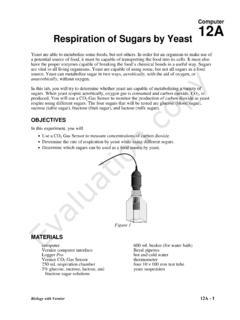
4 Detergents are designed to make lipids soluble in water. Since Biological Membranes are made of both lipids and water soluble materials, they are disrupted by detergents. You will design tests to determine the effect of this detergent on Biological Membranes . The pH of an environment is critical for living things. If the environment is too acidic or too basic, organisms cannot survive. You will design tests to determine the effect of pH on Biological Membranes . You will be using the Colorimeter or Spectrometer. In this device, blue light from the LED light source will pass through the solution and strike a photocell. The salt solutions used in this experiment are clear.
5 If the beet pigment leaks into the solution, it will color the solution red. A higher concentration of colored solution absorbs more light and transmits less light than a solution of lower concentration. The computer-interfaced Colorimeter or Spectrometer monitors the light received by the photocell as either an absorbance or a percentage transmittance value. The absorbance of light will be used to monitor the extent of cellular membrane damage. Figure 1 Evaluation copyComputer 9 9 - 2 Biology with Vernier OBJECTIVES In this experiment, you will Use a computer and a Colorimeter or Spectrometer to measure color changes due to disrupted cell Membranes .
6 Determine the effect of osmotic balance on Biological Membranes . Determine the effect of detergents on Biological Membranes . Determine the effect of pH on Biological Membranes . MATERIALS computer Beral pipet(s) to transfer solutions Vernier computer interface* forcepsLogger Pro knifeColorimeter or Spectrometer lab apron100 mL beaker pair of glovesthree 18 150 mm test tubes w/ rackpH buffer solutionsmicroplate, 24-well test tube racktwo 2 mL pipets ruler (cm)
7 Pipet pump or bulbtap water15% salt solution timer or stopwatchbeet root tissues (preferably lint free) cotton swabs toothpicksdetergent solution * Not necessary is using a Spectrometer PROCEDURE 1. Obtain and wear goggles, an apron, and gloves. Testing for the effect of osmotic stress 2. Obtain 10 mL of 15% salt solution and about 10 mL of tap water in labeled test tubes. 3. Prepare six salt solutions: 0%, 3%, 6%, 9%, 12%, and 15%. If your instructor has supplied graduated pipets with pipet pumps, add the mL of water specified in Table 1 to five of the six wells in the microwell plate. If your instructor has supplied Beral pipets, add the number of drops of water specified in Table 1 to each of four wells.
8 4. Use a different graduated pipet or Beral pipet to add 15% salt solution to five of the six wells in the microwell plate. See Table 1 to determine the volume of salt solution to add. 5. Clean the pipet used to transfer the salt solution. 6. Obtain a piece of beet from your instructor. Cut six squares, each cm cm cm in size. They should fit into a microwell easily, without being wedged in. Be sure that: there are no ragged edges. no piece has any of the outer skin on it. all of the pieces are the same size. the pieces do not dry out. Biological Membranes Biology with Vernier 9 - 3 7.
9 Rinse the beet pieces twice using a small amount of water. Immediately drain off the water. This will wash off any pigment released during the cutting process. Table 1 Well H2O 15% Salt Concentration number mL drops mL dropsof salt (%) 1 60 0 0 2 48 12 3 3 32 24 6 4 24 32 9 5 12 48 12 6 0 60 15 8.
10 Set the timer to 15 minutes and begin timing. Using forceps, add a piece of beet to each of the six well plates as shown in Figure 2. Stir the beet in the salt solution once every minute with a toothpick. Be careful not to puncture or damage the beet. While one team member is performing this step, another team member should proceed to Step 9. SaltSolutions0%3%6%9%12%15% Figure 2 9. Prepare a blank by filling a cuvette 3/4 full with distilled water. To correctly use a cuvette, remember: Wipe the outside of each cuvette with a lint-free tissue. Handle cuvettes only by the top edge of the ribbed sides. Dislodge any bubbles by gently tapping the cuvette on a hard surface.