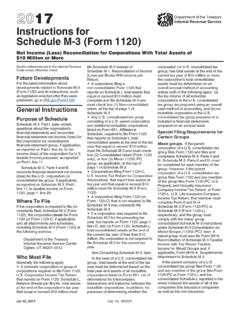
Transcription of 2020 Instructions for Form 8606 - IRS
1 Userid: CPMS chema: instrxLeadpct: 100%Pt. size: Draft Ok to PrintAH XSL/XMLF ileid: .. ions/I8606/2018/A/XML/Cycle05/source(Ini t. & Date) _____Page 1 of 10 16:56 - 17-Jan-2019 The type and rule above prints on all proofs including departmental reproduction proofs. MUST be removed before for form 8606 Nondeductible IRAsDepartment of the TreasuryInternal Revenue ServiceSection references are to the Internal Revenue Code unless otherwise InstructionsFuture DevelopmentsFor the latest information about developments related to 2018 form 8606 and its Instructions , such as legislation enacted after they were published, go to 's NewForm 1040A has been retired. form 1040A is not in use for years after 2017. All references to the form have been removed or AGI limit for Roth IRA con-tributions increased. You can contribute to a Roth IRA for 2018 only if your 2018 modified adjusted gross income (AGI) for Roth IRA purposes is less than: $199,000 if married filing jointly or qualifying widow(er); $135,000 if single, head of household, or married filing separately and you didn t live with your spouse at any time in 2018; or $10,000 if married filing separately and you lived with your spouse at any time in Roth IRAs, date for contributions.
2 The due date for making contributions for 2018 to your IRA for most people is Monday, April 15, 2019. If you live in Maine or Massachusetts, you have until Wednesday, April 17, 2019, because of the Patriots Day holiday in those states and the Emancipation Day holiday in the District of the time this publication went to print, Congress was considering legislation that would do the additional tax relief for those affected by certain 2018 certain tax benefits that expired at the end of 2017 and that currently can't be claimed on your 2018 tax ! certain other tax learn whether this legislation was enacted resulting in changes that affect your 2018 tax return, go to and recharacterizations of conver-sions made in 2018 or later. A conversion of a traditional IRA to a Roth IRA, and a rollover from any other eligible retirement plan to a Roth IRA, made after December 31, 2017, cannot be recharacterized as having been made to a traditional IRA. For more information, see Recharacterizations, of FormUse form 8606 to report: Nondeductible contributions you made to traditional IRAs; Distributions from traditional, SEP, or SIMPLE IRAs, if you have ever made nondeductible contributions to traditional IRAs; Conversions from traditional, SEP, or SIMPLE IRAs to Roth IRAs; and Distributions from Roth information.
3 For more details on IRAs, see Pub. 590-A, Contributions to Individual Retirement Arrangements (IRAs); and Pub. 590-B, Distributions from Individual Retirement Arrangements (IRAs).If you received distributions from a traditional, SEP, or SIMPLE IRA in 2018 and you have never made nondeductible contributions (including nontaxable amounts you rolled over from a qualified retirement plan) to traditional IRAs, don t report the distributions on 2018 form 8606 . Instead, see the Instructions for form 1040, lines 4a and 4b; or form 1040NR, lines 17a and 17b. Also, to find out if any of your contributions to traditional, SEP, or SIMPLE IRAs are deductible, see the Instructions for Schedule 1 ( form 1040), line 32; or form 1040NR, line Must FileFile form 8606 if any of the following apply. You made nondeductible contributions to a traditional IRA for 2018, including a repayment of a qualified reservist distribution. You received distributions from a traditional, SEP, or SIMPLE IRA in 2018 and your basis in traditional IRAs is more than zero.
4 For this purpose, a distribution doesn t include a distribution that is rolled over (other than a repayment of a qualified 2017 disaster distribution (see 2018 form 8915B)), qualified charitable distribution, one-time distribution to fund an HSA, conversion, recharacterization, or return of certain contributions. You converted an amount from a traditional, SEP, or SIMPLE IRA to a Roth IRA in 2018. You received distributions from a Roth IRA in 2018 (other than a rollover, recharacterization, or return of certain contributions see the Instructions for Part III, later). You received a distribution from an inherited traditional IRA that has a basis, or you received a distribution from an inherited Roth IRA that wasn t a qualified distribution. You may need to file more than one form 8606 . See IRA with basis under What if You Inherit an IRA? in Pub. 590-B for more If you recharacterized a 2018 Roth IRA contribution as a traditional IRA contribution, or vice versa, treat the contribution as having been made to the second IRA, not the first IRA.
5 See Recharacterizations, don t have to file form 8606 solely to report regular contributions to Roth IRAs. But see What Records Must I Keep, and Where To FileFile 2018 form 8606 with your 2018 form 1040 or 1040NR by the due date, including extensions, of your you aren t required to file an income tax return but are required to file form 8606 , sign form 8606 and send it to the IRS at the same time and place TIPJan 17, 2019 Cat. No. 25399 EPage 2 of 10 Fileid: .. ions/I8606/2018/A/XML/Cycle05/source16:5 6 - 17-Jan-2019 The type and rule above prints on all proofs including departmental reproduction proofs. MUST be removed before would otherwise file form 1040 or 1040NR. Be sure to include your address on page 1 of the form and your signature and the date on page 2 of the IRAsA qualified employer plan (retirement plan) can maintain a separate account or annuity under the plan (a deemed IRA) to receive voluntary employee contributions. If in 2018 you had a deemed IRA, use the rules for either a traditional IRA or a Roth IRA depending on which type it was.
6 See Pub. 590-A for more IRAsFor purposes of form 8606 , a traditional IRA is an individual retirement account or an individual retirement annuity other than a SEP, SIMPLE, or Roth An overall contribution limit applies to traditional IRAs and Roth IRAs. See Overall Contribution Limit for Traditional and Roth IRAs, later. Contributions to a traditional IRA may be fully deductible, partially deductible, or completely Your basis in traditional, SEP, and SIMPLE IRAs is the total of all your nondeductible contributions and nontaxable amounts included in rollovers made to these IRAs minus the total of all your nontaxable distributions, adjusted if necessary (see the Instructions for line 2, later).Keep track of your basis to figure the nontaxable part of your future IRAsA simplified employee pension (SEP) is an employer-sponsored plan under which an employer can make contributions to traditional IRAs for its employees. If you make contributions to that IRA (excluding employer contributions you make if you are self-employed), they are treated as contributions to a traditional IRA and may be deductible or nondeductible.
7 SEP IRA distributions are reported in the same manner as traditional IRA IRAsA SIMPLE IRA plan is a tax-favored retirement plan that certain small employers (including self-employed CAUTION!individuals) can set up for the benefit of their employees. Your participation in your employer's SIMPLE IRA plan doesn t prevent you from making contributions to a traditional or Roth IRAsA Roth IRA is similar to a traditional IRA, but has the following features. Contributions are never deductible. Contributions can be made after the owner reaches age 701/2. No minimum distributions are required during the Roth IRA owner's lifetime. Qualified distributions aren t includible in distribution. Generally, a qualified distribution is any distribution from your Roth IRA that meets the following is made after the 5-year period beginning with the first year for which a contribution was made to a Roth IRA (including a conversion or a rollover from a qualified retirement plan) set up for your benefit, distribution is or after the date you reach age 591/2, your death, to your disability, qualified first-time homebuyer You can contribute to a Roth IRA for 2018 only if your 2018 modified AGI for Roth IRA purposes is less than: $199,000 if married filing jointly or qualifying widow(er); $135,000 if single, head of household, or if married filing separately and you didn t live with your spouse at any time in 2018; or $10,000 if married filing separately and you lived with your spouse at any time in the Maximum Roth IRA Contribution Worksheet to figure the maximum amount you can contribute to a Roth IRA for 2018.
8 If you are married filing jointly, complete the worksheet separately for you and your you contributed too much to your Roth IRA, see Recharacterizations, !Modified AGI for Roth IRA purposes. First, figure your AGI ( form 1040, line 7; or form 1040NR, line 35). Then, refigure it the IRA conversions included on form 1040, line 4b; or form 1040NR, line IRA rollovers from qualified retirement plans included on form 1040, line 4b; or form 1040NR, line the deduction from Schedule 1 ( form 1040), line 32; or form 1040NR, line loan interest deduction from Schedule 1 ( form 1040), line 33; or form 1040NR, line production activities deduction included on Schedule 1 ( form 1040), line 36; or form 1040NR, line For 2018, the DPAD deduction is only for certain taxpayers who have a DPAD from fiscal-year pass-through of interest from form 8815, Exclusion of Interest From Series EE and I Savings Bonds Issued After of employer-provided adoption benefits from form 8839, Qualified Adoption earned income exclusion from form 2555, Foreign Earned Income; or form 2555-EZ, Foreign Earned Income housing exclusion or deduction from form the time these Instructions went to print, the deduction for qualified tuition and fees had expired.
9 To find out if legislation extended this deduction, go to figuring modified AGI for Roth IRA purposes, you may have to refigure items based on modified AGI, such as taxable social security benefits and passive activity losses allowed under the special allowance for rental real estate activities. See Can You Contribute to a Roth IRA? in Pub. 590-A for See the Instructions for Part III, !CAUTION!-2- Instructions for form 8606 (2018)Page 3 of 10 Fileid: .. ions/I8606/2018/A/XML/Cycle05/source16:5 6 - 17-Jan-2019 The type and rule above prints on all proofs including departmental reproduction proofs. MUST be removed before Contribution Limit for Traditional and Roth IRAsIf you aren t married filing jointly, your limit on contributions to traditional and Roth IRAs is generally the smaller of $5,500 ($6,500 if age 50 or older at the end of 2018) or your taxable compensation (defined below).If you are married filing jointly, your contribution limit is generally $5,500 ($6,500 if age 50 or older at the end of 2018) and your spouse's contribution limit is $5,500 ($6,500 if age 50 or older at the end of 2018) as well.
10 But if the combined taxable compensation of both you and your spouse is less than $11,000 ($12,000 if one spouse is 50 or older at the end of 2018; $13,000 if both spouses are 50 or older at the end of 2018), see Kay Bailey Hutchison Spousal IRA Limit in Pub. 590-A for special limit doesn t apply to employer contributions to a SEP or SIMPLE Rollovers, Roth IRA conversions, Roth IRA rollovers from qualified retirement plans and repayments of qualified 2017 disaster distributions (see form 8915B and its Instructions ), and qualified reservist distributions don t affect your contribution amount you can contribute to a Roth IRA also may be limited by your modified AGI (see Contributions, earlier, and the Maximum Roth IRA Contribution Worksheet).Taxable compensation. Taxable compensation includes the following. Wages, salaries, tips, etc. If you received a distribution from a nonqualified deferred compensation plan or nongovernmental section 457 plan that is included in form W-2, box 1, or in form 1099-MISC, box 7, don t include that distribution in taxable compensation.