Transcription of Capital Adequacy Framework (Capital Components)
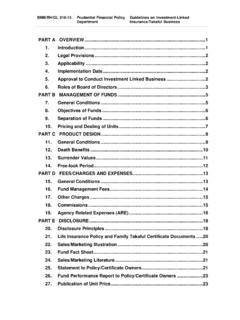
1 Capital Adequacy Framework ( Capital Components). Issued on: 28 November 2012. BNM/RH/GL 001-35 Prudential Financial Policy Department Capital Adequacy Framework ( Capital Components). PART A Overview .. 1 1. Introduction .. 1 2. Applicability .. 1 3. Legal provisions .. 2 4. Issuance date .. 2 5. Effective 2 6. Level of application .. 2 PART B General Requirements .. 4 7. Capital Adequacy ratios .. 4 8. Minimum Capital Adequacy requirements .. 5 9. Capital buffer requirements .. 5 PART C Components of Capital .. 7 10. Common Equity Tier 1 Capital .. 7 11. Additional Tier 1 Capital .. 7 12. Tier 2 Capital .. 8 PART D Criteria for Inclusion in Capital .
2 10 13. Ordinary shares .. 10 14. Additional Tier 1 Capital instruments .. 12 15. Tier 2 Capital instruments .. 15 16. Minority interest and Capital instruments issued out of consolidated subsidiaries and held by third parties .. 17 PART E Regulatory Adjustments .. 22 17. Goodwill and other intangibles .. 22 18. Deferred tax assets and 22 19. Property revaluation gains/losses .. 23 20. Cumulative gains/losses of financial instruments classified as available-for-sale . or designated at fair value .. 24 21. Profit equalisation reserve .. 24 22. Cash flow hedge reserve .. 24 23. Regulatory reserve for loans/financing .. 25 24. Shortfall of eligible provisions to expected losses.
3 25 25. Valuation adjustments .. 25 26. Increases in equity Capital resulting from a securitisation transaction .. 26 BNM/RH/GL 001-35 Prudential Financial Policy Department Capital Adequacy Framework ( Capital Components). 27. Cumulative gains/losses due to changes in own credit risk on fair valued liabilities .. 26 28. Defined benefit pension fund assets and liabilities .. 26 29. Investments in own Capital instruments .. 27 30. Investments in the Capital of unconsolidated financial and insurance/takaful entities .. 28 31. Other requirements .. 30 PART F Other Requirements .. 31 32. Requirements to ensure loss absorbency at the point of non-viability.
4 31 33. Write-off or conversion mechanisms for achieving principal loss absorption and/or loss absorbency at the point of non-viability .. 33 34. Disclosure requirements .. 35 35. Regulatory process and submission requirements .. 35 36. Transitional 38 45 Appendix 1 General treatment of equity investments .. 45 Appendix 2 Illustrative example on minority interest and Capital instruments issued out of consolidated subsidiaries held by third parties .. 46 Appendix 3 Transitional arrangements for Capital instruments .. 49 Appendix 4 Illustrative example on the gradual phase-out treatment .. 51 Appendix 5 Write-off mechanism for Tier 2 Capital instruments structured using exchange-based contracts.
5 53 BNM/RH/GL 001-35 Prudential Financial Policy Capital Adequacy Framework Page 1/53. Department ( Capital Components). PART A OVERVIEW. 1. Introduction Regulatory Capital requirements seek to ensure that risk exposures of a banking institution are backed by an adequate amount of high quality Capital which absorbs losses on a going concern basis. This ensures the continuing ability of a banking institution to meet its obligations as they fall due while also maintaining the confidence of customers, depositors, creditors and other stakeholders in their dealings with the institution. Capital requirements also seek to further protect depositors and other senior creditors in a gone concern situation by promoting an additional cushion of assets that can be used to meet claims in liquidation.
6 The Capital Adequacy Framework sets out the approach for computing regulatory Capital Adequacy ratios, as well as the levels of those ratios at which banking institutions are required to operate. The Framework has been developed based on internationally-agreed standards on Capital Adequacy promulgated by the Basel Committee on Banking Supervision (BCBS). This document sets out the general requirements concerning regulatory Capital Adequacy , and the components of eligible regulatory Capital . It shall be read together with the Capital Adequacy Framework (Basel II Risk- Weighted Assets) which details out the requirements for computing risk- weighted assets.
7 2. Applicability The Framework is applicable to all banking institutions licensed under the Banking and Financial Institutions Act 1989 (BAFIA). BNM/RH/GL 001-35 Prudential Financial Policy Capital Adequacy Framework Page 2/53. Department ( Capital Components). 3. Legal provisions The Framework is issued pursuant to section 37 of the BAFIA. 4. Issuance date The Capital Adequacy Framework was first issued on 4 August 1989, with amendments and additional requirements introduced subsequently. This document was last updated on 28 November 2012. 5. Effective date The requirements in this document take effect on 1 January 2013, and are subject to the transition arrangements as set out in paragraphs to 6.
8 Level of application A banking institution is required to comply with the Capital Adequacy Framework at the following levels: i. entity level1, referring to the global operations of the banking institution ( including its overseas branch operations) on a stand-alone basis, and including its Labuan banking subsidiary; and ii. consolidated level, which includes entities covered under the entity level requirement, and the consolidation 2 of all subsidiaries 3 , except 1. Also referred to as the solo or stand-alone level. 2. In accordance with the Malaysian Financial Reporting Standards (MFRS). 3. Financial and non-financial subsidiaries.
9 A financial entity refers to any entity, whether incorporated in Malaysia or otherwise, engaged substantively in, or acquiring holdings in other entities engaged substantively in, any of the following activities: banking, provision of credit, securities broking, fund management, asset management, leasing and factoring and similar activities that are ancillary to the conduct of these activities. BNM/RH/GL 001-35 Prudential Financial Policy Capital Adequacy Framework Page 3/53. Department ( Capital Components). insurance/takaful subsidiaries which shall be deducted in the calculation of Common Equity Tier 1 Capital4. Where consolidation of the subsidiaries required under paragraph (ii) is not feasible5, banking institutions may instead, seek the Bank's approval to: i.
10 In the case of financial entities, deduct such investments in accordance with paragraph ; and ii. in the case of non-financial entities, apply a risk weight of 1250% to such investments in accordance with paragraphs , and of the Capital Adequacy Framework (Basel II Risk-Weighted Assets). In addition to paragraph (i), a banking institution carrying on Skim Perbankan Islam 6 (hereafter referred to as an SPI ), shall comply with the requirements under the Capital Adequacy Framework for Islamic Banks ( Capital Components) at the level of the SPI, as if it were a stand-alone Islamic bank. The above treatment, as well as that applicable for other equity investments, is summarised in Appendix 1.