Example: dental hygienist
Ch. 11: EDTA Titrations
The equilibrium constant for the reaction of a metal with a ligand is called the formation constant, Kf, or the stability constant: In many transition metal complexes, EDTA engulfs the metal ion, forming the six-coordinate species. If you build a space-filling model of a six-coordinate metal-EDTA complex, you find strain in the chelate rings.
Tags:
Information
Domain:
Source:
Link to this page:
Documents from same domain

Ch. 5: Quality Assurance & Calibration Methods
chem320.cs.uwindsor.caDetection of Analyte There are three very important considerations when deciding upon the analytical method to be used for the detection of a particular analyte.

Ch. 10: Acid-Base Titrations
chem320.cs.uwindsor.caTitration: Weak Acid with Strong Base We will consider the titration of 50.00 mL of 0.02000 M MES with 0.1000 M NaOH. MES is an abbreviation for 2-(N-morpholino)ethanesulfonic acid, which is a weak acid with pKa = 6.27. This the reverse of the Kb reaction for the base A−.Therefore, the equilibrium constant for is K = 1/Kb = 1/(Kw/Ka (for HA)) = 5.4 × 10⁷.

Ch. 26: Gravimetric Analysis
chem320.cs.uwindsor.careacting with the precipitant. e.g., In the gravimetric analysis of Be2+, Mg2+, Ca2+ or Ba2+ with the reagent N-p-chlorophenylcinnamohydroxamic acid, impurities such as Ag+, Mn2+, Zn2+, Cd2+, Hg2+, Fe2+, and Ga3+ are kept in solution by excess KCN. Post-precipitation: Impurities collect on the pure precipitated product while it is standing in the
Related documents

Dissolvine GL technical brochure - Nouryon
www.nouryon.com* A.E. Martell, R.M. Smith, NIST Critically selected stability constants of metal complexes (NIST standard reference database 46, Version 7.0, 2003) pK a values: as determined at an ionic strength of 0.1M and at a tempera-ture of 25° C, or if not available at 20° C. Figure 4: The ion species distribution for GLDA.

Chapter 12 EDTA Titrations - Cal State LA
www.calstatela.eduCoordinate Complexes EDTA Complexes • EDTA forms 1:1 complexes with most metals (Not with Group 1A metals) • EDTA complexes are usually stable water soluble complexes with high formation constants • Formation constant, K f, (or stability constant): • K f could have been defined for any form of EDTA [ ] [ ][ ]+ --+ - + « - = 4 4 f 4 M Y ...

Form and Stability of Aluminum Hydroxide Complexes in ...
pubs.usgs.govanion A1(OH) 4~. However, stability constants generally were obtained only for the species A1OH+2 and A1(OH) 4~ and fo^ the crystalline solid. In recent years, polynuclear complexes have frequently been postulated, with more than one metal atom in the simplest possible representation of the formula of the complex.

Precipitation and Crystallization Processes
www.cresp.orgFor the actinide metal ion precipitations to be reviewed briefly below, limiting the amount of ... formation of soluble anionic complexes of the actinide that reduce the yield of the product. The ... stability constants for the metal species in solution.

Chelates: What They Are and How/Where They Fit
fluidfertilizer.org1 R.M Smith; A.E. Martell, Crtical Stability Constants, Plenum Press, New York and London, 3rd Edition. Citric acid is natural biodegradable chelator. Because of its carboxyl groups, citric acid chelates / complexes metals in the acidic environment. Often used for formulation stability and foliar applicactions Citrate pKa Log Kf pK 3 6.1 6.1 pK ...

Principles of Biochemistry Introductory Series
www.qmul.ac.uk• Energy barriers and rate constants • Measuring Km and Vmax • The Lineweaver-Burk plot Lecture 9: Enzyme kinetics (Michaelis-Menten) ... • Metal ions • Coenzymes • Control of enzyme concentration (synthesis, degradation) ... (Complexes I to IV)
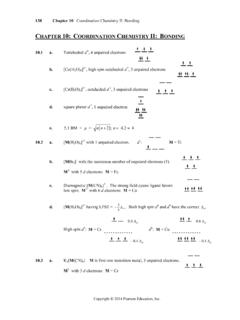
CHAPTER 10: COORDINATION CHEMISTRY II: BONDING
www.chem.uci.eduIn general, stability constants decrease as more ligands are added; the sequence for nickel is the common one. The huge drop in stability constant between the second and third ethylenediamine on Cu2+ is a result of the d 9 Jahn-Teller effect. The first two en ligands add in a square-planar geometry, with water molecules in the axial positions,

ANALYSIS OF CYANIDE
cdn.ymaws.comAll free cyanide, all dissociable cyanide complexes (i.e.WAD Cyanide),and all strong metal cyanide complexes including ferro-cyanide Fe(CN)6-4, ferri-cyanide Fe(CN)6-3, and portions of hexacyanocobaltate Co(CN)6-3 as well as portions of cyanide compounds containing gold …
B.Sc. - FIRST YEAR
mjpru.ac.instability and carbon-carbon bond lengths of benzene, resonance structure, MO picture. Aromaticity: The Huckle rule, aromatic ions. Aromatic electrophilic substitution – general pattern of the mechanism, role of σ and π complexes, Mechanism of nitration, halogenation, sulphonation, mercuration and …
Chemistry of Iron in Natural Water - USGS
pubs.usgs.govThe inorganic complexes most likely to be found in natural waters are those formed with chloride, fluoride, phosphate, sulfate, and carbonate ions. Organic complexes also may be present. The ferrous oxidation state, less strong in its complexing properties than the ferric, forms few inorganic complexes. Ferrous hydroxide,