Transcription of Chapter 5: JOINT PROBABILITY DISTRIBUTIONS Part 1 ...
1 Chapter 5: JOINT PROBABILITYDISTRIBUTIONSPart 1: Sections to bothdiscreteandcontinuousrandom variables wewill discuss the JOINT DISTRIBUTIONS (for two or s) Marginal DISTRIBUTIONS (computed from a JOINT distribution ) Conditional DISTRIBUTIONS ( (Y=y|X=x)) Independence sXandYThis is a good time to refresh yourmemory on double-integration. Wewill be using this skill in the upcom-ing a discreteprobability distribution (orpmf) for a Xwith the example (x) we re simultaneously interested intwo or more variables in a random re looking for a relationshipbetween the for s Year in college vs. Number of credits taken Number of cigarettes smoked per day vs.
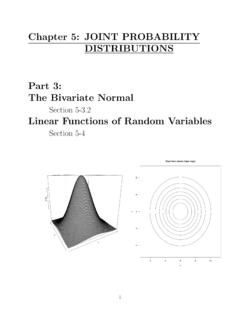
2 Dayof the weekExamples for s Time when bus driver picks you up of caffeine in bus driver s system Dosage of a drug (ml) vs. Blood compoundmeasure (percentage)2In general, ifXandYare two random variables,the PROBABILITY distribution that defines their si-multaneous behavior is called a JOINT here as a table for two discrete randomvariables, which givesP(X=x,Y=y).x12310 1/6 1/6y21/6 0 1/631/6 1/6 0 Shown here as a graphic for two continuous ran-dom variables asfX,Y(x,y).3 IfXandYare discrete, this distribution can bedescribed with a JOINT PROBABILITY mass continuous, this distribution canbe described with a JOINT PROBABILITY density function. Example: Plastic covers for CDs(Discrete JOINT pmf)Measurements for the length and width of arectangular plastic covers for CDs are roundedto the nearestmm(so they are discrete).
3 LetXdenote the length andYdenote the possible values ofXare 129, 130, and131mm. The possible values ofYare 15 and16mm(Thus, bothXandYare discrete).4 There are 6 possible pairs (X,Y).We show the PROBABILITY for each pair in thefollowing table:x=length129 130 131y= sum of all the probabilities is combination with the highest probabil-ity is (130,15).The combination with the lowest probabilityis (131,16).The JOINT PROBABILITY mass functionis the func-tionfXY(x,y) =P(X=x,Y=y). Forexample, we havefXY(129,15) = we are given a JOINT PROBABILITY distributionforXandY, we can obtain the individual prob-ability distribution forXor forY(and theseare called theMarginal PROBABILITY Dis-tributions).
4 Example: Continuing plastic covers for CDsFind the PROBABILITY that a CD cover haslength of 129mm( 129).x= length129130 131y= (X= 129) =P(X= 129 andY= 15)+P(X= 129 andY= 16)= + = is the PROBABILITY distribution ofX?6x= length129130131y= PROBABILITY distribution forXappearsin the column (x) NOTE: We ve used a subscriptXin the probabilitymass function ofX, orfX(x), for clarification sincewe re considering more than one variable at a can do the same for theYrandom variable:rowx= lengthtotals129130131y= (y) the the PROBABILITY mass functions forXandYappear in the marginsof the table( column and row totals), they are often re-ferred to as theMarginal there are two random variables of inter-est, we also use the termbivariate probabil-ity distributionorbivariate distributionto refer to the JOINT JOINT PROBABILITY Mass FunctionThe JOINT PROBABILITY mass functionof the dis-crete random variablesXandY, denoted asfXY(x,y), satisfies(1)fXY(x,y) 0(2) x yfXY(x,y) = 1(3)fXY(x,y) =P(X=x,Y=y)For when the s are discrete.
5 (Often shown with a 2-way table.)x= length129 130 131y= Marginal PROBABILITY Mass FunctionIfXandYare discrete random variableswith JOINT PROBABILITY mass functionfXY(x,y),then the marginal PROBABILITY mass functionsofXandYarefX(x) = yfXY(x,y)andfY(y) = xfXY(x,y)where the sum forfX(x) is over all points inthe range of (X,Y) for whichX=xand thesum forfY(y) is over all points in the rangeof (X,Y) for whichY= found the marginal distribution forXin theCD example (x) : When asked forE(X) orV(X) ( val-ues related to only 1 of the 2 variables) but youare given a JOINT PROBABILITY distribution , firstcalculate the marginal distributionfX(x) andwork it as we did before for the univariate case( for a single random variable).
6 Example: BatteriesSuppose that 2 batteries are randomly cho-sen without replacement from the followinggroup of 12 batteries:3 new4 used (working)5 defectiveLetXdenote the number of new the number of used ) FindfXY(x,y){ the JOINT PROBABILITY distribution }.b) FindE(X).ANS:a) ThoughXcan take on values 0, 1, and 2,andYcan take on values 0, 1, and 2, whenwe consider them jointly,X+Y 2. So,not all combinations of (X,Y) are are 6 possible : no new, no used (so all defective)fXY(0,0) =(52)(122)= 10/6612 CASE: no new, 1 usedfXY(0,1) =(41)(51)(122)= 20/66 CASE: no new, 2 usedfXY(0,2) =(42)(122)= 6/66 CASE: 1 new, no usedfXY(1,0) =(31)(51)(122)= 15/6613 CASE: 2 new, no usedfXY(2,0) =(32)(122)= 3/66 CASE: 1 new, 1 usedfXY(1,1) =(31)(41)(122)= 12/66 The JOINT distribution number ofnewchosen012y=number of010/6615/66 3/66used120/6612/66chosen26/66 There are 6 possible (X,Y) , x yfXY(x,y) = ) FindE(X).
7 15 JOINT PROBABILITY Density FunctionA JOINT PROBABILITY density functionfor thecontinuous random variableXandY, de-noted asfXY(x,y), satisfies the (x,y) 0 for all x, y2. fXY(x,y)dx dy= 13. For any regionRof 2-D spaceP((X,Y) R) = RfXY(x,y)dx dyFor when the s are Example: Movement of a particleAn article describes a model for the move-ment of a particle. Assume that a particlemoves within the regionAbounded by thexaxis, the linex= 1, and the liney=x. Let(X,Y) denote the position of the particle ata given time. The JOINT density ofXandYis given byfXY(x,y) = 8xyfor(x,y) Aa) Graphically show the region in theXYplane wherefXY(x,y) is PROBABILITY density functionfXY(x,y)is shown graphically the information thatfXY(x,y) = 0for (x,y) outside ofA, we could plot the fullsurface, but the particle is only found in thegiven triangleA, so the JOINT PROBABILITY den-sity function is shown on the gives a volume under the surface that isabove the regionAequal to (x,y)xyf(x,y)Not apdfApdf18b) FindP( < X <1,0< Y < )c) FindP(0< X < ,0< Y < )19d) FindP( < X <1, < Y <1)
8 20 Marginal PROBABILITY DensityFunctionIfXandYare continuous random variableswith JOINT PROBABILITY density functionfXY(x,y),then the marginal density functionsforXandYarefX(x) = yfXY(x,y)dyandfY(y) = xfXY(x,y)dxwhere the first integral is over all points inthe range of (X,Y) for whichX=x, andthe second integral is over all points in therange of (X,Y) for whichY= :E(X) andV(X) can be obtained byfirst calculating the marginal PROBABILITY distri-bution ofX, orfX(x).21 Example: Movement of a particleAn article describes a model for the move-ment of a particle. Assume that a particlemoves within the regionAbounded by thexaxis, the linex= 1, and the liney=x.
9 Let(X,Y) denote the position of the particle ata given time. The JOINT density ofXandYis given byfXY(x,y) = 8xyfor(x,y) Aa) FindE(X)22 Conditional PROBABILITY DistributionsRecall for eventsAandB,P(A|B) =P(A B)P(B)We now apply this conditioning to random random variablesXandYwith jointprobabilityfXY(x,y), the conditionalprobability distributionofYgivenX=xisfY|x(y) =fXY(x,y)fX(x)forfX(x)> conditionalprobability can be statedas thejointprobability over : we can definefX|y(x) in a similar manner if we areinterested in that conditional Example: Continuing the plastic ) Find the PROBABILITY that a CD cover hasa length of 130mmGIVEN the width :P(X= 130|Y= 15) =P(X=130,Y=15)P(Y=15)= ) Find the conditional distribution ofXgivenY= (X= 129|Y= 15) = = (X= 130|Y= 15) = = (X= 131|Y= 15) = = you re GIVEN thatY=15, you re in a different space.
10 For the subset of the covers with a width of15mm, how are the lengths (X) conditional distribution ofXgivenY=15,orfX|Y=15(x):x129 130 131fX|Y=15(x) sum of these probabilities is 1, and thisis a legitimate PROBABILITY distribution . NOTE: Again, we use the subscriptX|Yfor clarityto denote that this is a conditional conditional PROBABILITY distributionfY|x(y)has the following properties are satisfied: For discrete random variables (X,Y)(1)fY|x(y) 0(2) yfY|x(y) = 1(3)fY|x(y) =P(Y=y|X=x) For continuous random variables (X,Y) |x(y) 02. fY|x(y)dy= (Y B|X=x) = BfY|x(y)dyfor any setBin the range ofY26 Conditional Mean and Variancefor DISCRETE random variablesThe conditional meanofYgivenX=x, de-noted asE(Y|x) or Y|xisE(Y|x) = yyfY|X(y) = Y|xand the conditional varianceofYgivenX=x, denoted asV(Y|x) or 2Y|xisV(Y|x) = y(y Y|x)2fY|X(y)= yy2fY|X(y) 2Y|x=E(Y2|x) [E(Y|x)]2= 2Y|x27 Example: Continuing the plastic 130 131y= ) Find theE(Y|X= 129) andV(Y|X= 129).