Transcription of CHAPTER 6 BUILDING SERVICES AND SYSTEMS - …
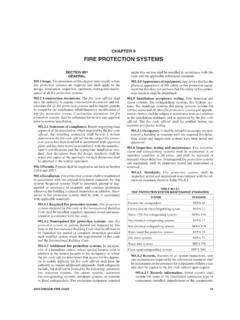
1 CHAPTER 6 BUILDING SERVICES AND SYSTEMSSECTION provisions of this CHAPTER shall apply to theinstallation, operation and maintenance of fuel-fired appli-ances and heating SYSTEMS , emergency and standby power sys-tems, electrical SYSTEMS and equipment, mechanicalrefrigeration SYSTEMS , elevator recall, stationary storage batterysystems and commercial kitchen shall be obtained for refrigeration sys-tems and battery SYSTEMS as set forth in Sections following words and terms shall, for thepurposes of this CHAPTER and as used elsewhere in this code,have the meanings shown system , STATIONARY sys-tem which consists of three interconnected subsystems:1.
2 A lead-acid A battery A collection of rectifiers, inverters, converters and asso-ciated electrical equipment as required for a TYPESL ithium-ion storage battery that consists of lith-ium ions embedded in a carbon graphite or nickel metal-oxide substrate. The electrolyte is a carbonate mixture or agelled polymer. The lithium ions are the charge carriers ofthe metal polymer storage battery that iscomprised of nonaqueous liquid or polymerized electro-lytes, which provide ionic conductivity between lithiatedpositive active material electrically separated from metalliclithium or lithiated negative active cadmium (Ni-Cd)
3 Alkaline storage bat-tery in which the positive active material is nickel oxide, thenegative contains cadmium and the electrolyte is storage battery in which,under conditions of normal use, hydrogen and oxygen gas-ses created by electrolysis are vented into the air outside ofthe storage battery in which, underconditions of normal use, hydrogen and oxygen gases cre-ated by electrolysis are converted back into water inside thebattery instead of venting into the air outside of the storage group of electrochemicalcells interconnected to supply a nominal voltage of DCpower to a suitably connected electrical load, designed forservice in a permanent location.
4 The number of cells con-nected in a series determines the nominal voltage rating ofthe battery. The size of the cells determines the dischargecapacity of the entire battery. After discharge, it may berestored to a fully charged condition by an electric currentflowing in a direction opposite to the flow of current whenthe battery is lead-acid (VRLA) lead-acidbattery consisting of sealed cells furnished with a valve thatopens to vent the battery whenever the internal pressure ofthe battery exceeds the ambient pressure by a set amount.
5 InVRLA batteries, the liquid electrolyte in the cells is immo-bilized in an absorptive glass mat (AGM cells or batteries)or by the addition of a gelling agent (gel cells or gelled bat-teries).Vented (Flooded) lead-acid lead-acid batteryconsisting of cells that have electrodes immersed in liquidelectrolyte. Flooded lead-acid batteries have a provision forthe user to add water to the cell and are equipped with aflame-arresting vent which permits the escape of hydrogenand oxygen gas from the cell in a diffused manner such thata spark, or other ignition source, outside the cell will notignite the gases inside the cell.
6 [M] COMMERCIAL COOKING used in a commercial food service establishment forheating or cooking food and which produce grease vapors,steam, fumes, smoke or odors that are required to be removedthrough a local exhaust ventilation system . Such appliancesinclude deep fat fryers; upright broilers; griddles; broilers;steam-jacketed kettles; hot-top ranges; under-fired broilers(charbroilers); ovens; barbecues; rotisseries; and similar appli-ances. For the purpose of this definition, a food service estab-lishment shall include any BUILDING or a portion thereof used forthe preparation and serving of food.
7 [M] air-intake device used to capture by entrap-ment, impingement, adhesion or similar means, grease andsimilar contaminants before they enter a duct kitchen hood for collecting and removing greasevapors and fluid used for heat transfer in a refrig-erating system ; the refrigerant absorbs heat and transfers it at ahigher temperature and a higher pressure, usually with achange of combination of intercon-nected refrigerant-containing parts constituting one closedrefrigerant circuit in which a refrigerant is circulated for thepurpose of extracting OREGON FIRE CODE591M:\data\CODES\STATE CODES\Oregon\2010\Fire\Final VP\ , November 17, 2009 12:44:02 PMColor profile.
8 Generic CMYK printer profileComposite Default screenSECTION 603 FUEL-FIRED installation of nonportable fuel gasappliances and SYSTEMS shall comply theInternational FuelGas Code. The installation of all other fuel-fired appliances,other than internal combustion engines, oil lamps and portabledevices such as blow torches, melting pots and weed burners,shall comply with this section and theInternational Mechani-cal Manufacturer s installationshall be made in accordance with the manufacturer sinstructions and applicable federal, state and local rules andregulations.
9 Where it becomes necessary to change, modifyor alter a manufacturer s instructions in any way, writtenapproval shall first be obtained from the design, construction and installa-tion of fuel-fired appliances shall be in accordance with theInternational Fuel Gas Codeand theInternationalMechanical Electrical wiring and wir-ing and equipment used in connection with oil-burningequipment shall be installed and maintained in accordancewith Section 605 and NFPA Fuel grade of fuel oil used in a burner shallbe that for which the burner isapprovedand as stipulated bythe burner manufacturer.
10 Oil containing gasoline shall notbe used. Waste crankcase oil shall be an acceptable fuel inGroup F, M and S occupancies, when utilized in equipmentlistedfor use with waste oil and when such equipment isinstalled in accordance with the manufacturer s instructionsand the terms of its installation shall be readily accessiblefor cleaning hot surfaces; removing burners; replacingmotors, controls, air filters, chimney connectors, draft regu-lators and other working parts; and for adjusting, cleaningand lubricating Testing, diagrams and instal-lation of the oil-burning equipment, operation and combus-tion performance tests shall be conducted to determine thatthe burner is in proper operating condition and that allaccessory equipment, controls, and safety devices installing industrialoil-burning SYSTEMS shall furnish not less than two copiesof diagrams showing the main oil lines and controllingvalves.