Transcription of Edmonton Symptom Assessment Scale - NPCRC
1 Capital Health Guidelines for using Regional palliative Care Program the Edmonton Symptom Assessment System (ESAS). Purpose of the ESAS. This tool is designed to assist in the Assessment of nine symptoms common in cancer patients: pain, tiredness, nausea, depression, anxiety, drowsiness, appetite, wellbeing and shortness of breath, (there is also a line labelled Other Problem ). The severity at the time of Assessment of each Symptom is rated from 0 to 10 on a numerical Scale , 0 meaning that the Symptom is absent and 10 that it is of the worst possible severity. The patient and family should be taught how to complete the scales. It is the patient's opinion of the severity of the symptoms that is the gold standard for Symptom Assessment .
2 The ESAS provides a clinical profile of Symptom severity over time. It provides a context within which symptoms can begin to be understood. However, it is not a complete Symptom Assessment in itself. For good Symptom management to be attained the ESAS must be used as just one part of a holistic clinical Assessment . How to do the ESAS. The patient circles the most appropriate number to indicate where the Symptom is between the two extremes. No pain 0 1 2 3 4 5 6 7 8 9 10 Worst possible pain The circled number is then transcribed onto the Symptom Assessment graph (see ESAS Graph below). Synonyms for words that may be difficult for some patients to comprehend include the following: Depression - blue or sad Anxiety - nervousness or restlessness Tiredness - decreased energy level (but not necessarily sleepy).
3 Drowsiness - sleepiness Wellbeing - overall comfort, both physical and otherwise; truthfully answering the question, How are you? . When to do the ESAS. a) In palliative home care, it is a good practice to complete and graph the ESAS during each telephone or personal contact. If symptoms are in good control, and there are no predominant psychosocial issues, the ESAS can be completed weekly for patients in the home. In hospice and tertiary palliative care units the ESAS. should be completed daily. In other settings the palliative consultants will utilize this tool in their Assessment on each visit. b) If the patient's symptoms are not in good control, daily assessments need to be done in person by the attending health professionals until the symptoms are well-controlled (see d below).
4 C) If Symptom management is not attained, or consultation about possible care options is needed, patient assessments by palliative Care Consultants are available (attending physician must agree). Consultative discussions not requiring in-person patient assessments are available from palliative Care Consultants upon request. d) If, after all therapeutic options have been exhausted and consensus is reached that a Symptom cannot be further improved, visits and assessments can return to their normal pattern for that patient. (OVER). CH-0373 Mar 2001. Who should do the ESAS. Ideally, patients fill out their own ESAS. However, if the patient is cognitively impaired or for other reasons cannot independently do the ESAS, then it is completed with the assistance of a caregiver (a family member, friend, or health professional closely involved in the patient's care).
5 If the patient cannot participate in the Symptom Assessment , or refuses to do so, the ESAS is completed by the caregiver alone. Note: when the ESAS is completed by the caregiver alone the subjective Symptom scales are not done ( tiredness, depression, anxiety, and wellbeing are left blank) and the caregiver assesses the remaining symptoms as objectively as possible, pain is assessed on the basis of a knowledge of pain behaviors, appetite is interpreted as the absence or presence of eating, nausea as the absence or presence of retching or vomiting, and shortness of breath as laboured or accelerated respirations that appears to be causing distress for the patient.
6 When a patient is irreversibly cognitively impaired and cannot participate in doing the ESAS, the caregiver continues to complete the ESAS as outlined above and the Edmonton Comfort Assessment Form (ECAF) may also be used (see ECAF guidelines). The method in which the ESAS was completed must be indicated in the space provided at the bottom of the ESAS Numerical Scale and the ESAS Graph as follows: Bottom of Bottom of ESAS Numerical Scale ESAS Graph Completed by (check one) Completed by insert appropriate Key: letter from key in date Patient P = Patient column (date indicated Caregiver C = Caregiver at the top of form). Caregiver -assisted A = Caregiver -assisted Where to document the ESAS.
7 The ESAS is always done on the ESAS Numerical Scale and the results later transferred to the ESAS. Graph. Graphing Symptom severity directly onto the ESAS Graph without the use of the numerical Scale is not a valid use of the ESAS nor a reliable method of Symptom Assessment (attention to the graphed historical trend may affect the current scores and so undermine one of the main purposes of the ESAS, to assess the current Symptom profile as accurately as possible). Other Information About the ESAS. The ESAS Graph also contains space to add the patient's Mini-Mental Status Exam score. The normal box refers to the normal range for the patient, based on age and education level (see Instructions for MMSE).
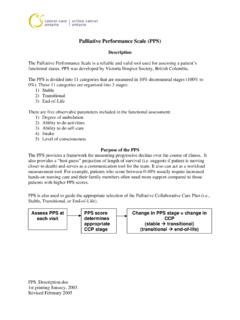
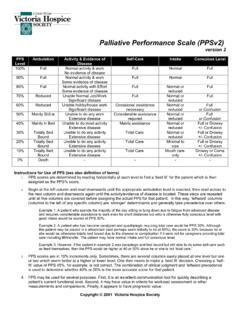
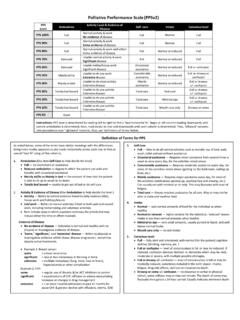
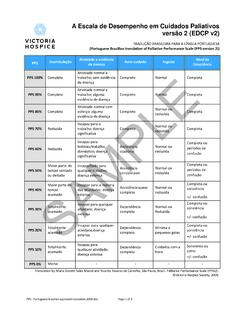
8 As well, a space for the palliative performance Scale (PPS) is included. The ESAS is available in other languages and also in faces for those patients who do not read. Capital Health Edmonton Symptom Assessment System Graph (ESAS). Date 10. Pain 0. 10. Tiredness 0. 10. Nausea 0. 10. Depression 0. 10. Anxiety 0. 10. Drowsiness 0. 10. Appetite 0. 10. Wellbeing 0. 10. Shortness of breath 0. 10. Other 0. Mini-Mental (Normal _____ ). PPS. Completed by P = patient Level of Education _____. C = caregiver A = caregiver-assisted Cage Score _____. CH-0208 May 2001. Capital Health Edmonton Symptom Assessment System: Numerical Scale Regional palliative Care Program Please circle the number that best describes.
9 No pain 0 1 2 3 4 5 6 7 8 9 10 Worst possible pain Not tired 0 1 2 3 4 5 6 7 8 9 10 Worst possible tiredness Not nauseated 0 1 2 3 4 5 6 7 8 9 10 Worst possible nausea Not depressed 0 1 2 3 4 5 6 7 8 9 10 Worst possible depression Not anxious 0 1 2 3 4 5 6 7 8 9 10 Worst possible anxiety Not drowsy 0 1 2 3 4 5 6 7 8 9 10 Worst possible drowsiness Best appetite 0 1 2 3 4 5 6 7 8 9 10 Worst possible appetite Best feeling of 0 1 2 3 4 5 6 7 8 9 10 Worst possible feeling wellbeing of wellbeing No shortness of 0 1 2 3 4 5 6 7 8 9 10 Worst possible breath shortness of breath Other problem 0 1 2 3 4 5 6 7 8 9 10. Complete by (check one). Patient's Name _____.
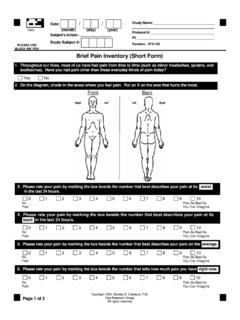
10 Patient Date _____ Time _____ Caregiver Caregiver assisted BODY DIAGRAM ON REVERSE SIDE. CH-0202 May 2001. Please mark on these pictures where it is you hurt. Right Right SOME REFERENCES ON ESAS. August 25, 2005. Bruera E, Kuehn N, Miller MJ, Selmser P, Macmillan K. The Edmonton Symptom Assessment System (ESAS): a simple method of the Assessment of palliative care patients. Journal of palliative Care 1991; 7:6-9. Bruera E, Macdonald S. Audit methods: the Edmonton Symptom Assessment . In: Higginson I, editor. Clinical Audit in palliative Care. Oxford: Radcliffe Medical Press, 1993:61-77. Chang VT, Hwang SS, Feuerrman M. Validation of the Edmonton Symptom Assessment Scale .