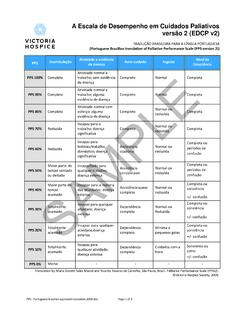
Transcription of Palliative Performance Scale (PPS) - South West
1 1st printing January, 2003. Revised February 2005 Palliative Performance Scale (PPS) Description The Palliative Performance Scale is a reliable and valid tool used for assessing a patient s functional status. PPS was developed by Victoria Hospice Society, British Columbia. The PPS is divided into 11 categories that are measured in 10% decremental stages (100% to 0%). These 11 categories are organized into 3 stages: 1) Stable 2) Transitional 3) End-of-Life There are five observable parameters included in the functional assessment: 1) Degree of ambulation 2) Ability to do activities 3) Ability to do self-care 4) Intake 5) Level of consciousness Purpose of the PPS The PPS provides a framework for measuring progressive decline over the course of illness.
2 It also provides a best guess projection of length of survival ( suggests if patient is moving closer to death) and serves as a communication tool for the team. It also can act as a workload measurement tool. For example, patients who score between 0-40% usually require increased hands-on nursing care and their family members often need more support compared to those patients with higher PPS scores. PPS is also used to guide the appropriate selection of the Palliative Collaborative Care Plan ( , Stable, Transitional, or End-of-Life). Assess PPS at each visit PPS score determines appropriate CCP stageChange in PPS stage = change in CCP (stable transitional) (transitional end-of-life) 1st printing January, 2003.
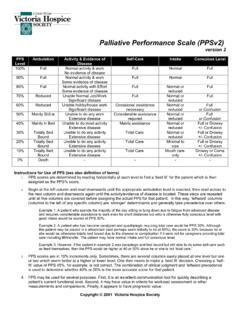
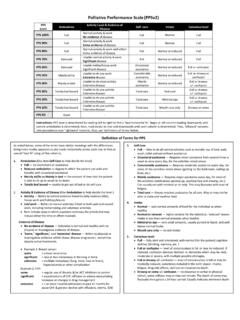
3 Revised February 2005 How to do the PPS The PPS score is determined by reading horizontally at each level to find the best fit for the patient. Leftward columns are stronger determinants, thereby taking precedence over others. 1) Begin at the left column until the appropriate ambulation level is found 2) Read across to the next column until the correct activity/evidence of disease is located 3) Read across to the self-care column, intake and conscious level columns before assigning the PPS score to the patient Ambulation: Reduced ambulation occurs at PPS 70% and 60%. The difference between 70% and 60% is subtly related to the activity columns that is whether the patient is unable to do work (70%) or unable to do hobbies or house work (60%). Also note that the patient at 60% requires occasional assistance with self-care.
4 There are subtle differences between mainly sit/lie and mainly in bed . The difference is subtly related to items in the self-care and intake columns. Use these adjacent columns to help decide. As well, the difference between mainly sit/lie and mainly in bed is proportionate to the amount of time the patient is able to sit up versus the need to lie down. Activity & Evidence of Disease: Some , significant and extensive disease refer to physical and investigative evidence showing degree of disease progression. Example: Breast Cancer - local recurrence = some disease - 1 or 2 metastases = significant disease - multiple mets = extensive disease The extent of disease is also judged in the context of the patient s ability to maintain work, hobbies and activities. For example, reduced activity may mean playing 9 holes of golf instead of 18, or continuing with morning walks but at a reduced distance.
5 Self Care: Occasional Assistance - Most of time the patient can transfer, walk, wash, toilet, eat own meals but sometimes needs help ( , once a day or few times a week) Considerable Assistance Regularly every day the patient needs help ( , to get to the bathroom but can brush own teeth; needs food cut but can feed self) Mainly Assistance This is an extension of the considerable assistance category. ( , patient needs help getting to bathroom and washing) Total Care The patient is unable to eat, toilet or do any self care without help Intake: Normal refers to patient s usual eating habits while healthy Reduced a reduction of the patient s normal eating habits Minimal very small amounts, usually pureed or liquid, which are well below nutritional sustenance 1st printing January, 2003.
6 Revised February 2005 Conscious Level: Full consciousness full alertness, orientation, good cognitive abilities Confusion presence of delirium or dementia and a reduced level of consciousness, which may be mild, moderate or severe. Drowsiness may be due to fatigue, drug side-effects, delirium, closeness to death Coma absence of response to verbal or physical stimuli. Depth of coma may fluctuate. Making Best Fit Decisions Only use the PPS in 10% increments ( , cannot score 45%) Sometimes one or two columns seem easily placed at one level but one or two columns seem better at higher or lower levels. In these cases, use your clinical judgment and the leftward dominance rule to determine a more accurate score the patient. (Example case studies are provided at end of PPS section.)
7 When to do the PPS a) Patients at Home It is good practice to complete the PPS each visit. The PPS should only be completed on a daily basis for those patients receiving more than one nursing visit per day. b) Patients Admitted to Hospital, Palliative Care Unit, or Long-Term Care Facility It is good practice to complete the PPS every day. It may be more helpful to complete the PPS at the end of the day shift. Who Should Complete the PPS The PPS can be used by any regulated health care provider. It is anticipated that in most cases, the PPS will be completed by a registered nurse or registered practical nurse. Where to Document the PPS The PPS score is transcribed into the medical chart, , on the flow sheet or in progress notes as per organization policy.
8 Example Case Study #1 The patient spends the majority of the day sitting in bed or lying down due to fatigue from advanced disease. She requires considerable assistance to walk even short distances. She is fully conscious. She has good nutritional intake. What is the patient s PPS score? (see bottom of page for best fit score) Example Case Study #2 The patient is very weak and remains in a chair a couple of hours a day. The rest of the time, he is in bed. He has advanced disease and is requiring almost complete assistance with self-care and feeding. He is experiencing decreased food intake, with a few small snacks that remain mostly unfinished. He has adequate fluid intake. The patient is drowsy but not confused. 1st printing January, 2003.
9 Revised February 2005 What is the patient s PPS score? (see bottom of page for best fit score) Example Case Study #3 The patient is up and about on her own. She has experienced a recent recurrence of disease. She can do household chores with adequate rest periods. The patient requires occasional assistance with self-care whereby her caregiver watches her get in and out of the shower. Her intake is reduced from normal but still adequate. The patient is fully conscious with no confusion. What is the patient s PPS score? (see bottom of page for best fit score) [Reference: Victoria Hospice Society] PPS Case Study Answers: Case study #1: PPS score 50% Case study #2: PPS score 40% Case study #3: PPS score 70% Palliative Performance Scale (PPSv2) version 2 PPS Level Ambulation Activity & Evidence of Disease Self-Care Intake Conscious Level 100% Full Normal activity & work No evidence of disease Full NormalFull90% Full Normal activity & work Some evidence of disease Full NormalFull80% FullNormal activity with EffortSome evidence of disease Full Normal or reduced Full 70% Reduced Unable Normal Job/Work Significant disease Full Normal or reduced Full 60% Reduced Unable hobby/house workSignificant disease Occasional assistance necessary Normal or reduced Full or Confusion 50% Mainly Sit/Lie Unable to
10 Do any work Extensive disease Considerable assistance required Normal or reduced Full or Confusion 40% Mainly in Bed Unable to do most activityExtensive disease Mainly assistance Normal or reduced Full or Drowsy +/- Confusion 30% Totally BedBound Unable to do any activity Extensive disease Total Care Normal or reduced Full or Drowsy +/- Confusion 20% Totally BedBound Unable to do any activity Extensive disease Total Care Minimal to sips Full or Drowsy +/- Confusion 10% Totally BedBound Unable to do any activity Extensive disease Total Care Mouth care only Drowsy or Coma +/- Confusion 0% Death ---- Used with permission Victoria Hospice Society, 2006 Palliative Performance Scale Aug 25, 2003