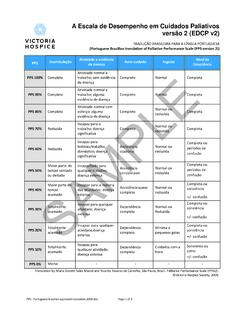
Transcription of Palliative Performance Scale PPS and Palliative Care ...
1 Quality Palliative Care in Long Term Care Alliance (QPC-LTC) Palliative Performance Scale (PPS) and Palliative Care Conferences Acknowledgements This document was created through research conducted by the Quality Palliative Care in Long Term Care (QPC-LTC) Alliance that includes four long term care homes, 30 researchers & knowledge brokers and 50 community organizational partners. We would also like to acknowledge our funders. The Social Sciences and Humanities Research Council (SSHRC) provided funding for the QPC-LTC Alliance research and the Canadian Institutes of Health Research (CIHR) funded the Knowledge Translation for this project. Please copy and share this document. We would appreciate you referencing the source of this document as Spirituality In-service, Quality Palliative Care in Long Term Care, Version 1, For more information regarding the project please visit or email our team at Introduction The information in this toolkit is based on current literature and best practices.
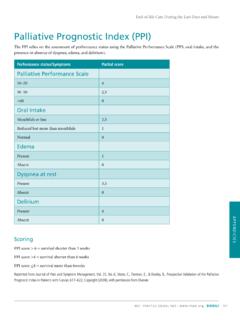
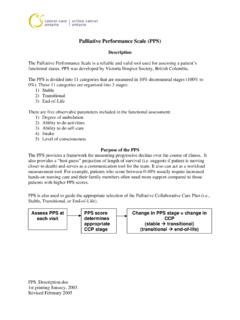
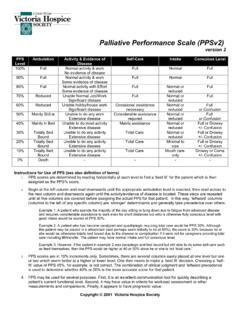
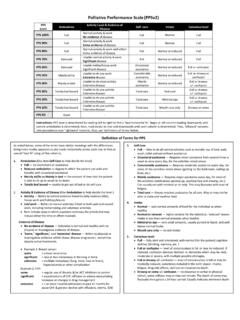
2 It is an introduction to the implementation of the Palliative Performance Scale (PPS). Data was collected Creek Way Village, a part of Halton Region, in Burlington, Ontario. This toolkit is a result of the research conducted on the project by Southern Ontario Lead Investigator Dr. Sharon Kaasalainen, Research Coordinator Diane Crawshaw, and Research assistants Emma Brazil, Chloe Schotsman, and Natasha Laroque, for the Quality Palliative Care in Long Term Care Alliance (QPC-LTC). The Palliative Performance Scale (PPS) is a useful tool for measuring the progressive decline of a Palliative resident. It has five functional dimen-sions: ambulation, activity level and evidence of disease, self-care, oral in-take, and level of consciousness. To score, there are 11 levels of PPS from 0% to 100% in 10 percent increments. Every decrease in 10% marks a fairly significant decrease in physical function.
3 For example a resident with a score of 0% is deceased and a score of 100% is fully ambulatory and healthy. PPS serves as a way for the interprofessional team to communicate with each other or with residents and families as it can be used as a guide to help in initiating and facilitating conversations about a Palliative care or end-of-life care transition. What is the Palliative Performance Scale (PPS)? Victoria Hospice, 2003 Benefits of the PPS A way to track the decline of a resident 2,3 Using PPS as the indicator of residents prognosis can help in care planning 2,3 PPS, when explained, can help family members in making tough end-of-life decisions2,3 PPS is a good communication tool and a standard reference for healthcare providers to discuss a patient s condition PPS can be used not only as a communication tool within the long-term care (LTC) home between professions (ex.)
4 Registered staff to PSWs, dietary, and activation therapy) but also across sectors for residents being admitted to LTC or to and from hospital. PPS was not created for LTC homes and may not fully consider the uniqueness of these organizations Performance status indicators may not be clear (ex. Ambulation specific to what they can do) 3 PPS is based on an observer s recording there may be different opinions on what % a resident should be3 May be more difficult to score at certain PPS % levels between PPS 30% and 40%, or between PPS 80% and 90%. 3 Multiple variables to remember 3 Another task for staff to complete Drawbacks of the PPS Implementing the PPS within a LTC Home 1. Create a Palliative Performance Scale Implementation Team. This team should include: A champion PSW who can encourage frontline staff and initiate conversation about PPS A champion registered staff who can support the PSW in their role in implementing PPS in the home Palliative Care Consultant who can lead training and promote PPS to management Clinical Nurse Specialist to support PPS at an administration level.
5 This could also be someone in an administrative position such as a manager. This may help increase buy-in. Why do we need a team? The Palliative Performance Scale needs to be implemented as a multi-disciplinary approach. All staff need to understand the process of utilizing the Palliative Performance Scale and have support to sustain the utilization of this tool on the care units. Main Team Goals: The main goal of the team is to educate staff on the Palliative Performance Scale and to implement the utilization of the Palliative Performance Scale within the long term care home. Tip: Having PSW champions on this team can be crucial for the success of this initiative because if frontline staff own the initiation, they will see the benefits in continuing to use PPS Tip: Pain and Symptom Management Consultants can be extremely beneficial on the team as they can provide a level of respect and understanding to staff that are uneasy about starting a new initiative 2.
6 PPS Weekly Implementation Meetings Weekly meetings with PPS team staff completing PPS scores to remind them that PPS scores need to be completed. Consider the following agenda items: Prior to education: creating a timeline of events, creating goals for the initiative and training, scheduling education times, train the trainer, advertising the education After education: feedback from staff members, evaluating the implementation, looking at ongoing education strategies the would re-enforce the use of the PPS tool 3. Creating a Timeline of Events A timeline should be created to keep the team and goals of the project on track. The timeline should consider how much time the team can devote to this process and should consider the dates for other planned home educational events. See Appendix A for a sample PPS Implementation Timeline. 4. Plan PPS Training events Training sessions should be scheduled keeping in mind the physical layout of the LTC home and the shift rotation of staff.
7 For example a LTC home that has two floor may want to have two training sessions per floor so that day shift and afternoon shift can be trained. Training should be held over multiple days so that all staff have an opportunity to receive training. This creates an environment where staff can focus on the PPS and the importance of the tool. 5. Advertising PSS Training Posters about PPS and its benefits throughout the home See Appendix B Notice in home newsletter- See Appendix B Announce and present PPS in weekly staff meetings and continue to use it in later meetings Post PPS score on whiteboards or information boards for high risk residents if score is 30% or below (ex. If a resident is not to get out of bed, also include PPS score in notice). Tip: Utilize information boards that already exist in the homes. Try to integrate PPS in physical resources or forms the long term care home already has rather than create new tools.
8 This can help integration. 6. Documenting the PPS Process PPS was recorded by registered staff in PointClick Care for all residents to establish a baseline. That way, if a PPS score needs to be completed, managers and registered staff can be prompted to complete the PPS. Documentation for PPS included: PPS charts and explanations were included in every residents chart Care planning template (optional if home does not already have documentation) if the care plan needs to be changed due to PPS score 7. Quality Improvement Plan Do Study Act (PDSA) forms can be used to track the quality improvement of the implementation of the Palliative Performance Scale . Please visit for more information regarding PDSA. Consistent use of the PPS scores in I interprofessional meetings and discussions highlights the usefulness of the tool to staff- management support of the tool 8.
9 Next Steps Utilizing the PPS can be of great benefit to your LTC home however there needs to be a second step in place for residents indentified as having a PPS with a score of 30% or lower. Tip: Lunch and Learn sessions were held for registered staff where the champions led a role play to demonstrate a care conference. See What to do if PPS is Lower Than 30% Tip: How will know that this initiative is successful? How long after training should you start monitoring and for how long? QI sheet Appendix? Process Map: After Staff Education What to do if a resident has a PPS below 30%? Palliative Care Conference: If resident is at a 30% or below, a Palliative care conference should be called. Registered staff will recognize that 30% or below is to trigger a care conference and this should be brought to the attention of the rest of the healthcare team. A care conference is planned after team discusses resident situation and appropriateness of care conference.
10 A Palliative care conference is used to inform family members, staff and the resident (if able to attend), the state the resident is at and to further discuss care planning for resident. Preparing Staff for a Palliative Care Conference Mock trial took place with lead team members of the PPS implementation project. Registered staffs, s and PSWs were present at the mock trial lunch-and-learn to prepare for a Palliative care conference. An introduction to care conferences was given by presentation of a video All on the Same Page from the Palliative Approach Toolkit from the University of Queensland in Australia found by following the link: A mock up scenario was conducted by lead team members and preformed in front of staff to demonstrate how a typical care conference would go and roles that would be played ( one team member acted as resident, one team member acted as PSW, one team member acted as family member, etc.)