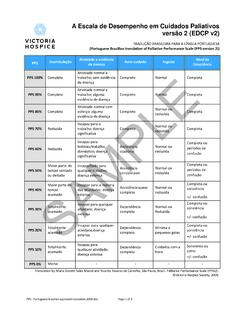
Transcription of Palliative Performance Scale PPSv2 - NPCRC
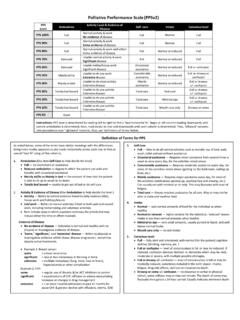
1 Palliative Performance Scale ( PPSv2 ) version 2 PPSL evelAmbulationActivity & Evidence ofDiseaseSelf-CareIntakeConscious Level100%FullNormal activity & workNo evidence of diseaseFullNormalFull90%FullNormal activity & workSome evidence of diseaseFullNormalFull80%FullNormal activity with EffortSome evidence of diseaseFullNormal orreducedFull70%ReducedUnable Normal Job/WorkSignificant diseaseFullNormal orreducedFull60%ReducedUnable hobby/house workSignificant diseaseOccasional assistancenecessaryNormal orreducedFull or Confusion50%Mainly Sit/LieUnable to do any workExtensive diseaseConsiderable assistancerequiredNormal orreducedFull or Confusion40%Mainly in BedUnable to do most activityExtensive diseaseMainly assistanceNormal orreducedFull or Drowsy+/- Confusion30%Totally BedBoundUnable to do any activityExtensive diseaseTotal Care Normal orreducedFull or
2 Drowsy+/- Confusion20%Totally BedBoundUnable to do any activityExtensive diseaseTotal Care Minimal tosipsFull or Drowsy+/- Confusion10%Totally BedBoundUnable to do any activityExtensive diseaseTotal Care Mouth care onlyDrowsy or Coma+/- Confusion0%Death----Instructions for Use of PPS (see also definition of terms)1. PPS scores are determined by reading horizontally at each level to find a best fit for the patient which is thenassigned as the PPS% Begin at the left column and read downwards until the appropriate ambulation level is reached, then read across tothe next column and downwards again until the activity/evidence of disease is located. These steps are repeateduntil all five columns are covered before assigning the actual PPS for that patient. In this way, leftward columns(columns to the left of any specific column) are stronger determinants and generally take precedence over 1: A patient who spends the majority of the day sitting or lying down due to fatigue from advanced diseaseand requires considerable assistance to walk even for short distances but who is otherwise fully conscious level withgood intake would be scored at PPS 50%.
3 Example 2: A patient who has become paralyzed and quadriplegic requiring total care would be PPS 30%. Althoughthis patient may be placed in a wheelchair (and perhaps seem initially to be at 50%), the score is 30% because he orshe would be otherwise totally bed bound due to the disease or complication if it were not for caregivers providing totalcare including lift/transfer. The patient may have normal intake and full conscious 3: However, if the patient in example 2 was paraplegic and bed bound but still able to do some self-care suchas feed themselves, then the PPS would be higher at 40 or 50% since he or she is not total care. 3. PPS scores are in 10% increments only. Sometimes, there are several columns easily placed at one level but oneor two which seem better at a higher or lower level. One then needs to make a best fit decision.
4 Choosing a half-fit value of PPS 45%, for example, is not correct. The combination of clinical judgment and leftward precedence is used to determine whether 40% or 50% is the more accurate score for that PPS may be used for several purposes. First, it is an excellent communication tool for quickly describing apatient s current functional level. Second, it may have value in criteria for workload assessment or othermeasurements and comparisons. Finally, it appears to have prognostic 2001 Victoria Hospice SocietyDefinition of Terms for PPSAs noted below, some of the terms have similar meanings with the differences being more readily apparent as one readshorizontally across each row to find an overall best fit using all five AmbulationThe items mainly sit/lie, mainly in bed, and totally bed bound are clearly similar.
5 The subtle differences are relatedto items in the self-care column. For example, totally bed bound at PPS 30% is due to either profound weakness orparalysis such that the patient not only can t get out of bed but is also unable to do any self-care. The difference between sit/lie and bed is proportionate to the amount of time the patient is able to sit up vs need to lie down. Reduced ambulation is located at the PPS 70% and PPS 60% level. By using the adjacent column, the reduction ofambulation is tied to inability to carry out their normal job, work occupation or some hobbies or housework activities. Theperson is still able to walk and transfer on their own but at PPS 60% needs occasional Activity & Extent of disease Some, significant, and extensive disease refer to physical and investigative evidence which shows degrees ofprogression.
6 For example in breast cancer, a local recurrence would imply some disease, one or two metastases in thelung or bone would imply significant disease, whereas multiple metastases in lung, bone, liver, brain, hypercalcemia orother major complications would be extensive disease. The extent may also refer to progression of disease despite activetreatments. Using PPS in AIDS, some may mean the shift from HIV to AIDS, significant implies progression in physicaldecline, new or difficult symptoms and laboratory findings with low counts. Extensive refers to one or more seriouscomplications with or without continuation of active antiretrovirals, antibiotics, etc. The above extent of disease is also judged in context with the ability to maintain one s work and hobbies or in activity may mean the person still plays golf but reduces from playing 18 holes to 9 holes, or just a par 3, or tobackyard putting.
7 People who enjoy walking will gradually reduce the distance covered, although they may continue trying,sometimes even close to death (eg. trying to walk the halls).3. Self-Care Occasional assistance means that most of the time patients are able to transfer out of bed, walk, wash, toilet and eat bytheir own means, but that on occasion (perhaps once daily or a few times weekly) they require minor assistance. Considerable assistance means that regularly every day the patient needs help, usually by one person, to do some ofthe activities noted above. For example, the person needs help to get to the bathroom but is then able to brush his or herteeth or wash at least hands and face. Food will often need to be cut into edible sizes but the patient is then able to eat ofhis or her own accord. Mainly assistance is a further extension of considerable.
8 Using the above example, the patient now needs help gettingup but also needs assistance washing his face and shaving, but can usually eat with minimal or no help. This may fluctuateaccording to fatigue during the day. Total care means that the patient is completely unable to eat without help, toilet or do any self-care. Depending on theclinical situation, the patient may or may not be able to chew and swallow food once prepared and fed to him or IntakeChanges in intake are quite obvious with normal intake referring to the person s usual eating habits while healthy. Reduced means any reduction from that and is highly variable according to the unique individual circumstances. Minimal refers to very small amounts, usually pureed or liquid, which are well below nutritional Conscious Level Full consciousness implies full alertness and orientation with good cognitive abilities in various domains of thinking,memory, etc.
9 Confusion is used to denote presence of either delirium or dementia and is a reduced level ofconsciousness. It may be mild, moderate or severe with multiple possible etiologies. Drowsiness implies either fatigue,drug side effects, delirium or closeness to death and is sometimes included in the term stupor. Coma in this context is theabsence of response to verbal or physical stimuli; some reflexes may or may not remain. The depth of coma may fluctuatethroughout a 24 hour period. Copyright Notice. The Palliative Performance Scale version 2 ( PPSv2 ) tool is copyright to Victoria Hospice Society and replaces the first PPS publishedin 1996 [J Pall Care 9(4): 26-32]. It cannot be altered or used in any way other than as intended and described here. Programs mayuse PPSv2 with appropriate recognition. Available in electronic Word format by email request to should be sent to Medical Director, Victoria Hospice Society, 1900 Fort St, Victoria, BC, V8R 1J8, Canada