Transcription of Education Credits - IRS tax forms
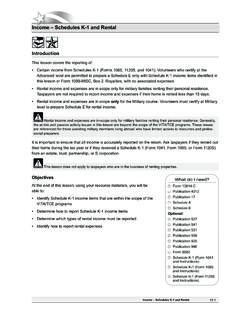
1 Education Credits22-1 IntroductionThis lesson covers tax Credits available to help the taxpayer offset the costs of higher Education by reducing the amount of income tax. This lesson suggests probing questions you can ask based on the intake and interview sheet, the volunteer Resource Guide, Tab J, Education Benefits, and on the rules for claiming Education the interview, ask taxpayers if they are aware of the Education Credits , and give a brief description. Next, gather information to determine if any Credits can be the end of this lesson, using your resource materials, you will be able to: Determine who qualifies for an Education credit Determine which credit the taxpayer can claimEducation CreditsWhat do I need?
2 form 13614-C Publication 4012 Publication 17 Publication 970 form 1098-T form 8863 and InstructionsOptional: form 1040 Instructions What are Education Credits ? Education Credits are amounts that will reduce the amount of tax due. The amount is based on qualified Education expenses that the taxpayer paid during the tax year. There are two different Education Credits : the American opportunity credit and the lifetime learning credit. The American opportunity credit allows 40% of the credit to be refundable. There are general rules that apply to these Credits , as well as specific rules for each an overview of the various Education tax benefits, review the volunteer Resource Guide, Tab J, Education Benefits, Highlights of Education Tax can take an Education credit?
3 Taxpayers can take Education Credits for themselves, their spouse, and/or dependents (claimed on the tax return) who were enrolled at or attended an eligible postsecondary educational institution during the tax year. The law requires that the student must generally receive a form 1098-T, Tuition Statement, in order for the taxpayers to claim the Education credit. However, if the student s educational institution is not required to furnish a form 1098-T, the taxpayer may claim a credit if the student does not receive a form 1098-T. The student is required to provide the information that would otherwise be included on the form 1098-T. Review the dependent section of the intake and interview sheet for children who are shown as full-time students.
4 Ask the taxpayer if there are Education Credits22-2 What basic requirements must the taxpayer meet?To claim an Education credit, verify that the following are true for the taxpayers: They cannot be claimed as a dependent on someone else s tax return They are not filing as Married Filing Separately Their adjusted gross income (AGI) is below the limitations for their filing status They were not nonresident aliens for any part of the tax year, or if they were, they elected to be treated as resident aliens Taxpayers claiming the American opportunity credit must have a valid identification number (SSN or ITIN) by the due date of the tax return (including extensions). Further, the student claimed for the credit must also have a valid identification number (SSN, ATIN, or ITIN) by the due date (including extensions).
5 Taxpayers cannot file an amended return to claim the credit for a year that the taxpayer and/or student did not originally have a required identification number by the return due do I handle dependents?The taxpayer must claim the student as a dependent to receive the credit for the student s qualified expenses. If the taxpayer claims the student as a dependent, all qualified Education expenses of the student are treated as being paid by the taxpayer. exampleCarol Marshall has a grandson named Gary. He is claimed as a dependent on his parent s joint return. Carol paid Gary s tuition directly to the university. For purposes of claiming an Education credit, Gary is treated as receiving the money as a gift and paying for the qualified tuition and related expenses.
6 Since his parents are claiming him on their return, they may be able to use the expenses to claim an Education credit. Alternatively, if he is claiming himself on his return, he might be able to claim the expenses as if he paid them to the is an eligible institution?An eligible institution is generally any accredited public, nonprofit, or private college, university, vocational school, or other postsecondary institution eligible to participate in a student aid program administered by the Department of Education . The school should be able to tell the student if it is an eligible Education institution. A searchable database of all accredited postsecondary institutions and programs is available at: Taxpayers claiming the American opportunity credit are required to report the EIN of the educational institution the student attended on form 8863, Education Credits (American Opportunity and Lifetime Learning Credits ).
7 What are qualifying expenses?Qualified Education expenses are tuition and certain related expenses required for enrollment or atten-dance at an eligible educational institution. Qualified Education expenses include nonacademic fees, such as student activity fees, athletic fees, or other expenses unrelated to the academic course of institution that must be paid to the institution as a condition of enrollment or attendance. However, for the American oppor-tunity credit, the definition for certain related expenses is different from the lifetime learning credit. This will be discussed later in the lesson. Ask to see documentation, such as form 1098-T, issued by the school. The taxpayer can add other expenses that qualify for Education Credits , such as books or supplies not purchased through the school account.
8 Education Credits22-3exampleWhen Janice enrolled for her freshman year of college, she had to pay a separate student activity fee in addition to her tuition. This activity fee is required of all students and is used solely to fund on-campus organizations and activities run by students, such as the student newspaper and the student govern-ment. No portion of the fee covers personal expenses. Although labeled as a student activity fee, the fee is required for Janice s college enrollment and attendance; therefore, it is a qualified expenses do not qualify?Do not include expenses such as: Room and board, insurance, medical expenses (including student health fees), transportation costs, or other similar personal, living, or family expenses Any course of instruction or other Education involving sports, games, or hobbies, unless the course is part of the student s degree program or (for the lifetime learning credit) helps the student to acquire or improve job skillsexampleJackie paid $3,000 for tuition and $5,000 for room and board at an eligible university.
9 The $5,000 paid for room and board is not a qualified expense for the Education any amounts excluded from qualified expenses?Certain tax-free funds used to pay tuition cannot be used to figure the credit. Once you have identified each person claiming a credit and their qualified expenses, ask if the student received any of these untaxed educational benefits during the year: Tax-free part of Pell grants Tax-free employer-provided educational assistance Veterans educational assistance Tax-free parts of scholarships and fellowships Any other nontaxable payments received as educational assistance (other than gifts or inheritances). For example, distributions from a 529 plan reported on form 1099-Q, Payments From Qualified Education Programs (Under Sections 529 and 530) Refunds of the year s qualified expenses paid on behalf of a student ( , the student dropped a class and received a refund of tuition) Emergency financial aid grants under the Coronavirus Aid, Relief, and Economic Security (CARES) Act are not includible in gross income.
10 Therefore, taxpayers cannot claim any deduction or credit for expenses paid with the grant including the tuition and fees deduction, the American opportunity credit, or the lifetime learning credit. Do not reduce the qualified Education expenses by any scholarship or fellowship reported as income on the student s tax return if the scholarship or fellowship grant (or any part of it) must be applied (by its terms) to expenses (such as room and board) other than qualified Education expenses, or if the scholarship or fellowship grant (or any part of it) may be applied (by its terms) to expenses (such as room and board) other than qualified Education expenses. Some students may choose to pay non-qualifying expenses with scholarship/Pell grants funds, making the scholarship/Pell grants taxable.