Example: quiz answers
Functional Groups - Purdue University
B. Alkenes • contain a carbon-carbon double bond C. Alkynes • contain a carbon-carbon triple bond . 2 D. Arenes • contain a benzene group E. Alcohols • contain an –OH (“hydroxyl”) group bonded to a tetrahedral carbon atom F. Ethers
Tags:
Information
Domain:
Source:
Link to this page:
Documents from same domain
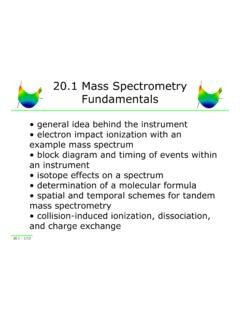
20.1 Mass Spectrometry Fundamentals - Purdue …
www.chem.purdue.edu20.1 Mass Spectrometry Fundamentals ... The mass spectrum can be used to determine molecular structure, to quantify single compounds or mixtures of

Ch. 7 - Enolates - Purdue University
www.chem.purdue.edu651.06 209 Enolates Enolates are the conjugate anions of carbonyl compounds. Although they have been known and used since the turn of the 20th Century, it was the development of “specific
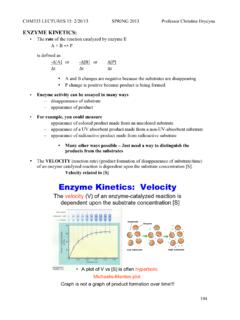
Enzyme Kinetics: Velocity - Purdue University
www.chem.purdue.edu• Enzyme activity can be assayed in many ways ... Enzyme Kinetics: Velocity . CHM333 LECTURES 15: 2/20/13 SPRING 2013 Professor Christine Hrycyna 105 • An example of how to do a ... • V is the reaction rate (velocity) at a substrate concentration [S]

PURDUE UNIVERSITY INSTRUMENT VAN PROJECT
www.chem.purdue.eduFACTORS AFFECTING ENZYME ACTIVITY PURDUE UNIVERSITY INSTRUMENT VAN PROJECT QUESTIONS 1. In what way is the rate of the reaction dependent on the concentration of the enzyme?
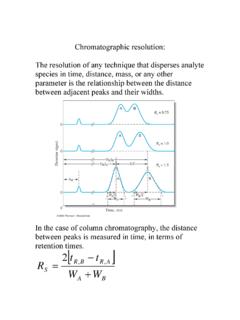
how to determine HETP from a peak - Purdue University
www.chem.purdue.eduChromatographic resolution is defined as the ratio of the difference of the retention times of two components to the sum of the peaks widths at the

The Fermentation of Pyruvate - Purdue University
www.chem.purdue.eduundergo lactate fermentation. Two pyruvates are converted to two lactic acid molecules, which ionize to form lactate. In this process two NADH + H+ are converted to two NAD+. Our muscle cells can undergo this process when they are in oxygen debt. If enough oxygen is not present to undergo aerobic respiration, pyruvate will undergo lactic acid
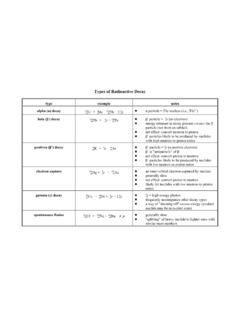
Types of Radioactive Decay - Purdue University
www.chem.purdue.eduTypes of Radioactive Decay type example notes alpha (α) decay 23 9 8 2 U 6 4 2 He + 23 9 4 0 Th + 2 0 0γ! α particle = 4 2 He nucleus (i.e., 4 2 He 2+) beta (β-) decay 23 9 4 0 Th 6! 0 1 e + 23 9 4 1 Pa! β-particle = ! 0 1 e (an electron)! energy released in decay process creates the β-particle (not from an orbital)! net effect: convert ...

Experiment 2: Acid / base titration - Purdue University
www.chem.purdue.eduExperiment 2: Acid / base titration cunknown =±62.0 0.5 mM @ 95% confidence level Nikolai Skrynnikov TA: Boone Prentice Section number: 1 25 Jan 2008 (data courtesy of Ike Fehrenbacher, 2004) 1

THEORY OF XRF - Purdue University
www.chem.purdue.eduXRF, and Chapter 4 describes how this physics is applied to spectrometers and their components. Chapter 5 explains how an XRF analysis is done. It describes the process of sample taking, measuring the sample and calculating the composition from the measurement results.
Purdue University: Department of Chemistry: Home
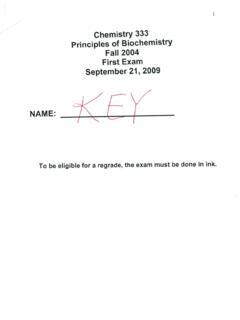
www.chem.purdue.eduSep 21, 2009 · Draw the structure of the peptide LCYRAIDCG as it would exist at pH 6.5 under oxidizing conditions. Be sure to draw any disulfide bonds that could form. EH — O-NA- Label the N-terminus of the peptide you drew in 3B above with a V. Label the C-terminus of the peptide you drew in 3B above with a Calculate the net charge of LCYRAIDG at pH 1.5.
Related documents

Reactions of Alkenes and Alkynes
pa01000125.schoolwires.net130 CHAPTER 5 Reactions of Alkenes and Alkynes From the perspective of the chemical industry, the single most important reaction of ethylene and other low-molecular-weight alkenes is the production of chain-growth polymers (Greek: poly, many, and meros, part).In the presence of certain catalysts called initiators, many alkenes form polymers by the addition of monomers …

NOMENCLATURE OF ORGANIC COMPOUNDS
chymist.comThis compound is named 5-ethyl-2,4-dimethyloctane. Note that the branches are named in alphabetical order. II. Naming Unsaturated Hydrocarbons – Alkenes and Alkynes Rules for Naming Alkenes and Alkynes Alkenes contain at least one carbon to carbon double bond. The suffix used is –ene. Alkynes contain at least one carbon to carbon triple bond.

Naming Alkenes - Vanderbilt University
www.vanderbilt.eduNaming Alkenes Suffix: -ene Many of the same rules for alkanes apply to alkenes 1. Name the parent hydrocarbon by locating the longest carbon chain that contains the double bond and name it according to the number of carbons with the suffix -ene. H 3 C CH 2 CH 2 C CH 2 H 3 C CH 2 H 3 C CH 2 CH 2 C CH 2
Experiment: Reactions of alkanes, alkenes, and ...
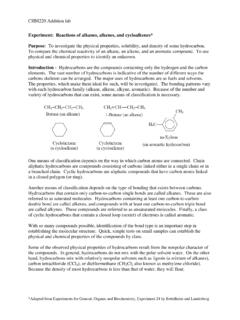
classes.kvcc.eduAlkenes react with cold concentrated sulfuric acid by addition. Alkyl sulfonic acids form as products and are soluble in H 2 SO 4. H 3 C CH + HOSO CH 2 OH CH 3 H Saturated hydrocarbons are unreactive (additions are not possible); alkynes react slowly and require a catalyst (HgSO 4); aromatic compounds also are unreactive because addition ...

4.6 ADDITION REACTIONS OF ALKENES - Macmillan Learning
www.saplinglearning.com148 CHAPTER 4 • INTRODUCTION TO ALKENES. STRUCTURE AND REACTIVITY A. Regioselectivity of Hydrogen Halide Addition When the alkene has an unsymmetrically located double bond, two constitutionally isomeric products are possible. As shown in Eq. 4.16, only one of the two possible products is formed from a 1-alkene in sig-nificant amount.

13 C Chemical Shift Table - Department of Chemistry
www2.chem.wisc.eduAlkenes Carbonyl: Ester Amide Carboxylic Acid Carbonyl: Aldehyde Ketone Alkanes Alkynes Amines Alkyl bromides Alkyl chlorides Alkyl fluorides CDCl 3 C R R C O R R R R C R O R C O O R C R R R R C R R R R C R R Cl R C R R Br R C R R F R C N R R R R RCR Nitriles RCN R=sp3CorH C represents carbon of interest. Title: 13 C Chemical Shift Table.xls