Example: marketing
Introduction to Liquid Chromatography
Particle size: 5 µm, 3 µm, and smaller Monodispersed means particles are the same size Very important for stable pressure and flow Smaller particles produce higher system pressure Pore size: 100-120 A is typical Surface area: 300-350 m2/g/g Carbon load: 9 …
Tags:
Information
Domain:
Source:
Link to this page:
Documents from same domain

Ziegler-Natta polymerization of olefins - …
www.chem.tamu.eduZiegler-Natta polymerization of olefins - stereoselectivity CHEM 462: Inorganic/Organometallic Chemistry Haomiao Xie & Xu Ye . …
Average, Standard Deviation and Relative Standard …
www.chem.tamu.eduAverage, Standard Deviation and Relative Standard Deviation How will your data compare with other people’s data? Let’s find out. We will do this by pulling together everybody’s

Selected Bond Energies and Bond Lengths
www.chem.tamu.eduSelected Bond Energies and Bond Lengths Arranged according to families. Energy (D) in kJ/mol. Bond length (r) in picometers. Hydrogen Compounds

Paramagnetism and Diamagnetism - Department of Chemistry
www.chem.tamu.edu1 Paramagnetism and Diamagnetism zAtoms with unpaired ↑electrons are called paramagnetic. • Paramagnetic atoms are attracted to a magnet. zAtoms with paired ↑↓electrons are called diamagnetic. • Diamagnetic atoms are repelled by a magnet.

NMR spectroscopy of paramagnetic complexes. Part 39 ...
www.chem.tamu.eduMAGNETIC RESONANCE IN CHEMlSTRY, VOL. 31, 2-6 (1993) NMR Spectroscopy of Paramagnetic Complexes Part 39*-Natural Abundance *H NMR of Paramagnetic Sandwich Compounds Janet Blumel, Peter Hofmann and Frank H. Kohlert Anorganisch-chemisches Institut, Technische Universitat Miinchen, D-8046 Garching, Germany
Chemistry 689 A Brief Introduction to Symmetry and Group ...
www.chem.tamu.eduA Brief Introduction to Symmetry and Group Theory in Chemistry Instructor: Dr. Timothy Hughbanks Time: TTh 12:45 - 2:00 PM; Room 2121 ... After a brief introduction to the abstract theory of groups is ... Franzen Physical Chemistry of Solids, Basic Principles …

Electron Paramagnetic Resonance: Hyperfine Interactions
www.chem.tamu.edu§ Abragam & Bleaney Electron Paramagnetic Resonance of Transition Ions; § Carrington & McLachlan, Introduction to Magnetic Resonance; § Wertz & Bolton, Electron Spin Resonance. 2. ... • Basic ideas from MO theory and ligand field theory must be familiar. 6. Experimental Aspects • EPR performed at fixed frequency (i.e., field is

Oxidation Numbers: Rules
www.chem.tamu.edu1 Oxidation Numbers: Rules 1) The oxidation number of the atoms in any free, uncombined element, is zero 2) The sum of the oxidation numbers of all atoms

CO2 Reduction Catalysts and Catalysis
www.chem.tamu.eduCO2 Reduction Catalysts and Catalysis CHEM 462 Kristina Goldstein . Soomin Park . 1

Coordination Chemistry Transition Metal Complexes
www.chem.tamu.eduCoordination Chemistry Transition Metal Complexes Direct Application of Lewis AB and Hard/Soft AB “Theories” A TEP (Thermal Ellipsoid Plot) of ... Metals may exhibit multiple oxidation states 3. Metals may exhibit paramagnetism dependent on …
Related documents

Gel Permeation Chromatography (GPC) - Waters Corporation
www.waters.com2 In 1964 John C. Moore, of the Dow Chemical Company, published his work on the preparation of Gel Permeation Chromatography (GPC) and changed how scientists studied synthetic polymers and macromolecules.

The Preparation of Buffers and Other Solutions: A Chemist ...
sun-lab.med.nyu.edupH 4.2, was 0.1 mole of sodium acetate added to 900ml of water, and then titrated to pH 4.2 with acetic acid before bringing to 1L volume? If so, the acetate concentration will be significantly higher than 0.1M. Or, was the pH overshot, necessitating the addition of dilute NaOH to bring the pH back to target, increas-
Chapter 3 Centrifugation - Sinica
www.phys.sinica.edu.tw4 Densities of biological material RNA 2.00 DNA 1.70 Proteins 1.30 Organelles 1.10 - 1.60 Mammalian cells 1.04 - 1.10 Microbial cells 1.05 - 1.15 Material Density (g/cm3)
BIOANALYTICAL METHOD VALIDATION –M10
database.ich.org3/20/2019 7 13 Table of Guideline Contents • 7. Additional Considerations (continued) o 7.4 Minimum Required Dilution o 7.5 Commercial and Diagnostics Kits o 7.6 New and Alternative Technologies - 7.6.1 Dried Matrix Methods • 8. Documentation o 8.1 Summary Information o 8.2 Documentation for Validation and Bioanalytical Reports • 9. Glossary
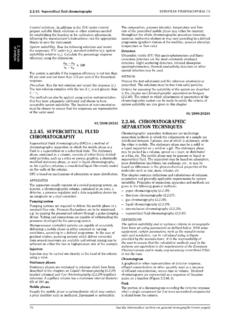
2.2.46. CHROMATOGRAPHIC SEPARATION TECHNIQUES …
www.drugfuture.comEUROPEAN PHARMACOPOEIA 7.0 2.2.46. Chromatographic separation techniques Figure 2.2.46.-1. The peak may be defined by the peak area, or the peak height (h) and the peak width at half-height (wh), or the peakheight (h) and the peak width between the points of inflection(wi).In Gaussian peaks (Figure 2.2.46.-1) there is the following
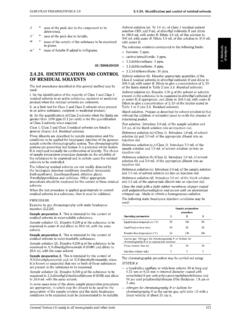
2.4.24. IDENTIFICATION AND CONTROL OF RESIDUAL …
www.drugfuture.comA flow diagram of the procedure is shown in Figure 2.4.24.-5. When a residual solvent (Class 2 or Class 3) is present at a level of 0.1 per cent or greater then the content may be quantitatively determined by the method of standard additions. 124 See the information section on general monographs (cover pages)