Transcription of IRA Inheritance Facts - T. Rowe Price
1 IRA Inheritance Facts RMD rules for the beneficiary Basic Process The Setting Every Community Up for Retirement Enhancement Act of 2019 (SECURE Act) was signed into law December 20, 2019, with The information provided is not intended as tax or legal advice. Prior to most provisions taking effect in January 2020. The act includes wide- completing the distribution form, please consult your tax or legal advisor ranging changes to the retirement savings landscape, which affect for more information. individuals. Before the SECURE Act, someone inheriting an IRA could generally 1.
2 B eneficiary completes the IRA Distribution form or the SEP-IRA and take RMDs over their expected lifetime. For some non-spouse benefi- SIMPLE IRA Distribution form. ciaries, that could stretch' out the distributions for many decades, 2. Attach a certified copy of the IRA owner's death certificate. extending the benefit of an IRA's tax deferral. Going forward, however, 3. For estate, trust, or entity beneficiary, include the appointment the accounts of IRA owners who die after December 31, 2019, of estate executor, trustee, or person authorized to act for the will generally need to be fully distributed to beneficiaries within 10.
3 Entity. Entities that require corporate resolution should be certified calendar years. within 60 days, all other documents showing appointment should Beneficiaries excluded from this rule include surviving spouses, be certified within 120 days of receipt by T. Rowe Price . Trust disabled or chronically ill individuals, or those less than 10 years document pages should include the trust name and date, current younger than the IRA owner. For beneficiaries who are minors, the trustees' names, and signatures. Entity beneficiaries must provide 10-year period to fully distribute the account starts when they reach documentation to verify existence of beneficiary as a legal Entity.
4 The age of majority. 4. If required by your state, provide an Inheritance tax waiver. 5. Assets from the decedent's account are transferred to a separate T. Rowe Price is unable to provide tax or legal advice. Therefore, it is account for the beneficiary. All beneficiary distributions will be made critical that you discuss your RMD requirements with your tax and/or from the beneficiary's account. Tax reporting will occur under the legal advisor prior to completing the IRA Distribution Form. Generally, beneficiary's tax identification number. failure to distribute RMDs in a timely fashion will result in a 50%.
5 Excise tax for the year(s) on the amount(s) not distributed as required. Beneficiary Options Definitions Your options as a beneficiary depend on whether you are the surviving spouse of the IRA owner. For purposes of this document, the following definitions are provided: If you are the surviving spouse Spouse A spouse is any individual who is a spouse under federal Treat the IRA as your own (Transfer). Your spouse's IRA will be law. Certain states have enacted laws that may make a former spouse transferred into a new or existing IRA in your name. named as a beneficiary invalid.
6 Roll over to your own IRA or to a qualified plan. The one-rollover- Transfer A tax-free movement of all or a portion of the IRA assets per-year limitation may apply for rollovers to an IRA. into another IRA in which no tax reporting is required on your income Transfer the IRA into an Inherited IRA. tax return. Rollover A tax-free distribution of all or a portion of the IRA assets Note: If you transfer or roll over your inherited assets to your own IRA, into another IRA or qualified retirement plan in the name of the spou- you will be subject to taxation and RMD rules that would normally sal beneficiary.
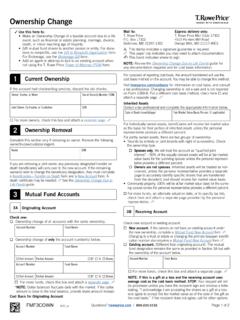
7 There are special rules that apply, and tax reporting is apply to your own IRA. In this case, the RMD rules described below required on your income tax return. This option is only available for a for the Inherited IRA do not apply. spouse of the deceased IRA owner. RMDs are never eligible for rollover. If you are NOT the surviving spouse Distribution Redeem all or a portion of the assets in the account. The Transfer the IRA into an Inherited IRA. This is the only option for a assets will be taxable in the year distributed. non-spouse beneficiary. Assets in an Inherited IRA may not be rolled over to another This paper clip indicates you may need to attach documentation.
8 Inherited IRA. Assets may only be moved by way of trustee to trustee transfer. Required Minimum Distribution (RMD). RMD rules for the deceased IRA owner In general, the deadline for the IRA owner's first RMD (the required beginning date, or RBD) is April 1 of the year following the year the IRA. owner reaches: *70 for IRA owners that die on or before December 31, 2019. *72 for IRA owners that die on or after January 1, 2020. If the IRA owner's death occurred on or after the RBD, an RMD must be distributed for the year of the owner's death. If no RMD or only a partial RMD has been distributed for the owner's year of death, you and any other beneficiaries must withdraw your respective portions of the required amount by the end of that year.
9 If the IRA is a Roth IRA, the Roth IRA owner is always treated as dying before his or her RBD, regardless of age at death. If the decedent had accounts of the same type at other financial insti- tutions, it's possible that he or she already took some or all of the RMD. for the year of death from one or more of these other accounts. IRA. rules permit combining the minimum amount for accounts of one type and distributing the total from one or more accounts of the same type. FMF4 IIDK_i 12/19_w Questions? | 800-225-5132.