Transcription of King's medium B Base - HiMedia Labs
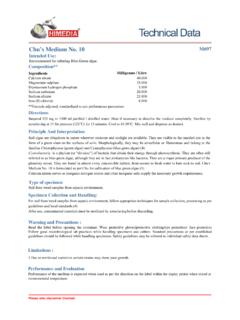
1 Please refer disclaimer 's medium B BaseM1544 Kings medium B base is recommended for non-selective isolation, cultivation and pigment production of Pseudomonas speciesComposition**IngredientsGms / LitreProteose peptone hydrogen sulphate. pH ( at 25 C) **Formula adjusted, standardized to suit performance parametersDirectionsSuspend grams of dehydrated medium in 1000 ml distilled water containing 15 ml of glycerol. Heat to boiling to dissolvethe medium completely. Mix well. Sterilize by autoclaving at 15 lbs pressure (121 C) for 15 minutes. Aseptically pour intosterile Petri And InterpretationPseudomonas aeruginosa is known to produce two types of pigments, pyocyanin and fluorescein which is a characteristicproperty and aids in isolation of Pseudomonas from clinical material. An additional pigment called as pyorubin was reportedby king . Pyocyanin is green while fluorescein is fluorescent yellow and pyorubin is reddish brown. Some strains produce allthese pigments while the others produce one or two pigments.
2 Can be identified on Hugh Leifson medium (M826). Kings medium B base is particularly suited for medium B base is based on the formulation of king et al (1,2). This medium can be used as a general medium for thenon-selective isolation and pigment production of Pseudomonas species from foods, cosmetic samples etc. Agrobacteriumhave been traditionally identified as gram-negative bacteria that do not produce fluorescent pigment on Kings B medium anddo produce tumors (or hairy roots) when inoculated onto test plants (3).These media contain proteose peptone, which provides carbonaceous and nitrogenous compounds for the growth of serves as a source of energy and also enhances pigment production. Magnesium sulphate also enhances pigmentproduction. Pigments and/ or their derivatives produced by Pseudomonas species play a role as siderophores in the iron uptakesystems of bacteria, and hence, their production is markedly enhanced under conditions of iron deficiency.
3 The production ofpigments especially non-fluorescent blue pigment, pyocyanin is readily demonstrated by culturing on Kings medium B, whichcontains no added iron (4). The addition of dipotassium phosphate increases the phosphorus content of the medium therebyenhancing production of fluorescent pigment. For inoculation, use the organisms freshly cultured in Kings medium A, incubateovernight at 37 C and then at room temperature for 6 days. With Kings medium B, incubate at 37 C for 6 ControlAppearanceCream to yellow homogeneous free flowing powderGellingFirm, comparable with Agar gelColour and Clarity of prepared mediumLight yellow coloured, clear to slightly opalescent gel forms in Petri platesReactionReaction of w/v aqueous solution (containing glycerol) at 25 C. pH : LaboratoriesTechnical DataDisclaimer :User must ensure suitability of the product(s) in their application prior to use. Products conform solely to the information contained in thisand other related HiMedia publications.
4 The information contained in this publication is based on our research and development workand is to the best of our knowledge true and accurate. HiMedia Laboratories Pvt Ltd reserves the right to make changes to specificationsand information related to the products at any time. Products are not intended for human or animal diagnostic or therapeutic use but forlaboratory, research or further manufacturing use only, unless otherwise specified. Statements contained herein should not be consideredas a warranty of any kind, expressed or implied, and no liability is accepted for infringement of any Laboratories Pvt. Ltd. A-516,Swastik Disha Business Park,Via Vadhani Ind. Est., LBS Marg, Mumbai-400086, India. Customer care No.: 022-61471919 Email: ResponseM1544: Cultural characteristics observed after an incubation at 35-37 C for 18-24 (CFU)GrowthRecoveryPigmentproductionPseu domonas aeruginosaATCC 1793450-100good-luxuriant>=70%greenish yellowPseudomonas aeruginosaATCC 2785350-100good-luxuriant>=70%greenish yellowPseudomonas aeruginosaATCC 902750-100good-luxuriant>=70%greenish yellowBurkholderia cepacia ATCC2560950-100good-luxuriant>=70%no pigmentStorage and Shelf LifeStore below 30 C in tightly closed container and prepared medium at 2-8 C.
5 Use before expiry period on the E. O., Ward M. K. and Raney D. E., 1954, J. Lab and Clin. Med., 44 P. R., Baron E. J., Jorgensen J. H., Pfaller M. A., Yolken R. H., (Eds.), 8th Ed., 2003, Manual of Clinical Microbiology,ASM, Washington, G., Matthysse, 1998, The Genus Agraobacterium, Chapter Martin Dworkin, 3rd Ed., The Prokaryotes, An EvolvingElectronic Resource for the Micrbiological K., Todars Online Textbook of Bacteriology, University of Wisconsin - Madison, Department of : 2 / 2015