Transcription of Methods Periods and Accounting
1 Userid: CPMS chema: tipxLeadpct: 100%Pt. size: 10 Draft Ok to PrintAH XSL/XMLF ileid: .. ons/P538/201612/A/XML/Cycle02/source(Ini t. & Date) _____Page 1 of 23 9:30 - 9-Feb-2017 The type and rule above prints on all proofs including departmental reproduction proofs. MUST be removed before of the TreasuryInternal Revenue ServicePublication 538(Rev. December 2016)Cat. No. 15068 GAccountingPeriods andMethodsGet forms and other information faster and easier at: (English) (Espa ol) ( ) ( ) (Pусский) (Ti ngVi t) ContentsFuture of Missing Tax Tax in Tax , S Corporations, and Personal Service Corporations (PSCs)..4 Corporations (Other Than S Corporations and PSCs)..7 Accounting in Accounting To Get Tax DevelopmentsThe IRS has created a page on for information about Publication 538, at Information about recent developments affecting Publication 538 will be posted on that taxpayer (individuals, business entities, etc.)
2 Must figure taxable income for an annual Accounting period called a tax year. The calendar year is the most common tax year. Other tax years include a fiscal year and a short tax taxpayer must use a consistent Accounting method, which is a set of rules for determining when to re-port income and expenses. The most commonly used ac-counting Methods are the cash method and the accrual the cash method, you generally report income in the tax year you receive it, and deduct expenses in the tax year in which you pay the the accrual method, you generally report income in the tax year you earn it, regardless of when payment is received. You deduct expenses in the tax year you incur them, regardless of when payment is 09, 2017 Page 2 of 23 Fileid: .. ons/P538/201612/A/XML/Cycle02/source9:30 - 9-Feb-2017 The type and rule above prints on all proofs including departmental reproduction proofs. MUST be removed before publication explains some of the rules for ac counting Periods and Accounting Methods .
3 In some cases, you may have to refer to other sour ces for a more in depth explanation of the and suggestions. We welcome your com-ments about this publication and your suggestions for fu-ture can send us comments from Click on More Information and then on Give us feed-back. Or you can write to:Internal Revenue ServiceTax Forms and Publications1111 Constitution Ave. NW, IR-6526 Washington, DC 20224We respond to many letters by telephone. Therefore, it would be helpful if you would include your daytime phone number, including the area code, in your we cannot respond individually to each email, we do appreciate your feedback and will consider your comments as we revise our tax forms and publications. Visit to download forms and publications. Other-wise, you can go to to order current and prior-year forms and instructions. Your order should arrive within 10 business Questions. If you have a tax question not an-swered by this publication, check and How To Get Tax Help at the end of this of Missing ChildrenThe Internal Revenue Service is a proud partner with the National Center for Missing & Exploited Children (NCMEC).
4 Photographs of missing children selected by the Center may appear in this publication on pages that would otherwise be blank. You can help bring these children home by looking at the photographs and calling 1-800-THE-LOST (1-800-843-5678) if you recognize a ItemsYou may want to see:PublicationInstallment SalesPartnershipsCorporationsForm (and Instructions)Application To Adopt, Change, or Retain a Tax YearTIP 537 541 542 1128 Election by a Small Business CorporationApplication for Change in Accounting MethodElection To Have a Tax Year Other Than a Required Tax YearSee Ordering forms and publications, earlier for informa-tion about getting these publications and PeriodsYou must use a tax year to figure your taxable income. A tax year is an annual Accounting period for keeping re-cords and reporting income and expenses. An annual ac-counting period does not include a short tax year (dis-cussed later). You can use the following tax years:A calendar year; orA fiscal year (including a 52-53-week tax year).
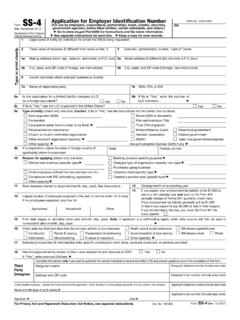
5 Unless you have a required tax year, you adopt a tax year by filing your first income tax return using that tax year. A required tax year is a tax year required under the Internal Revenue Code or the Income Tax Regulations. You cannot adopt a tax year by merely:Filing an application for an extension of time to file an income tax return;Filing an application for an employer identification number (Form SS-4); orPaying estimated section discusses:A calendar fiscal year (including a period of 52 or 53 weeks).A short tax improper tax change in tax situations that apply to that apply to the Accounting period of a partnership, S corporation, or personal service situations that apply to YearA calendar year is 12 consecutive months beginning on January 1st and ending on December you adopt the calendar year, you must maintain your books and records and report your income and expenses from January 1st through December 31st of each you file your first tax return using the calendar tax year and you later begin business as a sole proprietor, be-come a partner in a partnership, or become a shareholder in an S corporation, you must continue to use the calendar year unless you obtain approval from the IRS to change it, 2553 3115 8716 Page 2 Publication 538 (December 2016)Page 3 of 23 Fileid.
6 Ons/P538/201612/A/XML/Cycle02/source9:30 - 9-Feb-2017 The type and rule above prints on all proofs including departmental reproduction proofs. MUST be removed before are otherwise allowed to change it without IRS appro-val. See Change in Tax Year, , anyone can adopt the calendar year. How-ever, you must adopt the calendar year if:You keep no books or records;You have no annual Accounting period;Your present tax year does not qualify as a fiscal year; orYou are required to use a calendar year by a provision in the Internal Revenue Code or Income Tax YearA fiscal year is 12 consecutive months ending on the last day of any month except December 31st. If you are al-lowed to adopt a fiscal year, you must consistently main-tain your books and records and report your income and expenses using the time period Tax YearYou can elect to use a 52-53-week tax year if you keep your books and records and report your income and ex-penses on that basis. If you make this election, your 52-53-week tax year must always end on the same day of the week.
7 Your 52-53-week tax year must always end on:Whatever date this same day of the week last occurs in a calendar month, orWhatever date this same day of the week falls that is nearest to the last day of the calendar To make the election for the 52-53-week tax year, attach a statement with the following information to your tax month in which the new 52-53-week tax year day of the week on which the tax year always date the tax year ends. It can be either of the fol-lowing dates on which the chosen occurs in the month in (1), above, nearest to the last day of the month in (1), you figure depreciation or amortization, a 52-53-week tax year is generally considered a year of 12 calendar determine an effective date (or apply provisions of any law) expressed in terms of tax years beginning, in-cluding, or ending on the first or last day of a specified cal-endar month, a 52-53-week tax year is considered to:Begin on the first day of the calendar month beginning nearest to the first day of the 52-53-week tax year, andEnd on the last day of the calendar month ending nearest to the last day of the 52-53-week tax Assume a tax provision applies to tax years beginning on or after July 1, which (for purposes of this example) happens to be a Sunday.
8 For this purpose, a 52-53-week tax year that begins on the last Tuesday of June, which falls on June 26, is treated as beginning on July Tax YearA short tax year is a tax year of less than 12 months. A short period tax return may be required when you (as a taxable entity):Are not in existence for an entire tax year, orChange your Accounting on a short period tax return is figured differently for each in Existence Entire YearEven if a taxable entity was not in existence for the entire year, a tax return is required for the time it was in exis-tence. Requirements for filing the return and figuring the tax are generally the same as the requirements for a re-turn for a full tax year (12 months) ending on the last day of the short tax 1. XYZ Corporation was organized on July 1. It elected the calendar year as its tax year. The corpora-tion s first tax return will cover the short period from July 1 through December 2. A calendar year corporation dissolved on July 23.
9 The corporation s final return will cover the short period from January 1 through July of individual. Although the return of the decedent is a return for the short period beginning with the first day of his last taxable year and ending with the date of his death, the filing of a return and the payment of tax for the decedent may be made as though the decedent had lived throughout his last taxable year. The decedent s tax return must be filed for the decedent by the 15th day of the 4th month after the close of the individual's regular tax year. If the due date falls on a Saturday, Sunday, or legal holiday, file by the next business day. The decedent's final return will be a short period tax return that begins on January 1st, and ends on the date of death. In the case of a dece-dent who dies on December 31st, the last day of the regu-lar tax year, a full calendar-year tax return is Tax for Short YearIf the IRS approves a change in your tax year or if you are required to change your tax year, you must figure the tax and file your return for the short tax period.
10 The short tax period begins on the first day after the close of your old tax year and ends on the day before the first day of your new tax 538 (December 2016) Page 3 Page 4 of 23 Fileid: .. ons/P538/201612/A/XML/Cycle02/source9:30 - 9-Feb-2017 The type and rule above prints on all proofs including departmental reproduction proofs. MUST be removed before tax for a short year under the general rule, ex-plained below. You may then be able to use a relief proce-dure, explained later, and claim a refund of part of the tax you rule. Income tax for a short tax year must be an-nualized. However, self-employment tax is figured on the actual self-employment income for the short An individual must figure income tax for the short tax year as your adjusted gross income (AGI) for the short tax year and then subtract your actual itemized deductions for the short tax year. You must itemize deductions when you file a short period tax the dollar amount of your exemptions by the number of months in the short tax year and divide the result by the amount in (2) from the amount in (1).