Example: dental hygienist
MICROENCAPSULATION - Jiwaji University
Conventional light microscopy-Used to determine the shape and outer structure of the microparticles. Scanning electron microscopy-It can be used for the investigation of double walled systems. Conflocal fluorescence microscopy-35 used for the structure characterization of multiple walled microspheres.
Tags:
Information
Domain:
Source:
Link to this page:
Documents from same domain

JIWAJI UNIVERSITY, GWALIOR
www.jiwaji.eduJIWAJI UNIVERSITY, GWALIOR (NAAC Accredited “A” Grade)ADMISSION NOTIFICATION 2018-19 Online Applications are invited for admission to the following academic programs being offered by the University at its campus for the academic year 2018 …

JIWAJI UNIVERSITY, GWALIOR
www.jiwaji.eduJIWAJI UNIVERSITY, GWALIOR (NAAC Accredited “A” Grade) ADMISSION NOTIFICATION 2017-18 Online Applications are invited for admission to the following academic programs being offered by the University at its campus for …
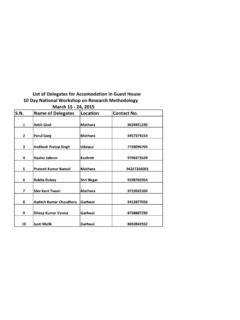
List of Delegates for Accomodation in Guest …
www.jiwaji.edu11 Shankar Dayal Garhwal 9450102683 12 Layak Singh Bansal Shivpuri 9893671058 13 Santosh Rathore Lalitpur 9450034057 14 Swikrati Singh Jhansi 8853777955
www.jiwaji.edu
www.jiwaji.eduCreated Date: 3/9/2015 1:14:51 PM

Summary of the Résumé of Prof. Sangeeta Shukla
www.jiwaji.eduSummary of the Résumé of Prof. Sangeeta Shukla 1. Present Position : Vice Chancellor School of Studies in Zoology Jiwaji University, Gwalior

1442 fnukad % 20 -062013 @ @ vf/klwpuk - Jiwaji University
www.jiwaji.edujiwaji university, gwalior result of : b.sc. sixth semester exam.june-2013 ----- first div.

JIWAJI UNIVERSITY, GWALIOR
www.jiwaji.eduEnzyme Technology 19 No Change 2 Divya Gurjar 1272004 1. Enzyme Technology 38 No Change 2. Envir. Biotechnology & Animal Biotechnology 22 No Change 3 Mohit Garg 1272163 1. Immunotechnology 17 33 Change 2. Enzyme Technology 15 No Change 4 Abhijeet Thakur 1272251 1. Enzyme Technology …
EVALUATION OF CRUDE DRUGS - Jiwaji University
www.jiwaji.eduEg. Eucalyptus oil (0oc to +10oc), honey (+3oc to -15oc) 4) Refractive index- It is defined as the property of a material that changes the speed of light, computed as the ratio of the speed of light in a vacuum to the speed of light through the material. when light travels at an angle between two

GOOD WAREHOUSING PRACTICES - Jiwaji University
www.jiwaji.eduSidney H. Willing ,Good manufacturing Practices For Pharmaceutics , 1 st edition,, page no:173-76. DR.MGR , Ananth Vannemsetty , Tinu Thomas ,Consise text book of QC & Q.A , ,Page no: 222 –231. Available on who.int (Surfing on 19-11-11). Also available in revised schedule-M (Surfing on 19-11-11). 29

PACKAGING PHARMACEUTICAL PACKAGING
www.jiwaji.eduShrink wrapper The shrink wrap concept involves the packaging of the product in a thermoplastic film that has been stretched and oriented during its manufacture. An L shaped sealer seals the over wrap The major advantage of this type of wrapper are the flexibility
Related documents
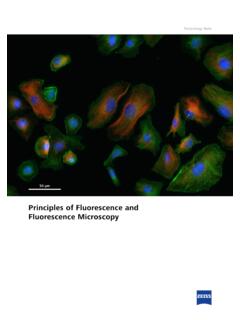
Principles of Fluorescence and Fluorescence Microscopy
pages.zeiss.comFluorescence microscopy can be based on autofluorescence or the addition of fluorescent dyes. It is mainly used in biology and medicine to observe structures and processes within a specimen. Introduction In 1852, the Irish physicist and mathematician Sir George Gabriel Stokes first observed fluorescence when sunlight, filtered

MGITTM Procedure Manual - FIND
www.finddx.orgMicroscopy 4. Reporting . MGITTM Procedure Manual 4 ... The introduction of the BACTEC 460 TB System revolutionized laboratory ... resulting in fluorescence within the MGIT tube when visualized under UV light. The intensity of fluorescence is directly proportional to the

Spectroscopy: Principles, Theory, Techniques and Applications
mazams.weebly.comFluorescence spectroscopy uses higher energy photons to excite a sample, which will then emit lower energy photons. This technique has become popular for its biochemical and medical applications, and can be used for confocal microscopy, fluorescence resonance energy transfer, and fluorescence lifetime imaging. X-ray When X-rays of sufficient

Lipophilic Tracers—Dil, DiO, DiD, DiA, and DiR
tools.thermofisher.commoderate fluorescence quantum yields, and short excited state lifetimes in lipid environments (~1 ns).34 They are insoluble in water, but their fluorescence is readily detected when incorpo-rated into membranes. A summary of spectral properties is shown in Table 2, together with appr o priate filter sets for fluorescence microscopy applications

AFB Smear Microscopy - APHL
www.aphl.orgFluorescence Microscopy • A fluorescence microscope is required for examining fluorochrome-stained smears: –Mercury vapor or halogen bulb light source (about 150 hours of use) –Newer mercury bulbs (about 2,000 hours of use) –LED Bulbs (about 15,000 hours of use) –Excitation and emission (barrier) filters are necessary for

MICROSCOPY I. OBJECTIVES II. INTRODUCTION
www.sas.upenn.eduII. INTRODUCTION There are several types of microscope (simple, compound, light or bright-field, dark-field, electron, fluorescence, interference, etc.) but the one most commonly used for bacteriological purposes is the bright-field or light microscope. This microscope is
Propidium Iodide Nucleic Acid Stain - Thermo Fisher Scientific
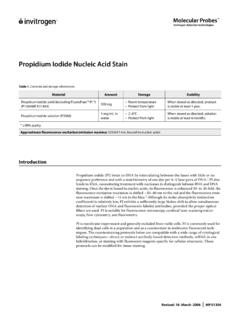
assets.thermofisher.comApproximate fluorescence excitation/emission maxima: 535/617 nm, bound to nucleic acids Propidium Iodide Nucleic Acid Stain Introduction Propidium iodide (PI) binds to DNA by intercalating between the bases with little or no sequence preference and with a stoichiometry of one dye per 4–5 base pairs of DNA.1 PI also
Immunocytochemistry (ICC) - Novus Biologicals
images.novusbio.comFluorescence quantum yield is a measurement of emission efficiency and is calculated by the formula: ΦF = number of emitted photons/number of absorbed photons. The maximum quantum yield possible (ΦF = 1) signifies a 100% efficient fluorescence process. An example of a fluorochrome with high quantum yield is Alexa Fluor® 488 which has ΦF= 0.92.