Transcription of MOSTOVOY Improving Returns-Based Style …
1 Improving Returns-Based Style Analysis Autumn, 2007. Daniel MOSTOVOY Northfield Information Services Main Points For Today Over the past 15 years, Returns-Based Style Analysis become a very widely used analytical method We're going to review RBSA and discuss useful several improvements to the basic technique confidence Intervals Testing for Regime Change Kalman Filter / Exponential Weighting Adjusting for Heteroscedasticity Recently, RBSA has gained a new usage in connection with hedge fund replication strategies 2.
2 Basic RBSA. First introduced as Effective Asset Mix Analysis . by Sharpe (1988, 1992). Given a time series of returns of a fund, we try to find the mix of market indices that most closely fits the fund returns Rt = j = 1 to n WjRjt + t Rt is the return on the fund during period t Wj is the weight of index j Rjt is the return on index j during period t N is the number of indices t is the residual for period t Sum of Wj = 1, 0 < Wj < 1. Basically an OLS multiple regression with constrained coefficients 3. Refinement #1.
3 confidence Intervals Like any other estimate we need to know if our Style weights results are meaningful A Style weight estimate of 10% small cap value . isn't very useful if its really 10% +/- 50% . We can only analyze a fund to the extent that the spanning indices are not linear combinations of each other Correlation between the spanning indices can frequently cause very large confidence intervals on Style weights, as the constraints on the coefficients mask multicolinearity that would be observable in an OLS regression 4.
4 confidence interval Problem Was Solved a While Ago Lobosco, Angelo and Dan DiBartolomeo. Approximating The confidence Intervals For Sharpe Style Weights, Financial Analyst Journal, 1997, v53(4,Jul/Aug), 80-85. Oddly, most commercial Style analysis software packages still do not incorporate any form of confidence interval on the results 5. Refinement #2. Allowing Leverage Some portfolios such as hedge funds employ explicit leverage Other funds have portfolio properties that are possibly outside the range of the spanning indices An equity portfolio with a beta higher than any available A bond portfolio with maturities longer than any available index Solution is to include a cash equivalent among the spanning indices and allow negative weights, provided that the sum of weights is still constrained to one.
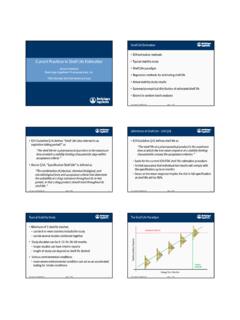
5 6. Refinement #3. Testing for Regime Changes Do we want to look at fund results over the last 3 years, 5. years, 32 months, etc. ? CUSUM is an optimum statistic to determine the change in the mean of a process Was adapted for the purposes of monitoring external asset managers by the IBM pension fund Use CUSUM based methods to determine the optimal "look- back" period for the Style analysis Mathematically: What is the look back date such that the cumulative active return between then and now is least likely to have come about by random chance?
6 Forthcoming paper by Bolster, diBartolomeo and Warrick summarized in our February 2005 newsletter 7. Refinement #4. Capturing Recent Influences Traditional Style weights represent the fund average behavior over a time sample What we should be worried about is a fund that has changed Style recently, rendering average past information useless One Approach Plot the absolute value of the residual against time during the sample If the slope is positive, the fit is getting worse as we come forward in time. Exponentially weight observations until the slope is not statistically significantly positive Another way is to use Kalman filtering Swinkels, Laurens and Peter Van Der Sluis, Returns based Style Analysis with Time Varying Exposures , ABP Working Paper, 2001.
7 Kalman filtering requires use of Markov Chain Monte- Carlo analysis if Style weights are constrained to be 8. positive Refinement #5. Asking the Right Question An easy experiment Nine year sample period from 1998 through 2006. Make up a monthly return stream for a hypothetical fund whose returns are equal to the S&P 500 for 1/3 of the 9. years, equal to the FTSE Europe for 1/3 of the 9 years, and equal to the Merrill Lynch Global High Yield for 1/3 of the 9 years First intuition suggests Style weights should be 1/3 S&P.
8 500, 1/3 FTSE Europe and 1/3 MLGHY. Generally WRONG. It depends on the order of events 9. A Curious Result SE R^2 S&P FTSE MLGHY. FTMLSP FTSPML MLFTSP MLSPFT SPFTML SPMLFT 0 10. What's Going On The results are order dependent The Style analysis process, like a regression is minimizing the sum of squared residuals The volatility of markets is different across the three sub-periods, and the more volatile periods are counted more heavily Not only do the weights vary across the different orders but goodness of fit changed a lot too Variation in alpha estimates ranged from to + This huge difference in alpha arises from the accidental market timing arising from the ordering Averaged across all six possible orders we get our expected result of 1/3, 1/3, 1/3 for weights 11.
9 Refinement #5. Asking the Right Question The more volatile periods do count for more in the returns experienced by investors If we want to know what market returns influenced the returns of the fund, this is the right answer This corresponds to Sharpe's original concept of Effective Asset Mix . But if we want to know whether a manager's Style was consistent with a prescribed strategy, we have to filter out the effects of heteroscedasticity within the sample period For each time period calculate the spanning dispersion , the average absolute difference in return between all possible pairs within the spanning indices Weight the observations inversely with the square root of the dispersion 12.
10 Refinement #6. Volatility based Spanning Indices Many hedge fund strategies are predicted on the level of market volatility, rather than expected returns Purported uncorrelated with the direction of markets ( writing option spreads). Fung and Hsieh (2002) suggest spanning indices that are volatility related Relative returns between mortgage backed securities and coupon bonds are sensitive to interest rate volatility Bondarenko (2004) constructs a index where the return is based on the difference between implied and realized OEX volatility diBartolomeo (2006) reviews literature on dispersion of security returns within asset classes, 13.