Transcription of PRACTICE Script Language User's Guide - Lauterbach
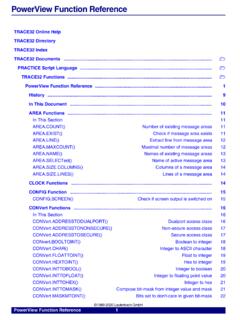
1 PRACTICE Script Language user s Guide 1 1989-2018 Lauterbach GmbHPRACTICE Script Language user s GuideTRACE32 Online Help TRACE32 Directory TRACE32 Index TRACE32 Documents .. PRACTICE Script Language .. PRACTICE Script Language User's Guide ..1 History ..2 Why Use PRACTICE Scripts ..3 Related Documents ..3 PRACTICE Script Structure ..4 Function4 Difference between Variables and PRACTICE Macros4 PRACTICE Script Elements5 Script Flow6 Conditional Script Flow7 Script Nesting7 Block Structures8 PRACTICE Macros (Variables)9 Parameter Passing11 Input and Output12 File Operations.
2 13 Automatic Start-up Scripts ..14 Debugging PRACTICE Scripts ..15 External Editors and Syntax Highlighting ..17 Configuring an External Editor17 Working with TRACE32 and the External Editor18 Appendix A ..19 How to Run Demo Scripts Copied from the PDF Manuals19 Demo Scripts in the TRACE32 Demo Folder22 PRACTICE Script Language user s Guide 2 1989-2018 Lauterbach GmbHPRACTICE Script Language user s GuideVersion 22-Mar-2018 History09-Aug-17 The chapter Automatic Start-up Scripts has been revised and describes the new behavior.
3 PRACTICE Script Language user s Guide 3 1989-2018 Lauterbach GmbHWhy Use PRACTICE ScriptsUsing PRACTICE scripts (*.cmm) in TRACE32 will help you to: Execute commands right on start of the debugger Customize the TRACE32 PowerView user interface to your project requirements Set up the debugger with settings for the board Standardize repetitive and complex actions Initialize the target ( the memory to load an application) Load the application and / or the symbols Add your own and extend available features Speed up debugging through automation Share the debugger methods with other users and empower them to work more efficiently Make debug actions reproducible for verification purposes and regression testsRelated Documents Training Script Language PRACTICE ( ).
4 Describes how to run and create PRACTICE Script files (*.cmm). PRACTICE Script Language Reference Guide ( ) PRACTICE Reference Card ( ) Video Tutorials ( ) PRACTICE Script Language user s Guide 4 1989-2018 Lauterbach GmbHPRACTICE Script StructureFunctionPRACTICE is a line-oriented test Language which can be used to solve all usual problems of digital measurement engineering. PRACTICE -II is an enhanced version of this test Language , first developed in 1984 for in-circuit emulators. The test Language allows interactive Script development with the possibility of a quick error removal and an immediate Script execution.
5 The execution of PRACTICE testing scripts can be stopped and restarted at any time. PRACTICE contains an extremely powerful concept for handling Script variables and command parameters. This macro concept allows to substitute parameters at any point within the commands. Since PRACTICE variables can only occur as PRACTICE macros, conflicts between target program names are ruled between Variables and PRACTICE MacrosPRACTICE macros are based on a simple text replacement mechanism similar to C preprocessor macros. However, in contrast to C preprocessor macros, a PRACTICE macro can change its contents during it s life time by simply assigning a new time the PRACTICE interpreter encounters a macro it is replaced with the corresponding character sequence.
6 Only after performing all text replacements the resulting line is interpreted (just like the C compiler only works on the fully preprocessed text). PRACTICE macros are declared using the commands PRIVATE or LOCAL or visibility of PRACTICE macros differs notably from other Script languages (unless declared using the PRIVATE command): they are accessible from all subsequently executed code while they are alive in: Subroutines (GOSUB .. RETURN) Sub-scripts (DO .. ENDDO) Sub-blocks (IF .., RePeaT, WHILE, etc.)NOTE: PRACTICE does not know the concept of variables with a corresponding type like uint32 or uint8 in C. PRACTICE Script Language user s Guide 5 1989-2018 Lauterbach GmbHPRACTICE Script ElementsPRACTICE scripts consist of labels, commands, and comments: LabelsLabels always start in the first column and are always followed by a colon.
7 Labels are case are prefaced by a semicolon ; or two forward slashes //.Inline comments for Var.* commands must start with two forward slashes //.Line Continuation CharacterTo continue a string on the next line, a backslash \ is used to indicate a line continuation in a PRACTICE Script (*.cmm). No white space permitted after the backslash. If the line continuation character is used at the end of a comment line, then the next line is interpreted as a comment line as well. func7( , ) //execute a function in the "Please switch ON the TRACE32 debugger first"+\" and then switch ON the target board."//examplecomment starting with //start:labelStepcommandGOTO startcommand and labelB::command to change the default preceded by a device selector;examplecomment starting with ; PRACTICE Script Language user s Guide 6 1989-2018 Lauterbach GmbHScript FlowSeveral commands allow to control the Script flow.
8 Scripts may be divided in several modules. Subroutines within a module are called by the GOSUB command, another module is called by the DO temporarilyENDT erminate Script and clear stackCONT inueContinue with Script executionDOCall Script moduleENDDOT erminate Script moduleRUNC lear PRACTICE stack and call moduleGOSUBCall subroutineRETURNR eturn from subroutineGOTOB ranch within moduleJUMPTOB ranch to other module PRACTICE Script Language user s Guide 7 1989-2018 Lauterbach GmbHConditional Script FlowConditional Script execution is made by several commands:For detailed information on logical operations refer to chapter Operators in IDE user s Guide ( ).
9 Script NestingPRACTICE scripts can be nested hierarchically. A second Script may be called as a subroutine from the initial Script . This subroutine on its part may call up a third Script as a subroutine. This allows a structured, modular Script block executionELSEB lock that is only compiled when the IF condition is falseWHILEC onditional Script loopRePeaTRepetitive Script loopONEvent-controlled PRACTICE Script executionGLOBALONG lobal event-controlled PRACTICE Script executionWAITWait for event or delay timeIF ( )PRINT "File exists"ELSEPRINT "File doesn't exist"WHILE Register(pc)==0x1000 Step; step until pc = 1000 HRePeaT 100.
10 Step; step 100 timesRePeaT 0. Step; step endlessON ERROR GOTO errorexit; Script containing two Script callsPRINT "Start"DO modul1DO modul2 ENDDO; Execute Script module 1; Execute Script module 2 PRACTICE Script Language user s Guide 8 1989-2018 Lauterbach GmbHBlock StructuresSeveral PRACTICE commands can be combined to form a block. A block is a collection of commands, which are always executed simultaneously. Blocks usually require IF, WHILE, or RePeaT statements. They can, however, be implemented anywhere in order to mark connective blocks. Blocks are marked by round parentheses. You can jump out of a block, but not into a block.