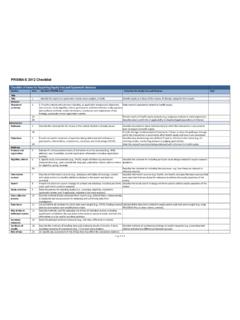
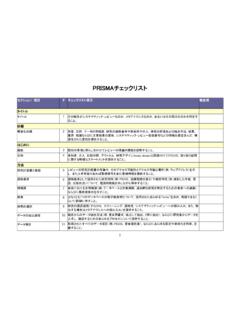
Transcription of PRISMA 2020 expanded checklist
1 From: Page MJ, McKenzie JE, Bossuyt PM, Boutron I, Hoffmann TC, Mulrow CD, et al. The PRISMA 2020 statement: an updated guideline for reporting systematic reviews. BMJ 2021;372:n71. doi: For more information, visit: PRISMA 2020 expanded checklist Note: This expanded checklist details elements recommended for reporting for each PRISMA 2020 item. Non-italicized elements are considered essential and should be reported in the main report or as supplementary material for all systematic reviews (except for those preceded by , which should only be reported where applicable). Elements written in italics are additional , and while not essential, provide supplementary information that may enhance the completeness and usability of systematic review reports. Note that elements presented here are an abridged version of those presented in the explanation and elaboration paper (BMJ 2021;372:n160), with references and some examples removed.
2 Consulting the explanation and elaboration paper is recommended if further clarity or information is required. Section and Topic Item # Elements recommended for reporting TITLE TITLE 1 Identify the report as a systematic review in the title. Report an informative title that provides key information about the main objective or question the review addresses ( the population(s) and intervention(s) the review addresses). Consider providing additional information in the title, such as the method of analysis used, the designs of included studies, or an indication that the review is an update of an existing review, or a continually updated ( living ) systematic review. ABSTRACT ABSTRACT 2 Report an abstract addressing each item in the PRISMA 2020 for Abstracts checklist . INTRODUCTION RATIONALE 3 Describe the current state of knowledge and its uncertainties. Articulate why it is important to do the review.
3 If other systematic reviews addressing the same (or a largely similar) question are available, explain why the current review was considered necessary. If the review is an update or replication of a particular systematic review, indicate this and cite the previous review. If the review examines the effects of interventions, also briefly describe how the intervention(s) examined might work. If there is complexity in the intervention or context of its delivery (or both) ( multi-component interventions, equity considerations), consider presenting a logic model to visually display the hypothesised relationship between intervention components and outcomes. OBJECTIVES 4 Provide an explicit statement of all objective(s) or question(s) the review addresses, expressed in terms of a relevant question formulation framework. If the purpose is to evaluate the effects of interventions, use the Population, Intervention, Comparator, Outcome (PICO) framework or one of its variants, to state the comparisons that will be made.
4 METHODS ELIGIBILITY CRITERIA 5 Specify all study characteristics used to decide whether a study was eligible for inclusion in the review, that is, components described in the PICO framework or one of its variants, and other characteristics, such as eligible study design(s) and setting(s), and minimum duration of follow-up. Specify eligibility criteria with regard to report characteristics, such as year of dissemination, language, and report status ( whether reports, such as unpublished manuscripts and conference abstracts, were eligible for inclusion). Clearly indicate if studies were ineligible because the outcomes of interest were not measured, or ineligible because the results for the outcome of interest were not reported. Specify any groups used in the synthesis ( intervention, outcome and population groups) and link these to the comparisons specified in the objectives (item #4). Consider providing rationales for any notable restrictions to study eligibility.
5 From: Page MJ, McKenzie JE, Bossuyt PM, Boutron I, Hoffmann TC, Mulrow CD, et al. The PRISMA 2020 statement: an updated guideline for reporting systematic reviews. BMJ 2021;372:n71. doi: For more information, visit: Section and Topic Item # Elements recommended for reporting INFORMATION SOURCES 6 Specify the date when each source ( database, register, website, organisation) was last searched or consulted. If bibliographic databases were searched, specify for each database its name ( MEDLINE, CINAHL), the interface or platform through which the database was searched ( Ovid, EBSCO host), and the dates of coverage (where this information is provided). If study registers, regulatory databases and other online repositories were searched, specify the name of each source and any date restrictions that were applied. If websites, search engines or other online sources were browsed or searched, specify the name and URL of each source.
6 If organisations or manufacturers were contacted to identify studies, specify the name of each source. If individuals were contacted to identify studies, specify the types of individuals contacted ( authors of studies included in the review or researchers with expertise in the area). If reference lists were examined, specify the types of references examined ( references cited in study reports included in the systematic review, or references cited in systematic review reports on the same or similar topic). If cited or citing reference searches (also called backward and forward citation searching) were conducted, specify the bibliographic details of the reports to which citation searching was applied, the citation index or platform used ( Web of Science), and the date the citation searching was done. If journals or conference proceedings were consulted, specify of the names of each source, the dates covered and how they were searched ( handsearching or browsing online).
7 SEARCH STRATEGY 7 Provide the full line by line search strategy as run in each database with a sophisticated interface (such as Ovid), or the sequence of terms that were used to search simpler interfaces, such as search engines or websites. Describe any limits applied to the search strategy ( date or language) and justify these by linking back to the review s eligibility criteria. If published approaches, including search filters designed to retrieve specific types of records or search strategies from other systematic reviews, were used, cite them. If published approaches were adapted, for example if search filters are amended, note the changes made. If natural language processing or text frequency analysis tools were used to identify or refine keywords, synonyms or subject indexing terms to use in the search strategy, specify the tool(s) used. If a tool was used to automatically translate search strings for one database to another, specify the tool used.
8 If the search strategy was validated, for example by evaluating whether it could identify a set of clearly eligible studies, report the validation process used and specify which studies were included in the validation set. If the search strategy was peer reviewed, report the peer review process used and specify any tool used such as the Peer Review of Electronic Search Strategies (PRESS) checklist . If the search strategy structure adopted was not based on a PICO-style approach, describe the final conceptual structure and any explorations that were undertaken to achieve it. SELECTION PROCESS 8 Recommendations for reporting regardless of the selection processes used: Report how many reviewers screened each record (title/abstract) and each report retrieved, whether multiple reviewers worked independently at each stage of screening or not, and any processes used to resolve disagreements between screeners.
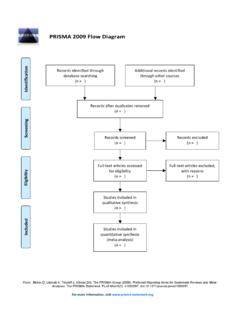
9 Report any processes used to obtain or confirm relevant information from study investigators. If abstracts or articles required translation into another language to determine their eligibility, report how these were translated. Recommendations for reporting in systematic reviews using automation tools in the selection process: Report how automation tools were integrated within the overall study selection process. From: Page MJ, McKenzie JE, Bossuyt PM, Boutron I, Hoffmann TC, Mulrow CD, et al. The PRISMA 2020 statement: an updated guideline for reporting systematic reviews. BMJ 2021;372:n71. doi: For more information, visit: Section and Topic Item # Elements recommended for reporting If an externally derived machine learning classifier was applied ( Cochrane RCT Classifier), either to eliminate records or to replace a single screener, include a reference or URL to the version used. If the classifier was used to eliminate records before screening, report the number eliminated in the PRISMA flow diagram as Records marked as ineligible by automation tools.
10 If an internally derived machine learning classifier was used to assist with the screening process, identify the software/classifier and version, describe how it was used ( to remove records or replace a single screener) and trained (if relevant), and what internal or external validation was done to understand the risk of missed studies or incorrect classifications. If machine learning algorithms were used to prioritise screening (whereby unscreened records are continually re-ordered based on screening decisions), state the software used and provide details of any screening rules applied. Recommendations for reporting in systematic reviews using crowdsourcing or previous known assessments in the selection process: If crowdsourcing was used to screen records, provide details of the platform used and specify how it was integrated within the overall study selection process. If datasets of already-screened records were used to eliminate records retrieved by the search from further consideration, briefly describe the derivation of these datasets.