Transcription of Protected Leave Laws
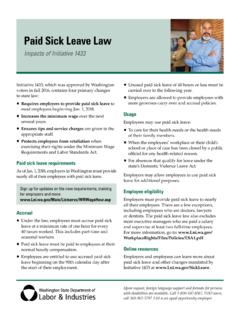
1 December 2019 1 Protected Leave Laws State Laws Department of Labor & Industries Paid Sick Leave (RCW ; WAC 296-128) Applies to Washington workers unless they do not meet the definition of employee under the Minimum Wage Act (MWA) or an employee has no accrued, unused paid sick Leave hours available for use. Employees must be allowed to accrue at least one hour of paid sick Leave for every 40 hours worked. Employees may use their accrued, unused paid sick Leave for one of the following authorized purposes: to care for an employee s self; to care for an employee s family member ; when the employee s place of business has been closed by order of a public official for any health-related reason, or the employee s child s school or place of care has been closed for such a reason; absences that qualify for Leave under the Domestic Violence Leave Act; and additional purposes allowed by the employer.
2 Family members included in the paid sick Leave law: a child, including a biological, adopted, or foster child, stepchild, or a child to whom the employee stands in loco parentis, is a legal guardian, or is a de facto parent, regardless of age or dependency status; a biological, adoptive, de facto, or foster parent, stepparent, or legal guardian of an employee or the employee's spouse or registered domestic partner, or a person who stood in loco parentis when the employee was a minor child; a spouse; a registered domestic partner; a grandparent; a grandchild; or a sibling. When employees use their accrued, unused paid sick Leave for one of the authorized purposes, they must be paid the greater of the minimum hourly wage rate established in the MWA or their normal hourly compensation. Family Care Act (RCW ; WAC 296-130) Applies to all employers who provide a paid Leave benefit.
3 Does not apply if an employee has no paid Leave available or is not yet entitled to use earned paid Leave (as in a probationary period). Employees can use their choice of earned paid Leave such as sick Leave , vacation, holiday, paid time off (PTO), and some short-term disability plans for family care purposes. Family members included in the Family Care Act are: spouses, registered domestic partners, children, parents, parents-in-law, and grandparents with a serious health condition or an emergency condition. Includes use of earned paid Leave to care for a child < 18 with a health condition that requires treatment or supervision, including preventive care or for an adult child 18 who cannot care for him or herself because of disability. Includes short-term care of a spouse or registered domestic partner temporarily disabled because of pregnancy or childbirth.
4 December 2019 2 Paid Family and Medical Leave (PFML) (RCW ) Washington State program that offers workers the opportunity to receive partial wage replacement for certain qualifying life events. Qualifying events can include: birth or placement of a new child into a family, recovery from a serious illness or injury, treatment of a chronic health condition, inpatient treatment for substance abuse or mental health, taking care of a family member with a serious health condition, and certain military events. Covers most Washington workers who have worked 820 hours in approximately the last year. Those exempted from the plan include federal employers and employees, federally recognized tribes, and self-employed individuals (unless opted in). Most eligible employees can take up to 12 weeks of paid Leave a year. If you give birth to a baby, you might be eligible for 16 to 18 weeks of paid Leave .
5 You may take the Leave intermittently. The amount of pay you receive from the state during the Leave is based on a percentage of your typical weekly earnings . Paid Family and Medical Leave is funded through small contributions that come from both workers and employers. Paid Family and Medical Leave is administered by the Employment Security Department visit for more details. *Family Leave Act sunsets on December 31, 2019 Leave for Victims of Domestic Violence, Sexual Assault & Stalking (RCW ) Provides job protection for employees who are victims or whose family members are victims of domestic violence, sexual assault or stalking. Family members include a child, a spouse, a parent, a parent-in-law, a grandparent or a person the employee is dating. Leave may be taken for legal or law enforcement assistance, medical treatment, counseling, obtaining services from a shelter or a victim s advocate program, or for safety planning or relocation.
6 Provides as much Leave as is reasonable under the circumstances. Employers may not refuse to make reasonable safety accommodations. Employees may choose unpaid or paid Leave if available such as sick Leave or vacation. Employers may not discriminate or retaliate against an individual because the individual is a victim or perceived victim of domestic violence, including refusing to hire qualified job applicants because the individual is an actual or perceived victim. All public and private employers are covered, regardless of size. If no emergency or unforeseen circumstances exist, the employee must give advance notice of intent to take Leave consistent with the employer s stated policy for requesting such Leave . The employee must give notice no later than the end of the first day of the Leave to qualify, even in emergency circumstances. December 2019 3 Leave for Spouses of Deployed Military Personnel (RCW ) Provides job protection for spouses or registered domestic partners of military personnel (active duty, national guard, or reserves).
7 All employers, public and private, are covered, regardless of size. An employee who works 20 hours per week on average is covered. Covered employees can take up to 15 days unpaid Leave to spend time together after receiving notice of an impending call or order to active duty and during the military member s Leave from deployment during times of military conflict. This law does not provide for Leave at the end of a deployment. Leave is without pay unless the employee has accrued paid Leave and chooses to substitute paid Leave for unpaid Leave . Employees must give notice of intent to take military family Leave within five business days of receiving official notice of the deployment or the Leave from deployment in order for the Leave to qualify for job protection. Leave for Certain Emergency Services Personnel (RCW ) Public and private employers who employed 20 full time equivalent employees in the previous year are covered.
8 Volunteer firefighters, reserve officers or civil air patrol members are covered. Provides job protection to covered employees responding to, working at, or returning from a fire alarm or emergency call. Volunteer firefighters must be on the alarm or emergency call and ordered to remain at the scene by the commanding authority in order to be covered. Does not provide Leave for participating in training or other nonemergency activities. Complaints must be filed within 90 days. Federal Law Department of Labor Family and Medical Leave Act (FMLA) Employers with 50 employees within 75-mile radius; employees with 1,250 hours in past year. Provides job protection for 12 weeks Leave to care for self or family member with serious health condition: includes spouse, child, or parent. L&I has no enforcement authority call Department of Labor, Seattle District Office, at 206-398-8039 or visit the Department of Labor Wage and Hour Division s webpage on FMLA.
9 December 2019 4 Washington Leave Law Paid or Unpaid Leave Family Members Covered Leave Allowed Employer-Employee Criteria Paid Sick Leave RCW WAC 296-128 Paid sick Leave only applies when employees have accrued, unused Leave for use Child, a parent, a spouse, a registered domestic partner, a grandparent, a grandchild, or a sibling Employees must be allowed to accrue at least one hour of paid sick Leave for every 40 hours worked. Employees may use their accrued, unused paid sick Leave to care for an employee s self; to care for an employee s family member ; when the employee s place of business, or the employee s child s school or place of care has been closed by order of a public official for any health-related reason; absences that qualify for Leave under the Domestic Violence Leave Act; and additional purposes allowed by the employer Applies to Washington businesses that meet the definition of employer under the MWA, regardless of employer size; Applies to Washington workers unless they do not meet the definition of employee under the MWA Family Care Act RCW WAC 296-130 Paid Leave Child, spouse, registered domestic partner, parent, parent-in-law, grandparent Use of paid Leave for care of a sick family member No size requirement.
10 Employee must have a paid Leave benefit Paid Family and Medical Leave RCW Paid Leave Child, grandparent, parent, sibling, spouse 12 weeks annually Exception: Can be extended 16 to 18 weeks in some instances related to childbirth With very few exceptions, employers will have a responsibility to report employee wages, hours worked, collect and remit premiums Employers may have an approved voluntary plan Self employed and those employed by a federally recognized tribe may not be automatically eligible. Employee must have worked 820 hours in approximately the last 12 months for a Washington based employer Leave for Victims of Domestic Violence, Sexual Assault, and Stalking RCW WAC 296-135 Unpaid unless employee wishes to substitute paid Leave Child, spouse, parent, parent-in-law, grandparent, or person the employee is dating Reasonable Leave for domestic violence, sexual assault or stalking - for legal, or law enforcement assistance, medical treatment, counseling, victim advocate, safety, or relocation All employers and employees; No eligibility requirements December 2019 5 Leave for Spouses of Military Personnel RCW Employee may choose to substitute paid Leave Spouses of all military personnel 15 days Leave per deployment prior to deployment or when spouse on Leave from deployment All employers.