Example: tourism industry
S°) FOR CHEMICALS (non-math)
1 General Chemistry II Jasperse Entropy, Spontaneity, and Free Energy. Extra Practice Problems General Types/Groups of problems: Evaluating Relative Molar Entropy for Chemicals Calculatingp1 ΔGfor Reactions (Math) p5 Evaluating ΔS for Reactions (non-math) p2 ΔG, ΔH, ΔS, Equilibrium, and Temperature p6 Calculating ΔS for Reactions (Math) p2 Answers p7
Tags:
Information
Domain:
Source:
Link to this page:
Documents from same domain
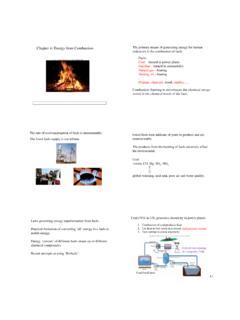
Chapter 4: Energy from Combustion The primary …
web.mnstate.eduChapter 4: Energy from Combustion The primary means of generating energy for human endeavors is the combustion of fuels. Fuels: Coal -burned in power plants Gasoline -burned in automobiles
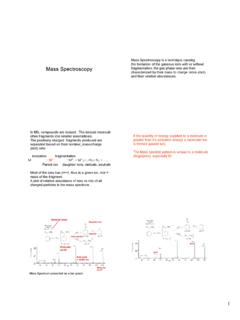
Mass Spectroscopy
web.mnstate.edu1 Mass Spectroscopy Mass Spectroscopy is a technique causing the formation of the gaseous ions with or without fragmentation; the gas phase ions are then

African Environmental Issues - Minnesota State …
web.mnstate.eduAfrican Environmental Issues . Environment in Africa: continuity & change. •Important to consider geological age of Africa & its tropical location. •Both affect
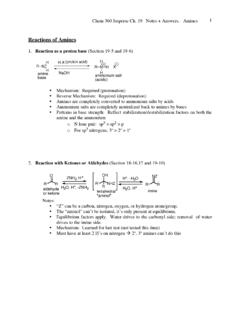
Reactions of Amines - Minnesota State University …
web.mnstate.eduChem 360 Jasperse Ch. 19 Notes + Answers. Amines 1 Reactions of Amines 1. Reaction as a proton base (Section 19-5 and 19-6) RN H H N H R H H X …

Test3 ch17b Buffer-Titration-Equilibrium Practice …
web.mnstate.edu4 Preparation and Recognition of Buffer Systems 14. Which of the following is not a buffer system? A solution containing roughly equal concentrations of _____ a.
Standardization of a Hydrochloric Acid Solution
web.mnstate.eduPage 1 Spring 2011 Standardization of a Hydrochloric Acid Solution The purpose of this experiment is to test your lab technique and examine potential sources of error in

Some Arrow-Pushing Guidelines (Section 1.14)
web.mnstate.eduOrganic Chemistry I Review: Highlights of Key Reactions, Mechanisms, and Principles 1 Some Arrow-Pushing Guidelines (Section 1.14) 1. Arrows follow electron movement.

Recrystallization I 9 Chem 355 Jasperse RECRYSTALLIZATION
web.mnstate.eduRecrystallization I 9 Chem 355 Jasperse RECRYSTALLIZATION Background: Impurities often contaminate organic compounds, whether they have been synthesized in

1. Given the relation R (1 1) (1 3) (1 4) (2 2) (3 1) (3 4 ...
web.mnstate.edu9. For each of the following collections of subsets of A= {1,2,3,4,5}, determine whether of not the collection is a partition. If it is, list the ordered pairs in the equivalence relation determined by the partition.
Gas Chromatograph Gas Chromatography
web.mnstate.eduColumn selection GC: Select a stationary phase that would retain (‘dissolve’) the analytes of interest. Stationary phase polarity ~ analyte polarity; (like dissolves like). Selectivity to individual analytes determines the quality of separation (ability to discern the
Related documents
Spontaneous Processes and Spontaneity, Entropy, Free Energy
ww2.odu.eduSpontaneity, Entropy, and Free Energy Spontaneous Processes and Entropy •Thermodynamics lets us predict whether a process will occur but gives no information about the amount of time required for the process. •A spontaneous process is one that occurs without outside intervention. Figure 16.2: The rate of a reaction depends on the pathway

1 General Chemistry II Jasperse Entropy, Spontaneity, and ...
web.mnstate.edu1 General Chemistry II Jasperse Entropy, Spontaneity, and Free Energy. Extra Practice Problems . General Types/Groups of problems: Evaluating Relative Molar Entropy for Chemicals Calculatingp1 ΔGfor Reactions (Math) p5 Evaluating ΔS for Reactions (non-math) p2 ΔG, ΔH, ΔS, Equilibrium, and Temperature p6 Calculating p2ΔS for Reactions (Math) Answers p7
Reviewing for ACS Final Exam - 1062
webs.anokaramsey.edu• 2nd & 3 rd laws or thermodynamics, entropy and ∆S, free energy and ∆G, spontaneity, relation to the equilibrium constant, work, state function, extensive property, enthalpy and ∆H, Hess’s Law, specific heat capacity • balancing redox reactions, voltaic and electrolytic cells, cell notation, emf, Ecell, electrode
GENERAL CHEMISTRY SECTION IV: THERMODYNAMICS
mccord.cm.utexas.eduThe second law of thermodynamics – the entropy in the universe is always increasing. The third law of thermodynamics – there is an absolute lowest temperature. ... The state function that determines spontaneity is ΔG, the free energy. So if you know the sign of ΔG, an easy way of

Schrodinger Wave Equation for a Particle in One ...
www.dalalinstitute.comEntropy Changes in Reversible and Irreversible Processes ..... 87 Variation of Entropy with Temperature, Pressure and Volume ..... 92 Entropy Concept as a Measure of Unavailable Energy and Criteria for the Spontaneity of Reaction

2004 AP Art History Scoring Guidelines
secure-media.collegeboard.org(ii) Which is more responsible for the spontaneity of the formation reaction at 298 K, the standard enthalpy of formation, ∆HfD, or the standard entropy of formation, ∆SfD? Justify your answer. ∆HfD is the more important factor. The reaction is exothermic, which favors spontaneity. ∆SfD is negative, which means the system becomes more

B. Sc. II YEAR PHYSICAL CHEMISTRY -II
uou.ac.inrod and a zinc rod immersed in aqueous zinc sulphate. But electrical energy is required to do so will be more than the heat energy in the direct reaction. 1.4 CRITERIA OF SPONTANEITY Some important criteria of spontaneous physical and chemical changes are given below.
SOLUBILITY & MISCIBILITY
cpb-us-e2.wpmucdn.comEntropy always increases with solution formation, in other words, ΔS soln > 0 (ΔS soln is always positive). So the spontaneity of solution formation (whether or not a solution will form) depends on the sign of the enthalpy of solution, ΔH soln. Applying Hess’ Law, ΔH soln is the sum of 3 individual enthalpies (ΔH 1 + ΔH 2 + ΔH 3): ΔH

Entropy Changes in Reversible and Irreversible Processes
www.dalalinstitute.comThe entropy is an extensive property measured in joule per Kelvin per mole (JK. −1. mol. −1). The most important significance of entropy is that it can be used to measure the randomness in the system. Entropy Changes in Reversible Processes Suppose that the heat absorbed by the system and heat lost by the surrounding are under completely