Transcription of Section 7 Miscellaneous Titling Information
1 Section 7. Miscellaneous Titling Information Vehicle Section , RSMo, provides that when an application is made for a missouri certificate of title for a motor vehicle previously registered or titled in Identification a state other than missouri (or for a prior salvage vehicle being retained by the Number and owner as provided in Section , RSMo), the application shall be accompanied by a current inspection form certified by an authorized official Odometer inspection station. The inspection shall certify that the manufacturer's Verification identification number for the vehicle has been inspected, that it is correctly displayed on the vehicle and shall certify the reading shown on the odometer Required With at the time of inspection. The inspection must accompany the title application. Out-Of- State If the vehicle is being registered, a current safety and emissions inspection (if applicable) must be submitted.
2 Titles Sections to , RSMo; , RSMo; , RSMo and , RSMo provide that the purchaser of a motor vehicle, trailer, manufactured home, vessel (watercraft), or outboard motor may elect certain forms of ownership or may designate a beneficiary in case of death. These choices must be made at the time application for title is made as outlined below. Tenants In Common (T/C). Tenants in Common/ missouri law presumes that where more than one owner is shown on the title application, the motor vehicle, manufactured home, trailer, vessel (watercraft), or Transfer on outboard motor will be held in joint tenancy unless otherwise specified. This means if one of the owners dies, the surviving owner(s) receives the unit upon Death proof of death. Persons who own the motor vehicle, trailer, manufactured home, vessel (watercraft) or outboard motor as joint tenants may also designate beneficiaries as outlined below. If motor vehicle, trailer, manufactured home, vessel (watercraft), or outboard motor owners do not want their ownership as joint tenancy, they may designate the unit be held as tenants in common.
3 This means each owner owns an equal share of the unit and if one dies, the other owner(s) will still only own his or her share, while the deceased owner's share must transfer by Probate Court. NO BENEFICIARIES MAY BE NAMED BY OWNERS AS. TENANTS IN COMMON. To designate ownership as tenants in common, the T/C block must be marked on the title application. The title will print with the T/C brand code. Transfer On Death (TOD). The owner(s) of a motor vehicle, trailer, manufactured home, vessel (watercraft), or outboard motor may designate one or more beneficiaries to receive the unit upon the death of all listed owners. The beneficiaries hold no ownership rights in the unit while the owner(s) is alive, but becomes the owner/co-owner of the unit after the original owner's death. If more than one person owns the unit, the beneficiaries do not become the owner until all listed owners have died. 7-1.
4 To designate beneficiaries, the beneficiaries name(s) must appear to the right of the owner(s) name(s) in the space provided for TOD beneficiaries and the TOD block must be marked. One or more beneficiaries can be named. The letters TOD and the beneficiaries name(s) do not have to appear on the title assignment. For the beneficiaries to obtain title to a motor vehicle, trailer, manufactured home, vessel (watercraft), or outboard motor, the beneficiaries must submit a completed and signed application for title, proof of death of all owners, the existing certificate of title designating the TOD beneficiary and the appropriate title and processing/agent fee. NOTE: The beneficiaries may assign the title without first applying for a title in their name(s). The beneficiaries must provide the purchaser proof of death of the owner(s) on the face of the title, and the properly assigned title. Title Penalty Motor Vehicle, Trailer, All-Terrain Vehicle, and Manufactured Homes Information missouri law requires that applications for a certificate of title for a motor vehicle, trailer, manufactured home, or an ATV must be made within 30 days from the date of purchase.
5 If the purchaser does not apply for a certificate of title and pay all applicable taxes and fees within 30 days from the date of purchase, a delinquent title penalty fee of $25 for each 30 days of delinquency, not to exceed $200, will be imposed. Title penalties will be assessed on all manufactured homes purchased after December 18, 1983. Vessel (Watercraft) and Outboard Motor missouri law requires that application for a certificate of title be made within 60. days after a vessel (watercraft) or outboard motor is purchased. (See Section 8 for units that must be titled.). If the purchaser does not apply for a certificate of title and pay all applicable taxes and fees within 60 days from the date of purchase, a delinquent title penalty fee will be imposed as follows: 61 days to 90 days $10. 91 days to 120 days $20. 121 days and over $30. $30 is the maximum amount of penalty for a vessel (watercraft) or outboard motor.
6 All title penalties will be calculated based on the date of sale. The date of sale is the date on which a Manufacturer's Statement of Origin or certificate of ownership is assigned by the seller to the purchaser. 7-2. missouri law allows certain tax credits on the purchase of a motor vehicle, trailer, Trade-ins, vessel (watercraft), or outboard motor as outlined below: Replacement Trade-In Credit: Any article of tangible personal property can be claimed as a Vehicle, Total trade-in allowance to a registered dealer; however, the amount allowed for the article traded in cannot exceed the true value of the article. When a motor Loss Tax vehicle, trailer, watercraft, or outboard motor is being used as a trade-in tax Credits, credit, the owner listed on the title for the unit being traded is not required to be the same as the owner of the unit being purchased. Real property (land) does Rebates, and not qualify for a trade-in allowance.
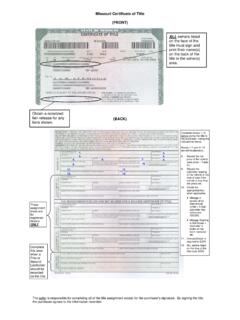
7 Discounts Effective December 12, 2011: The dealer must: Record the purchase price, actual trade-in amount or None if there is no trade-in, and the net price on the title assignment; and Provide the purchaser with one of the following, and advise the purchaser to submit the copy with their title application to the local License Office: o A copy of the front and back of the title assigned from the owner to the dealer for the trade-in; or o A copy of the Secure Power of Attorney (Form-5086) for the trade-in vehicle if the title is held by the lienholder or a duplicate title is needed. Example: An individual may purchase two vehicles from a dealer and trade in only one vehicle. The trade-in allowance for the one vehicle may be divided and credit applied to the purchase price of each vehicle provided the total trade-in allowance for the vehicle does not exceed the actual trade-in value. Similarly, an individual can trade in more than one vehicle.
8 Replacement Vehicle Credit: The seller of a motor vehicle, trailer, vessel (watercraft), or outboard motor who purchases or contracts to purchase a subsequent unit may receive a tax credit if the subsequent unit is purchased or contracted to purchase within 180 days before or after the date the original unit is sold. The actual sale price of the unit will be deducted from the purchase price of the new unit for the purposes of calculating state and local taxes, if applicable. The applicant must submit a bill of sale or notice of sale with the application for title to receive the tax credit. The bill of sale or notice of sale is not required to be notarized to receive the vehicle sales tax credit. The law DOES NOT restrict the tax credit to exact or like replacement units, , a motor vehicle for a motor vehicle, trailer for trailer, etc. Accordingly, an individual can sell a boat and buy a motor vehicle or trailer or vice versa and still qualify for the tax credit.
9 The unit being purchased or contracted to purchase must be titled in at least one of the owners' names as the unit being replaced (or sold) to qualify for a tax credit. 7-3. Effective December 12, 2011, new missouri residents MUST submit original proof of ownership from their previous state of residence ( , original registration receipt or certified title record from the other state) before allowing the vehicle to be used as a 180-day tax credit. Individuals who sell a unit in their personal name, may not use the tax allowance toward the purchase of a vehicle titled to their trust. Total Loss Credit: The purchaser of a motor vehicle, trailer, vessel (watercraft), or outboard motor may deduct the amount of a total loss claim settlement received from an insurance company plus the owner's deductible from the purchase price of another like unit that is purchased or contracted to purchase after the total loss occurs, but within 180 days before or after the date of the total loss claim settlement.
10 The applicant must present a notarized statement from the insurance company indicating the year, make, and identification number of the total loss unit, the date the insurance company pays the settlement, the amount of the insurance settlement, and the amount of the insurance deductible, if applicable. If the insurance agent certifies that the Information in the statement is true and accurate, the form does not have to be notarized. The total loss statement can be in anyone's name; however, at least one of the owners of the total loss vehicle must be the same on the application for title on the newly acquired vehicle. Example: John and Jane Smith have a vehicle titled in their name that is declared a total loss. Brenda Smith insured the vehicle and receives a certified total loss claim from the insurance company. As long as John or Jane's name is listed as an owner or co-owner on the new vehicle, the total loss credit in Brenda's name may be used.