Example: tourism industry
Simple House Acceptable Solution - Building Performance
sh/as1 siMple house DepartMent of BuilDing anD housing, 31 March 2010 5 Acceptable Solution SH/AS1 1.0 scope 1.1 using the document The ‘Simple House Acceptable Solution’ is a
Tags:
Information
Domain:
Source:
Link to this page:
Documents from same domain

E2 External Moisture
www.building.govt.nzFor single- and two-storey concrete and concrete masonry construction within specific limitations: E2/AS3. For light steel framed buildings up to 3 storeys, within specific limitations: E2/AS4. E2.3.3 Ground contact or proximity All walls, floors and structural elements in ground contact or proximity, except for buildings where external
C/AS2 - Acceptable Solution for Acceptable Solution for ...
www.building.govt.nzC/AS2 Acceptable Solution for Buildings with Sleeping (non institutional) (Risk Group SM) For New Zealand Building Code Clauses C1-C6 Protection from Fire
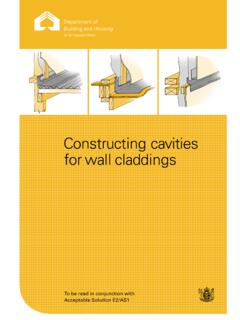
Constructing Cavities - Building Performance
www.building.govt.nzTable 23 (’Properties of roof underlays and building wraps‘). Install the wall underlay directly over the framing. Install the cavity battens directly over the wall underlay as described in Cavity battens on page 9. No additional wall underlay is needed between the wall cladding and the cavity battens except in the following situations.
Building work that does not require a building consent
www.building.govt.nzGUIDANCE Building Act 2004 THIRD EDITION 2014 - AMENDED AUGUST 2017 Building work that does not require a building consent
Earthquake geotechnical engineering practice
www.building.govt.nzEarthquake geotechnical engineering is a highly specialised field. As such the investigations for this need to be developed and carried out by an appropriately qualified and experienced geotechnical engineer or engineering geologist (referred to herein as the geotechnical professional). For the purposes of this document ‘geotechnical

Module 6: Earthquake resistant retaining wall design
www.building.govt.nzguidance on earthquake design aspects for retaining . structures that are not well covered in these handbooks or elsewhere. The main objective is to identify situations where seismic design of retaining structures should be considered, to provide the necessary seismic parameters, and to identify key issues relating to seismic design.
Worked Example 4 | Design of a tied-back retaining wall to ...
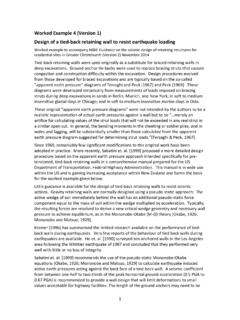
www.building.govt.nzDesign of a tied-back retaining wall to resist earthquake loading . Worked example to accompany MBIE Guidance on the seismic design of retaining structures for residential sites in Greater Christchurch (Version 2) November 2014 . Tied-back retaining walls were used originally as a substitute for braced retaining walls in deep excavations.
Acceptable Solutions and Verification Methods
www.building.govt.nz4.2 Sizing of downpipes 42 4.3 Installation of downpipes 42 5.0 Roof Gutters 42 5.1 Size of roof gutter 42 5.2 Materials44 5.3 Gradients44 5.4 Thermal movement 44 5.5 Overflow outlets 44 Appendix A Rainfall intensities 45 Index 47 Contents Amend 4 Dec 2000 Amend 4 …
Acceptable Solutions and Verification Methods
www.building.govt.nz4.2 Sizing of downpipes 42 4.3 Installation of downpipes 42 5.0 Roof Gutters 42 5.1 Size of roof gutter 42 5.2 Materials44 5.3 Gradients44 5.4 Thermal movement 44 5.5 Overflow outlets 44 E1/AS1 Appendix A Rainfall intensities 45 Acceptable Solution E1/AS2 52 1.0 AS/NZS 3500.3 Stormwater Dec 2000 drainage52 Index 56 Contents Amend 4

Commentary for Acceptable Solutions C/AS1 to C/AS7 ...
www.building.govt.nzDecember 2013. Contents Acceptable Solutions C/AS1 to C/AS7 Part 1: General 2 ... 4.11 Protected shafts 31 4.13 Floors 32 4.14 Subfloor spaces 32 ... INNOVATION AND EMPLOYMENT – 15 FEBRUARY 2013 I 1 Part 5: Control of external fire spread 34 5.1 General principles 34 5.2 Horizontal fire spread from external walls 36 5.5 Table method for ...
Related documents
The Effect of School Design on Student Performance
files.eric.ed.govbuildings and designs can boost student morale and performance. In fact, student performance is tied up with school design and equitable access to learning tools and spaces enable students to share best practices (Zubrzycki, 2013). Therefore, it is urgent to raise public awareness of school design and student performance.

Net-Zero Energy Buildings: Technical Report
www.nrel.govimportant to achieving high-performance buildings, the way an NZEB goal is defined is crucial to understanding the combination of applicable efficiency measures and RE supply options. This NZEB accounting and classification system is applicable to owners developing design goals, to

A guide to energy performance certificates for the ...
assets.publishing.service.gov.ukThe EU Directive on the energy performance of buildings (the Directive) came into effect progressively from 2007. Its implementation remains an important part of the strategy to tackle climate change. The current requirements are set out in the Energy Performance of Buildings (England and Wales) Regulations 2012, which came into effect on 9 January

Sustainable Buildings and Construction for India: Policies ...
www.teriin.orgperformance tend to change drastically with change in climatic zone, nature and function of the building). Very few studies are available on the baseline energy-performance of buildings of various types situated in different climatic zones of India and even those available are limited in scope. In the absence of such a study, an

EXISTING BUILDINGS
media.iccsafe.orgExisting buildings are permitted to continue without change as long as they are maintained in accordance with the code under which they were ... area and performance compliance. Each of these methods address repairs, alterations, additions and change of occupancy. FIGURE 1-9 Existing building regulated by the IEBC .
The Causes of Poor Performance in Mathematics among …
iosrjournals.orgCausations resident in the school such as school location and physical buildings; interpersonal relationship among the school personnel. ... attributed poor performance in mathematics to parental attitude, interrupted teaching, poor teaching and dyscalculia. Karue and Amukowa, (2013) pointed out that lack of meaningful library and laboratory ...

Supermarkets: An Overview of Energy Use and Energy ...
www.energystar.gov> Measure and track energy performance. > Establish an effective operations and maintenance program to identify and address ... individual buildings, qualify for recognition as ENERGY STAR Leaders. EPA will recognize building portfolios that have achieved reductions of 10, 20, 30 percent, or more.

Facade Conditions - An Illustrated Glossary of Visual Symptoms
www1.nyc.govbuildings. The glossary is by no means exhaustive, but hopefully it describes most of the typical façade problems encountered in New York City. As this manual refers to façade conditions only, the roofing conditions are not included, but one should note that their impact on the proper performance of the facade can be significant.
Performance Appraisal: Methods and Rating Errors
www.nationalforum.comPerformance appraisal is the systematic observation and evaluation of employees’ performance. Some of the most commonly used performance appraisal methods include ... buildings with a single bound Needs running start to jump tall buildings Can only leap small buildings Crashes into buildings Cannot recognize buildings Timeliness Is faster than

Security Guidance for Commercial Buildings
hsema.dc.govAbout 2,000 buildings in the United States (less than 1% of the total number) have more than 500,000 square feet of floor space, and about 7,000 (nearly 1%) have more than 200,000 square feet. The amount of space in these larger buildings is significant: nearly 30% of all commercial office floor space