Example: confidence
Split-Plot Designs: What, Why, and How
experimental units are two levels of randomization. One randomization is conducted to determine the assignment of block-level treatments to whole plots. Then, as always in a blocked experiment, a random-ization of treatments to split-plot experimental units occurs within each block or whole plot. Split-plot designs were originally developed by
Tags:
Information
Domain:
Source:
Link to this page:
Documents from same domain
Chapter 19 Split-Plot Designs - Department of …
www.stat.purdue.eduChapter 19 Split-Plot Designs Split-plot designs are needed when the levels of some treatment factors are more difficult to change during the experiment than
Analysis of Repeated Measures - Purdue University
www.stat.purdue.eduRepeated Measures, STAT 514 1 Analysis of Repeated Measures Hao Zhang 1 Introduction In many applications, multiple measurements are made on the same experimental units over a period
Description of controlled spike-in experiment
www.stat.purdue.eduDescription of controlled spike-in experiment September 19, 2011 1 Experimental design The experiment aimed at evaluating the ability of signi cance analysis to detect known fold changes, as well

Mixed Models - Purdue University
www.stat.purdue.edu1 Introduction In many experimental design situations, one or more of the factors in the study may be random factors. That is, the levels of those factors are actually a sample from a larger population of levels and inferences are desired
Integre Technical Publishing Co., Inc. …
www.stat.purdue.eduTables • T-13 Table entry for p is the critical value F∗ with probability p lying to its right. F* Probability p TABLE E F critical values (continued) Degrees of …
Introduction to Genetic Association Studies
www.stat.purdue.eduTopic Introduction Introduction to Genetic Association Studies Cathryn M. Lewis and Jo Knight Genetic association studies are used to find candidate genes or genome regions that contribute to a
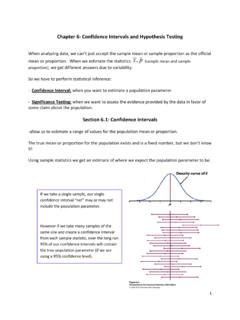
Chapter 6: Confidence Intervals and Hypothesis Testing
www.stat.purdue.eduState your conclusion about the data in a sentence, using the P‐value and/or comparing the P ‐value to a significance level for your evidence. STEP 1: State the null hypothesis H …
CV with Publications
www.stat.purdue.eduCurriculum Vitae S.V.N. Vishwanathan Teaching Selected Graduate Courses 2015 Advanced Machine Learning 2014 { 2015 Analysis of Algorithms 2011 { 2014 Introduction to Computing for Statisticians

6 Finite Sample Theory of Order Statistics and Extremes
www.stat.purdue.edu6 Finite Sample Theory of Order Statistics and Extremes The ordered values of a sample of observations are called the order statistics of the sample, and the
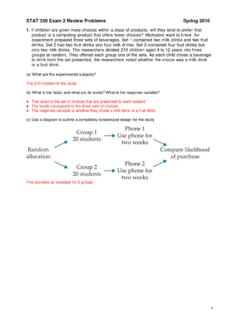
STAT 350 Exam 2 Review Problems Spring 2016
www.stat.purdue.eduSTAT 350 Exam 2 Review Problems Spring 2016 3 2. A random sample of 26 offshore oil workers took part in a simulated escape exercise, and their times (sec) to complete the escape are recorded. The sample mean is 370.69 sec and the sample standard deviation is 24.36 sec. Construct a 95% lower confidence bound on the true average escape time.
Related documents

Quantitative Research Designs: Experimental, Quasi ...
samples.jbpub.coma bit from book to book. First are experimental designs with an in tervention, control group, and randomization of participants into groups. Next are quasi-experimental designs with an in tervention but no randomization.Descriptive designs d o not have an intervention or treatment and are considered nonexperimental.

Chapter 14. Experimental Designs: Single-Subject Designs ...
uca.eduChapter 14. Experimental Designs: Single-Subject Designs and Time-series Designs Introduction to Single-Subject Designs Advantages and Limitations Advantages of the single-subject approach Limitations of the single-subject approach Why Some Researchers Use the Single-Subject Method Procedures for the Single-Subject Design Establishing a baseline

and Ex Post Facto Designs Experimental, Quasi-Experimental,
www.cs.utsa.eduCompared to pre-experimental designs, experimental designs offer a great degree of control and greater internal validity. People or other units of study are assigned always randomly. Such random assignment guarantees that any differences between the groups are probably quite small and, in any case, are due entirely to chance.

Quasi-Experimental Designs
people.uncw.eduQuasi-Experimental Designs Many types of Research designs beyond the scope of this course Right now, reading and understanding research is the goal To learn more, take more courses, get involved in research (DIS opportunities), read books and articles Psychology is a …

Quasi-Experimental Design and Methods
www.unicef-irc.orgQuasi-experimental methods that involve the creation of a comparison group are most often used when it is not possible to randomize individuals or groups to treatment and control groups. This is always the case for ex-post impact evaluation designs. It may also be necessary to use quasi-experimental designs for ex-ante
Causation and Experimental Design
www.sagepub.commeaning of causation and the logic of experimental design. Most social research, both academic and applied, uses data collection methods other than experiments. But because experimental designs are the best way to evaluate causal hypothe-ses, a better understanding of them will help you to be aware of the strengths and
Chapter 11: Quasi-Experimental Designs
www.uh.edu!Use pretest to assess equivalence "If there is not group equivalence it is still possible to ascertain the effects of the independent variable through changes in test scores (pretest and posttest) "If IV had an effect, experimental group will exhibit greater change