Example: biology
Statistical Field Theory - DAMTP
Shankar, Quantum Field Theory and Condensed Matter Both of these are more all-round condensed matter books, but with substantial sections ... In this scheme a solid di ers from a liquid because its crystal structure breaks the translational and rotational symmetries of space. Moreover, solids with di erent crystal ...
Tags:
Information
Domain:
Source:
Link to this page:
Documents from same domain
Quantum Field Theory - DAMTP
www.damtp.cam.ac.ukRecommended Books and Resources M. Peskin and D. Schroeder, An Introduction to Quantum Field Theory This is a very clear and comprehensive book, covering everything in this course at the
String Theory - University of Cambridge
www.damtp.cam.ac.ukString theory is a theory of quantum gravity String theory uni es Einstein’s theory of general relativity with quantum mechanics. Moreover, it does so in a manner …
Mathematical Methods - DAMTP
www.damtp.cam.ac.ukMathematical Methods University of Cambridge Part IB Mathematical Tripos David Skinner Department of Applied Mathematics and Theoretical Physics,
Electromagnetism - DAMTP
www.damtp.cam.ac.ukAt the atomic scale, electromagnetism (admittedly in conjunction with some basic quantum e ects) governs the interactions between atoms and molecules. It is the force that underlies the periodic table of elements, giving rise to all of chemistry and, through this, much of biology. It is the force which binds atoms together into solids and liquids.
Principles of Quantum Mechanics - DAMTP
www.damtp.cam.ac.ukPrinciples of Quantum Mechanics University of Cambridge Part II Mathematical Tripos David Skinner Department of Applied Mathematics and Theoretical Physics,
Part II Principles of Quantum Mechanics Michaelmas 2014
www.damtp.cam.ac.ukCONTENTS iii BOOKS E. Merzbacher Quantum Mechanics, 3rd edition. Wiley 1998 (various prices) B.H. Bransden and C.J. Joachain Quantum Mechanics, 2nd edition.
3. Quantum Gases - University of Cambridge
www.damtp.cam.ac.uk3. Quantum Gases In this section we will discuss situations where quantum effects are important. ... is the density of states: g(E)dEcounts the number of states with energy between E ... There is nothing particularly quantum mechanical about the density of states. In-deed, in the derivation above we have replaced the quantum sum with an ...
Statistical Physics - DAMTP
www.damtp.cam.ac.ukContents 1. The Fundamentals of Statistical Mechanics 1 1.1 Introduction 1 1.2 The Microcanonical Ensemble 2 1.2.1 Entropy and the Second Law of Thermodynamics 5
TASI Lectures on Solitons - DAMTP
www.damtp.cam.ac.ukPreprint typeset in JHEP style - PAPER VERSION June 2005 TASI Lectures on Solitons Instantons, Monopoles, Vortices and Kinks David Tong Department of Applied Mathematics and Theoretical Physics,
Electromagnetism - DAMTP
www.damtp.cam.ac.ukLent Term, 2015 Electromagnetism University of Cambridge Part IB and Part II Mathematical Tripos David Tong Department of Applied Mathematics and Theoretical Physics,
Related documents
Coordination Chemistry II: Ligand Field Theory Continued
www.chem.uci.eduTetrahedral Crystal Field Splitting barycenter (spherical field) t 2 orbitals point more directly at ligands and are destabilized. e orbitals point less directly at ligands and are stabilized. x y z M L opposite splitting of octahedral field L L L Δ t < Δ o because only 4 ligands and d orbitals point between ligands
Superconductivity
www.physics.usyd.edu.aumagnetic field, Ba, is then applied. This results in the field penetrating both materials. Both samples are ... their crystal lattices. They are also composed of many crystals, all bound together, resulting in many ... A microscopic theory of superconductivity was developed in 1957 by John Bardeen, Leon Cooper and J.

Electron Paramagnetic Resonance Theory E. Duin
webhome.auburn.eduspectrum of a single crystal you would have to measure a spectrum for the crystal in all possible x-, y-and z-directions. Alternatively you could ground up the single crystal into an actual powder. Fig. 6: Dependency of the g value on the oritentation of the molecules in the magnetic field.
Section 3: Crystal Binding - University of Nebraska–Lincoln
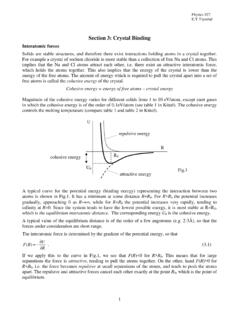
unlcms.unl.eduFor example a crystal of sodium chloride is more stable than a collection of free Na and Cl atoms. This ... described by a central field repulsive potential of the form λexp(−r / ρ), where λ and ρ are some ... theory of ionic crystals. In general it is not possible to …
THE EFFECTIVE MASS THEORY
s2.smu.eduIn this presentation, the effective mass theory (EMT) for the electron in the crystal lattice will be introduced. The dynamics of the electron in free space and in the lattice will be compared. The E-k diagram for direct band gap semiconductors will be ... electric or magnetic field as if its mass is equal to an effective
Toward a Theory of Anti-Oppressive Education
projects.iq.harvard.eduToward a Theory of Anti-Oppressive Education ... to "look beyond" the field of educational research to explore the possibilities of theories that remain marginalized, including post-struc ... (Crystal, 1989; Reynolds & Koski, 1995). The school also needs to provide supportive spaces where the Other can

π-Bonding and Molecular Orbital Theory
www.dalalinstitute.comHence, the crystal field splitting Δ o increases and the bond between the ligand and the metal strengthens when metal to ligand bonding takes place. 3. When ligand π-orbitals are empty as well as filled: There are many ligands, like I–, which have both filled p-orbitals as well as vacant d-orbitals of π symmetry.
Theory of Transistors - Vanderbilt University
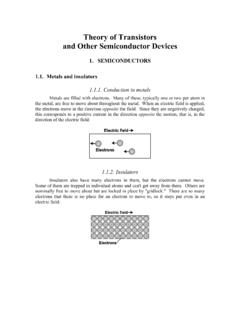
www.vanderbilt.eduTheory of Transistors and Other Semiconductor Devices 1. SEMICONDUCTORS 1.1. Metals and insulators 1.1.1. Conduction in metals Metals are filled with electrons. Many of these, typically one or two per atom in the metal, are free to move about throughout the metal. When an electric field is applied, the electrons move in the direction opposite ...