Transcription of The Asian Population: 2010
1 Department of Commerce Economics and Statistics Administration CENSUS BUREAUThe Asian population : 20102010 Census BriefsBy Elizabeth M. Hoeffel, Sonya Rastogi,Myoung Ouk Kim,and Hasan Shahid C2010BR-11 Issued March 2012 INTRODUCTIONA ccording to the 2010 Census, the Asian population grew faster than any other race group in the United States between 2000 and 2010. This was observed for the population who reported Asian alone (increased 43 percent), as well as for the popu-lation who reported Asian alone or in combination with another race (increased 46 percent). The Asian population continued to be concen-trated in the West, and the Chinese population was the largest detailed Asian report provides a portrait of the Asian population in the United States and discusses that population s distri-bution at the national level and at lower levels of It is part of a series that analyzes population and housing data collected from the 2010 Census.
2 The data for this report are based on the 2010 Census Redistricting Data (Public Law 94-171) Summary File, which was the first 2010 Census data product released with data on race and Hispanic origin, including information on the Asian popu-lation, and was provided to each state for use in drawing boundaries for legislative Data for this report also come from the 2010 Census Summary File 1, which was one of the first 2010 Census 1 This report discusses data for the 50 states and the District of Columbia, but not Puerto Information on the 2010 Census Redistricting Data (Public Law 94-171) Summary File is available online at < >.
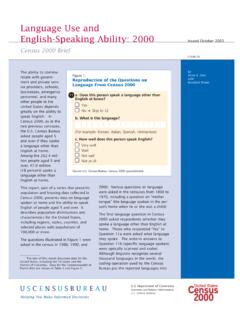
3 Data products to provide information on selected detailed groups, such as Asian Indians, Koreans, and RACE DATA FROM THE 2010 CENSUSThe 2010 Census used federal standards to collect and present data on the 2010 Census, the question on race was asked of individuals living in the United States (see Figure 1). An individual s response to the race question was based upon self-identification. The Census Bureau collects information on race following the guidance of the Office of Management and Budget s (OMB) 3 Information on the 2010 Census Summary File 1 is available online at < /press- >.Figure of the Question on Race From the 2010 CensusSource: Census Bureau, 2010 Census Census BureauDEFINITION OF Asian USED IN THE 2010 CENSUSA ccording to OMB, Asian refers to a person having origins in any of the original peoples of the Far east , Southeast Asia, or the Indian subcontinent, including, for example, Cambodia, China, India, Japan, Korea, Malaysia, Pakistan, the Philippine Islands, Thailand, and Vietnam.
4 The Asian population includes people who indicated their race(s) as Asian or reported entries such as Asian Indian, Chinese, Filipino, Korean, Japanese, and Vietnamese or provided other detailed Asian responses. 1997 Revisions to the Standards for the Classification of Federal Data on Race and These federal standards mandate that race and Hispanic origin (ethnicity) are separate and distinct concepts and that when collecting these data via self-identification, two different questions must be Starting in 1997, OMB required federal agencies to use a minimum of five race categories: White, Black or African American, American Indian or Alaska Native, Asian , and Native Hawaiian or Other Pacific Islander.
5 For respondents unable to identify with any of these five race categories, OMB approved the Census Bureau s inclusion of a sixth category Some Other Race on the Census 2000 and 2010 Census questionnaires. The 1997 OMB standards also allowed for respon-dents to identify with more than one race. The definition of the Asian racial category used in the 2010 Census is presented in the text box on this page. Data on race have been collected since the first decennial census in 1790, but no distinction was made for people of Asian descent. In 1860, the first Asian response category ( Chinese ) was added to the question on race in California only and in other states begin-ning in 1870.
6 A second Asian response category ( Japanese ) was included for the first time 4 The 1997 Revisions to the Standards for the Classification of Federal Data on Race and Ethnicity, issued by OMB, is available at < /omb/fedreg_1997standards>.5 The OMB requires federal agencies to use a minimum of two ethnicities: Hispanic or Latino and Not Hispanic or Latino. Hispanic origin can be viewed as the heritage, nationality group, lineage, or country of birth of the person or the person s parents or ancestors before their arrival in the United States. People who identify their origin as Hispanic, Latino, or Spanish may be of any race.
7 Hispanic or Latino refers to a person of Cuban, Mexican, Puerto Rican, South or Central American, or other Spanish culture or origin regardless of race. in the 1870 Census in California only and in other states starting in 1890. Additional Asian response categories were collected inter-mittently in the question on race over the course of seven censuses, from the 1920 Census to the 1980 Census. The use of six detailed Asian response categories in the decennial census question on race has remained unchanged since the 1980 Census ( Asian Indian, Chinese, Filipino, Japanese, Korean, and Vietnamese).Beginning with the 1910 Census, reports of detailed Asian groups that did not have separate response categories in the race question were tabulated from a general Other write-in area.
8 In the 1990 Census, a write-in area was introduced that was solely dedi-cated to the reporting of detailed Asian groups or detailed Native Hawaiian and Other Pacific Islander groups that did not have a sepa-rate response category. A shared write-in area for reports of detailed Asian groups or detailed Native Hawaiian and Other Pacific Islander groups that did not have specific response categories in the race question continued for Census 2000 and the 2010 For information about comparability of 2010 Census data with race and Hispanic origin to data collected in previous censuses, see the 2010 Census Redistricting Data (Public Law 94-171) Summary File Technical Documentation at < /cen2010/ >.
9 In Census 2000, for the first time, individuals were presented with the option to self-identify with more than one race, and this continued with the 2010 Census, as pre-scribed by OMB. There are 57 pos-sible multiple-race combinations involving the five OMB race catego-ries and Some Other 2010 Census question on race included 15 separate response categories and three areas where respondents could write in detailed information about their race (see Figure 1).8 The response catego-ries and write-in answers can be combined to create the five mini-mum OMB race categories plus Some Other Race. In addition to White, Black or African American, American Indian and Alaska Native, and Some Other Race, 7 of the 7 The 2010 Census provides information on the population reporting more than one race, as well as detailed race combinations ( , Asian and White; Asian and White and Native Hawaiian and Other Pacific Islander).
10 In this report, the multiple-race categories are denoted with the conjunction and in bold and italicized print to indicate the separate race groups that constitute the particular There were two changes to the question on race for the 2010 Census. First, the word-ing of the race question was changed from What is this person s race? Mark one or more races to indicate what this person con-siders himself/herself to be in 2000 to What is this person s race? Mark one or more boxes for 2010. Second, in 2010, examples were added to the Other Asian response category (Hmong, Laotian, Thai, Pakistani, Cambodian, and so on) and the Other Pacific Islander response category (Fijian, Tongan, and so on).